Insurance & InsurTech Investment Intelligence Report: Week of September 13-19, 2026
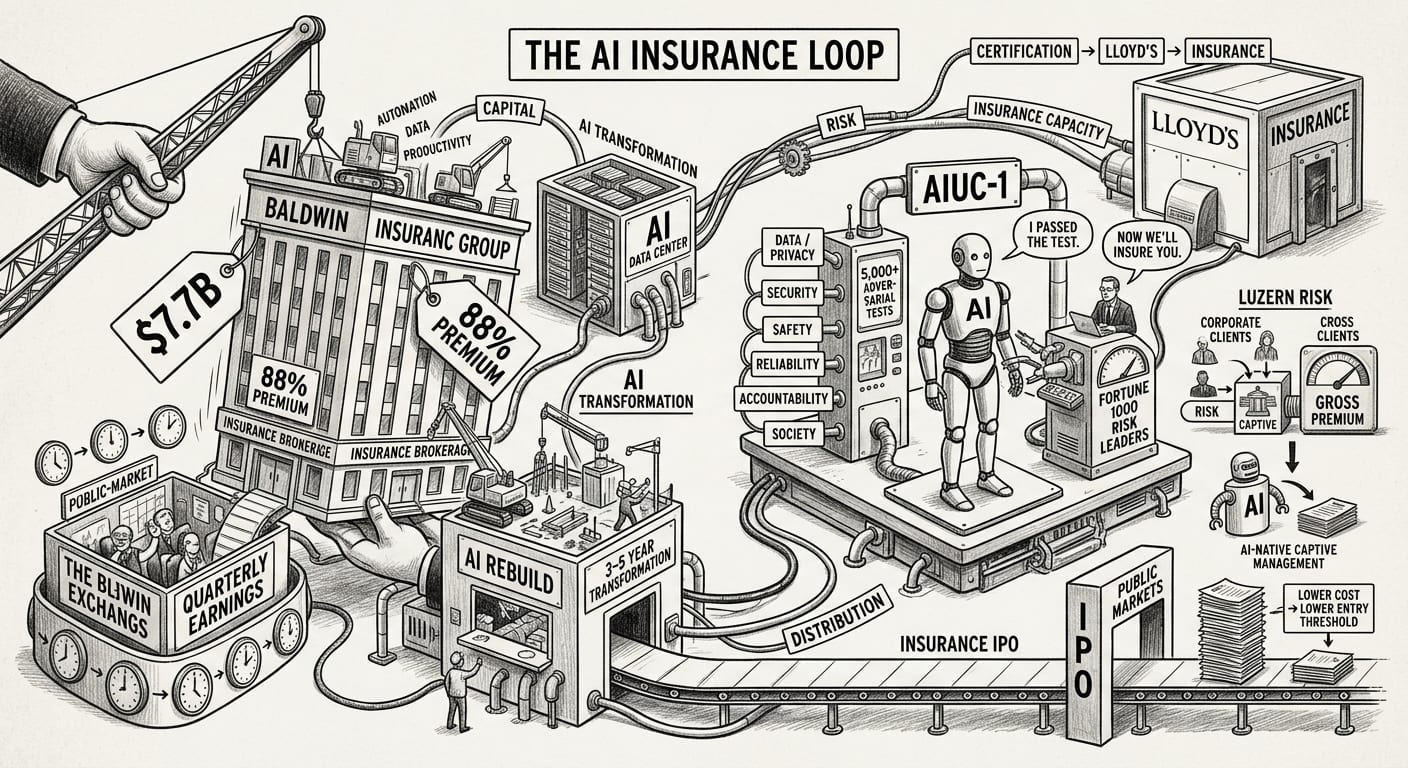
$8.03B+ in disclosed capital | 8 primary transactions + 1 transaction with impact + 5 M&A items + 3 market context items | An insurance broker goes private for $7.7 billion to escape quarterly earnings while it rebuilds around AI, and a company founded by Anthropic’s first product hire raises $40 million to underwrite AI agents with Lloyd’s paper
Two transactions this week define where insurance and artificial intelligence are converging, and they point in opposite directions.
The Baldwin Group agreed to go private for $7.7 billion, at an 88% premium, backed by Michael Dell’s family office. Reuters reported the explicit rationale: leaving public markets gives the broker flexibility to fund costly AI upgrades without quarterly earnings pressure or the share-price swings that accompany margin compression during a technology overhaul. That is insurance distribution paying $7.7 billion for the privilege of rebuilding itself in private.
Meanwhile AIUC raised $40 million led by Ribbit Capital to do something no insurance company has done at scale before: underwrite AI agents. Founded by Anthropic’s first product hire alongside a former McKinsey insurance partner, AIUC certifies AI systems against a standard built with 250 Fortune 1000 risk leaders, runs 5,000 adversarial tests across six risk domains, and backs the certification with actual Lloyd’s of London insurance coverage.
One company is spending billions to adopt AI. The other is selling the policy that makes adoption possible. Both happened in the same week.
Underneath that, the fall insurance IPO window opened and immediately tested the market. Orion180 priced below its range, raised $240 million instead of the $320 million its terms implied, and broke issue on day one. Bamboo Insurance launched a roadshow seeking up to $700 million. Luzern Risk raised $45 million from Insight Partners to build AI-native captive infrastructure, in a market where captives now write roughly $240 billion of gross premium.
GILAD SHAI ON THE WEEK'S DEALS — WHAT THE NUMBERS DON'T SAY
1. The Baldwin Group / Sequence Holdings and DFO Management (USA)
$7.7B All-Cash Take-Private | An 88% Premium to Fund an AI Rebuild in Private Date: September 14, 2026
What Happened
The Baldwin Group, Inc. (NASDAQ: BWIN) entered into a definitive agreement under which an entity formed by Sequence Holdings and DFO Management, the family investment office of Dell Technologies founder Michael Dell, will acquire a majority interest in an all-cash transaction valued at approximately $7.7 billion.
Shareholders receive $32.50 per share in cash, representing an 88% premium to Baldwin’s unaffected closing price of June 17, 2026, the day before media reports emerged that the company was exploring a sale. The transaction comprises approximately $4.6 billion in equity value plus $3.1 billion of net debt assumed or refinanced, valuing Baldwin at roughly 20 times trailing twelve month adjusted EBITDA of $396 million.
The transaction was unanimously approved by Baldwin’s board and an independent special committee. Class B shares will be cancelled, and eligible Baldwin colleagues retain a significant minority equity stake alongside Sequence and DFO. Tampa, Florida-based Baldwin will continue as a wholly owned subsidiary of the new parent and will delist from Nasdaq. Closing is expected in the first quarter of 2027.
CEO Trevor Baldwin stated that the company’s vision and strategy are not changing. Davis Polk is advising Baldwin.
Reuters reported the strategic rationale directly: the deal provides the insurance broker greater flexibility to pursue AI investments, and highlights a growing trend of companies exiting public markets to finance costly AI upgrades without the pressure of the quarterly earnings cycle or the share-price swings that often accompany short-term margin compression during major technological overhauls.
Market reaction was mixed. Baldwin shares rose roughly 7% to $31.69, well short of the headline 88% premium, because months of takeover speculation had already moved the stock near the eventual bid, leaving a deal spread of about 2%. William Blair downgraded the stock to Market Perform on limited remaining upside, and several law firms opened investigations into whether the price fairly values shareholders.
- Acquirers: Sequence Holdings and DFO Management (Michael Dell family office)
- Target: The Baldwin Group; Trevor Baldwin, CEO
- Terms: $32.50 per share, 88% premium to June 17 unaffected price, ~20x TTM adjusted EBITDA
- Adviser: Davis Polk (Baldwin)
Use of Funds
- Fund the all-cash acquisition of a majority interest
- Provide flexibility to pursue AI investment outside public market reporting cycles
- Preserve a significant minority equity stake for eligible Baldwin colleagues
Strategic Thesis
The stated reason for this transaction is the most important thing about it. Insurance brokers do not typically go private at 20 times EBITDA to escape scrutiny. They go private because the work required over the next three to five years produces margin compression that public markets punish quarter by quarter.
Rebuilding a distribution platform around AI is exactly that kind of work. It means capital expenditure with deferred payback, headcount changes that look like disruption before they look like efficiency, and a transition period where costs rise before productivity does. A public broker attempting it reports declining margins for several quarters and gets repriced. A private one does not.
The 88% premium to the unaffected price, against only a 2% spread to the trading price on announcement day, tells you the market had already largely priced this in since June. The premium is real against the June baseline and largely theoretical against the September one.
Michael Dell’s involvement is not incidental. DFO took Dell Technologies private in 2013 for similar reasons, executed a multi-year transformation outside public markets, and returned. That is the template being applied here.
Why It Matters
- At approximately 20 times trailing adjusted EBITDA on a business carrying $3.1 billion of net debt, this is an aggressive multiple for insurance distribution, and it is being justified by a technology transformation thesis rather than by near-term earnings.
- The explicit AI rationale makes Baldwin a test case other public brokers will be measured against. If the transformation works in private, the question of whether a public broker can execute a comparable rebuild becomes pressing for Gallagher, Brown & Brown and Marsh McLennan Agency.
- Eligible colleagues retaining a significant minority stake addresses the retention problem that typically accompanies a take-private in a producer-driven business, where the asset can resign.
Competition
- Direct competitors: Gallagher, Brown & Brown, Hub International and USI compete for the same middle-market commercial accounts through the same retail distribution model.
- Category competitors: Private equity-backed consolidators including Acrisure and Alliant compete for the same agencies and producer talent, generally as acquirers.
- Emerging dynamic: Brokers are beginning to treat AI transformation as a capital structure question rather than a technology budget question, with the implication that public ownership may be poorly suited to the transition period.
Market Consequences
For public insurance brokers, Baldwin’s rationale creates an uncomfortable comparison: if AI rebuilding genuinely requires escaping quarterly reporting, every listed broker either disputes that or explains why it can do the same thing in public. For private equity holding brokerage assets, a 20 times EBITDA take-private establishes a demanding reference multiple. For Baldwin’s producers and clients, private ownership removes short-term earnings pressure but introduces the leverage that comes with $3.1 billion of net debt.
Bottom line: Baldwin is paying $7.7 billion for permission to rebuild around AI without reporting the cost of it every ninety days. Whether that turns out to be foresight or an expensive way to avoid scrutiny is the question the next three years will answer.
2. AIUC (USA)
$40M Series A | Insuring AI Agents, With Lloyd’s Paper Behind the Certificate Date: September 15, 2026
What Happened
AIUC (Artificial Intelligence Underwriting Company), the San Francisco company building audit, certification and insurance infrastructure for enterprise AI, raised a $40 million Series A led by Ribbit Capital, with participation from First Harmonic and Terrain. The round follows a $15 million seed led by NFDG, Nat Friedman’s fund, joined by Emergence, Terrain and Anthropic co-founder Ben Mann, bringing total funding to $55 million.
AIUC was co-founded by Rune Kvist, who was Anthropic’s first product hire, and Rajiv Dattani, a former partner in McKinsey’s insurance practice and former COO of METR, the AI evaluation research organization.
Its core product is AIUC-1, a third-party audit and certification standard developed alongside a consortium of more than 250 security and risk leaders from Fortune 1000 firms. Certification requires more than 5,000 adversarial tests across six risk domains: data and privacy, security, safety, reliability, accountability, and society. Tests are modeled on documented real-world AI failures, and certified companies must undergo quarterly retests to maintain status.
The differentiating element is in the name. AIUC partners with Lloyd’s of London to provide actual insurance coverage for AI agents, tying financial protection directly to audit results. KPMG became the first Big Four firm to achieve AIUC-1 certification in August 2026, and the standard’s inclusion in the CSA STAR Registry lets certified organizations display a trustmark. Cursor, Lovable, Harvey and UiPath are among companies engaging with the standard.
New capital extends audits, standards and insurance from AI agents to frontier models.
- Co-founders: Rune Kvist (Anthropic’s first product hire), Rajiv Dattani (former McKinsey insurance partner, former COO of METR)
- Lead investor: Ribbit Capital
- Participating: First Harmonic, Terrain
- Prior round: $15M seed led by NFDG, with Emergence, Terrain, Ben Mann
- Insurance partner: Lloyd’s of London
Use of Funds
- Extend audits, standards and insurance from AI agents to frontier models
- Scale the AIUC-1 certification framework and expand insurance product offerings
- Grow the certification network before a competing standard establishes itself
Strategic Thesis
Rajiv Dattani’s framing is the clearest articulation of this business anyone has offered, and it is historically exact. When electricity was burning down houses, the insurers paying those claims funded Underwriters Laboratories to test and certify products. To this day the UL mark appears on most light bulbs in America. His argument is that AI needs the same combination of standards, testing and insurance.
That analogy holds up under scrutiny. UL was not created by regulators or by manufacturers. It was created by the parties bearing the financial loss, because they had both the incentive to measure risk accurately and the balance sheet to make certification consequential. AIUC is attempting the same structure, with Lloyd’s supplying the balance sheet.
Rune Kvist identifies the commercial bottleneck precisely: banks, hospitals, governments and militaries no longer decline to deploy AI because a model is not smart enough. They decline because they cannot produce evidence of security and reliability that survives a procurement review. A Cisco survey found 85% of enterprises experimenting with AI agents but only 5% moving them into production. That gap is the market.
The founding combination is unusually well suited to the problem. An Anthropic product veteran understands how these systems fail. A McKinsey insurance partner and METR COO understands both how to price risk and how to evaluate models. Neither skill alone builds this company.
This report has tracked the AI governance thread since Week 25, through Norm AI, Trussed AI, dodoAI, Klaimee, Alice and HelmGuard. Every one of those sells software that helps a company manage AI risk. AIUC is the first to transfer the risk. That is a categorically different product.
Why It Matters
- Backing certification with Lloyd’s coverage converts an assurance product into risk transfer, which is the difference between telling a buyer a system is probably safe and paying them when it is not.
- KPMG certifying under AIUC-1 creates a reference customer whose own clients will ask about the standard, which is the mechanism by which certification regimes reach critical mass.
- Ribbit Capital leading is notable: a fintech-focused investor treating AI assurance as financial infrastructure rather than as a security category.
Competition
- Direct competitors: Standalone AI assurance and certification efforts, including emerging offerings from established audit firms, compete to become the reference standard for enterprise AI procurement.
- Category competitors: HelmGuard, Onyx Security and Hush Security address adjacent parts of the same problem through continuous monitoring, prompt inspection and agent permission governance, without the insurance layer.
- Emerging dynamic: Investors deployed roughly $435 million into AI agent security startups across 12 financings in five months, and the category is consolidating toward whichever standard achieves procurement adoption first.
Market Consequences
For enterprises stalled between AI pilot and production, a certification backed by insurance gives procurement and risk committees something they can actually approve against. For Lloyd’s, underwriting AI agent failure establishes a position in a risk class with limited loss history, which is both the opportunity and the exposure. For competing AI governance software vendors, AIUC’s insurance layer is a feature they cannot replicate without an underwriting partner and a balance sheet.
Bottom line: Underwriters Laboratories exists because insurers paying fire claims decided they needed a way to test products. AIUC is the same idea for AI agents, with Lloyd’s paper behind the certificate.
3. Orion180 Insurance Group (USA)
$240M IPO Priced Below Range | The E&S Homeowners Thesis Meets Public Markets Date: Priced September 17, began trading September 18, 2026
What Happened
Orion180 Insurance Group completed its initial public offering, pricing 20 million Class A shares at $12.00, below its indicated range of $15 to $17, and raising $240 million. Shares began trading on the Nasdaq Global Select Market under OIG on September 18 and closed their first session at $11.66, down 2.8% from the offer price. The float values the Melbourne, Florida company at roughly $1.15 billion.
Bloomberg reported the book finished oversubscribed ahead of pricing, which makes the below-range pricing and the first-day decline more notable rather than less. Underwriters hold a 30-day option on an additional 3 million shares. The offering was expected to close September 21.
This report covered the roadshow launch last week, when the $15 to $17 range implied roughly $320 million of proceeds and a $1.58 billion valuation. The completed transaction came in approximately 25% below that on proceeds and roughly 27% below on market capitalization.
Founded in 2018 by Kenneth Gregg, Orion180 is the second-largest excess and surplus homeowners insurer in the United States, operating across 14 states with Texas, California and Florida as key markets, and producing $601 million in premiums over the twelve months through June 30, written internally or placed with outside carriers. First-half 2026 results showed $13.2 million in profit on $80.1 million of revenue, against a $3 million loss on $50.4 million a year earlier.
Company filings disclose that earlier in September, Orion180 distributed a $55 million dividend to investors including Gregg, following a $151 million distribution in May. The company stated it may use IPO proceeds to pay down a new credit facility that substantially financed both payouts.
RBC Capital Markets, UBS Investment Bank and Raymond James were lead book-running managers.
- Founder and CEO: Kenneth Gregg
- Terms: 20 million Class A shares at $12.00, below the $15 to $17 range
- Proceeds: $240 million; market value approximately $1.15 billion
- Lead book-running managers: RBC Capital Markets, UBS Investment Bank, Raymond James
Use of Funds
- Potentially repay a new credit facility that financed the May and September distributions
- Support continued growth across the 14-state footprint
- Strengthen capital position for catastrophe-exposed underwriting
Strategic Thesis
The pricing outcome is the finding. Orion180 brought a genuinely improving business to market: revenue up roughly 59%, a swing from loss to $13.2 million of profit, and a defensible position in a segment expanding because standard carriers keep withdrawing from it. The book was oversubscribed. It still priced 25% below the midpoint and traded down on day one.
Nicholas Einhorn of Renaissance Capital identified why. Investors in insurance IPOs scrutinize these companies closely, and recent insurance listings have often had to prove themselves after pricing rather than before. A growth story and a low loss ratio are necessary but not sufficient.
The distributions deserve straightforward treatment. Orion180 paid $206 million to existing holders across May and September, funded by a new credit facility, and disclosed that IPO proceeds may repay that facility. That structure is legal, disclosed and not unusual in sponsor-adjacent listings. It also means a meaningful portion of what public investors contributed effectively refinances money already paid out, and sophisticated buyers price that.
The result is a real data point on the E&S property thesis. Public markets will fund it, but at a roughly 27% discount to what the company and its bankers believed it was worth three weeks ago.
Why It Matters
- An oversubscribed book that still prices 25% below midpoint and breaks issue indicates demand existed only at a materially lower valuation, which is more informative than a failed deal would have been.
- The $206 million in pre-IPO distributions, financed by a credit facility that IPO proceeds may repay, is a disclosed structure that public investors visibly discounted.
- Orion180 is now a listed comparable for E&S homeowners, and its $1.15 billion valuation rather than $1.58 billion becomes the reference for Bamboo, Hub International and anyone else in the queue.
Competition
- Direct competitors: Kin Insurance, Slide Insurance and HCI Group’s TypTap write catastrophe-exposed homeowners property in overlapping states through comparable technology-enabled models.
- Category competitors: Admitted homeowners carriers including Universal Insurance Holdings and Heritage Insurance compete on filed rates where they retain appetite.
- Emerging dynamic: The fall 2026 insurance IPO window is open but selective, with Bamboo Insurance seeking up to $700 million and Hellman & Friedman-backed Hub International having filed confidentially in June.
Market Consequences
For Bamboo Insurance, which launched its roadshow the same week, Orion180’s outcome is a live pricing signal delivered days before its own. For private E&S property platforms considering a listing, the message is that public markets will transact but will set the price themselves. For Orion180, being public at $1.15 billion with a credit facility to address is a workable position, though a less comfortable one than the terms implied three weeks ago.
Bottom line: The book was oversubscribed and the deal still priced 25% below midpoint and broke issue. Public markets will fund catastrophe-exposed E&S property. They will not pay what the roadshow asked.
4. Luzern Risk (USA)
$45M Series B | AI-Native Captive Management in a $240 Billion Market Date: September 17, 2026
What Happened
Luzern Risk, the New York full-service captive manager formerly known as XN Captive, raised a $45 million Series B led by Insight Partners, with participation from Trust Ventures and existing investor Caffeinated Capital, which led both the company’s 2023 seed round and its $12 million Series A in 2025, marking its third consecutive backing.
Founded in 2023 by CEO Gabriel Weiss and CTO Jonathan York, Luzern operates an AI-native platform built to compress the time required to launch and administer custom captive programs at scale. The platform covers the full captive lifecycle, beginning with analysis of a company’s insurance spend, loss history and risk profile to determine whether a captive makes financial sense, then formation and ongoing administration. The company works with brokers, fronting carriers, reinsurers and advisers, serving both mid-market businesses and large publicly traded companies.
Approximately $240 billion in gross premium is currently written through captives, roughly 10% of the global property and casualty market.
Philine Huizing, Managing Director at Insight Partners, described the captive market as undergoing structural expansion from a tool reserved for large multinationals into a viable strategy for a much broader universe of companies, with Luzern building the infrastructure layer that makes the expansion possible. Varun Gupta, General Partner at Caffeinated Capital, described the firm as tripling down. Insight Partners reported more than $90 billion in regulatory assets under management as of December 31, 2025, with over 900 investments and more than 55 portfolio company IPOs.
- Co-founders: Gabriel Weiss (CEO), Jonathan York (CTO)
- Lead investor: Insight Partners (Philine Huizing, Managing Director)
- Participating: Trust Ventures, Caffeinated Capital (Varun Gupta, General Partner)
Use of Funds
- Advance the AI-native technology platform and expand AI capabilities
- Systemize operations to reduce turnaround times on complex specialized work
- Broaden client options across the alternative risk value chain
Strategic Thesis
Captives exist because commercial insurance pricing is volatile and policy terms are set by someone else. A captive converts an unpredictable expense into a structure the parent controls, lets it write coverage tailored to actual exposure, retain underwriting profit and accumulate surplus. The obstacle has never been the logic. It has been that forming and administering one requires specialized actuarial, regulatory and accounting work that made the economics viable only above a certain size.
Compressing that work is what makes the market expand downward. If formation and administration cost meaningfully less, the threshold at which a captive makes sense drops, and the addressable universe grows from large multinationals to the mid-market.
That is the same conclusion Huscarl reached from a different direction two weeks ago, raising $5.6 million to build an autonomous AI actuary specifically for corporations and their captives. Two companies, two weeks apart, both applying AI to the cost structure that has kept captives concentrated among the largest buyers.
Caffeinated Capital leading the seed, the Series A, and participating again in the Series B is a meaningful signal from an investor with three years of proprietary visibility into the business.
Why It Matters
- At roughly $240 billion of gross premium, captives already represent about 10% of global property and casualty, and the constraint on further growth is administrative cost rather than demand.
- Two AI-native captive infrastructure rounds in three weeks, Huscarl at $5.6 million and Luzern at $45 million, indicate investors are converging on the same thesis from different entry points.
- Insight Partners leading, with more than $90 billion under management and 55 prior portfolio IPOs, brings scaling experience to a category historically served by specialist managers without institutional technology capital.
Competition
- Direct competitors: Marsh Captive Solutions, Aon Captive and Insurance Management, and Artex compete for the same captive formation and management mandates.
- Category competitors: Traditional commercial insurance and fronting arrangements compete for the same risk financing decision at the point a company evaluates whether to retain or transfer.
- Emerging dynamic: Marsh-managed captives generated $79.1 billion in gross written premium in 2025 with 118 new formations, and nearly a quarter of captive owners now underwrite cyber risk versus 1% in 2014.
Market Consequences
For mid-market companies previously priced out of captive formation, a lower cost structure changes the threshold calculation directly. For established captive managers, an AI-native competitor with $45 million and Insight Partners behind it competes on turnaround time and cost rather than on relationships. For commercial insurers, every captive formed at the mid-market level represents premium leaving the traditional market permanently rather than cyclically.
Bottom line: Captives write $240 billion in premium and the limit on growth has always been the cost of running one. Two companies raised money in three weeks to attack exactly that cost.
5. Bamboo Insurance (USA)
Up to $700M Secondary IPO Roadshow | CVC Seeks Liquidity in the Fall Window Date: Week of September 14, 2026
What Happened
Bamboo Insurance Services, Inc., the CVC Capital Partners-backed homeowners insurance platform, launched its IPO roadshow, with existing holders including CVC Capital Partners seeking to sell up to $700 million of shares. The company has filed an amended Form S-1 with the SEC. The debut is expected the week following Orion180’s listing.
The structure is a secondary offering: proceeds go to selling shareholders rather than to the company. Bamboo’s existing credit agreement provides for $400 million in initial term loans and a revolving facility of up to $40 million, with term loan proceeds having financed acquisition consideration and refinanced existing borrowings.
Bamboo, like Orion180, cites lower-than-average loss ratios attributed to its underwriting platform, alongside rapid growth.
Nicholas Einhorn, vice president of research at Renaissance Capital, observed that both companies’ low loss ratios and growth should appeal to investors, while cautioning that investors in insurance IPOs scrutinize these companies closely and that such companies have sometimes had to prove themselves after listing.
Separately, Hellman & Friedman-backed Hub International confidentially filed IPO paperwork in June.
- Selling shareholder: CVC Capital Partners and other existing holders
- Size: Up to $700 million, secondary
- Status: Roadshow launched, debut expected the following week
Strategic Thesis
A secondary offering of up to $700 million is a liquidity event for CVC, not a capital raise for Bamboo. That distinction matters to how public investors will price it, particularly arriving days after Orion180 priced 25% below its range and broke issue.
The sequencing is unusually consequential. Bamboo’s bankers now have a live, same-sector, same-week pricing signal. Orion180 demonstrated that demand for catastrophe-exposed homeowners platforms exists, but at valuations materially below what roadshow ranges suggested. Bamboo can accept a lower range, reduce the offering size, or proceed and test whether its platform commands a different multiple.
Three insurance listings in one window, Orion180 completed, Bamboo pending and Hub International filed, constitutes the most active insurance IPO period in several years. What that window produces in pricing will determine whether the remaining private platforms follow or wait.
Why It Matters
- As a pure secondary, none of the up to $700 million reaches Bamboo’s balance sheet, which changes both the investment case and how the market reads sponsor conviction.
- Bamboo prices days after Orion180 broke issue in the same sector, giving it the clearest possible read on investor appetite and the least room to argue the comparison away.
- Hub International’s confidential June filing means a third insurance listing sits behind these two, and the outcomes here will inform its timing.
Competition
- Direct competitors: Orion180, Kin Insurance and Slide Insurance write comparable catastrophe-exposed homeowners business through technology-enabled platforms.
- Category competitors: Admitted homeowners carriers competing for the same properties where appetite remains.
- Emerging dynamic: The fall 2026 insurance IPO window is testing whether public markets will fund catastrophe-exposed property platforms and at what discount to private marks.
Market Consequences
For CVC, the outcome determines how much of its position converts to cash and at what valuation. For Hub International, Bamboo’s pricing is the second data point in a three-deal sequence that will shape its own decision. For private homeowners platforms, two below-expectation outcomes would effectively close the window until conditions change.
Bottom line: Bamboo prices days after Orion180 broke issue in the same sector. It is a pure secondary, so every dollar goes to CVC rather than the company. The window is open, and it is being priced carefully.
6. May Mobility (USA)
Public Listing via ACP Holdings Acquisition Corp | First Pure-Play Autonomous Ride-Hail Technology Company Date: September 16, 2026
What Happened
May Mobility announced a business combination with ACP Holdings Acquisition Corp that makes it the first publicly listed pure-play autonomous ride-hail technology company.
The company has completed more than 550,000 commercial autonomous rides across 1.1 million miles in the United States and Japan.
Why This Is in the Report
May Mobility is not an insurance company. It is included because commercial auto is the property and casualty line where loss costs have deteriorated most persistently, and autonomous vehicle deployment is the technology most likely to reset that line’s fundamental risk profile.
This report covered Gatik’s $200 million Series D three weeks ago, in which Intact Private Capital, the investment arm of Canada’s largest property and casualty insurer, tripled its commitment. The pattern is consistent: insurance capital is positioning around autonomous vehicle deployment before the underwriting implications are settled.
A public listing changes the information environment materially. A listed pure-play autonomous ride-hail company files quarterly, discloses incident data and operating metrics, and gives underwriters, reinsurers and actuaries a continuous public record where previously they had private disclosures and press releases. For a line of business attempting to price a risk with almost no loss history, that visibility has real value regardless of how the stock performs.
Bottom line: Commercial auto underwriters have been trying to price autonomous risk with almost no data. A listed pure-play now has to report quarterly, which is the most useful thing about this transaction for insurance.
7. Equal Parts / ProSource Insurance Agency (USA)
Undisclosed | Transportation Insurance Platform Expansion Date: September 18, 2026
Equal Parts acquired ProSource Insurance Agency, expanding its transportation insurance platform. Financial terms were not disclosed.
Equal Parts’ previous acquisitions include Blue Star Insurance Agency and Strategic Insurance, both based in New Mexico, indicating a deliberate regional and vertical build rather than opportunistic acquisition.
Transportation insurance is a specialist line for the same reason agricultural and marine insurance are: the exposures are distinctive, the loss patterns are unforgiving, and standard commercial markets price the category conservatively or decline it. Commercial auto specifically has experienced sustained adverse development, which is why platforms assembling genuine transportation underwriting and placement expertise attract capital.
Bottom line: Equal Parts is assembling a transportation insurance platform deliberately, in a line where standard markets have been retreating and specialist expertise carries a premium.
8. Jensten Group / Venture Risks Group (UK)
Undisclosed | Bain Capital-Backed Consolidator’s Fifth Acquisition Since January Date: September 18, 2026, completion expected October 2026
What Happened
Jensten Group agreed to acquire Venture Risks Group (VRG), a specialist technology-focused corporate broker. Financial terms were not disclosed. Completion is expected in October 2026.
Incorporated in 2018, VRG advises high-growth and innovation-led businesses and previously operated as an appointed representative of Momentum Broker Solutions. It joins Jensten’s Tech, Media, Cyber & Life Sciences division, and will continue trading under its existing brand with clients retaining their current point of contact.
The geographic logic is the substance. The acquisition extends Jensten’s specialist footprint into Cambridge, adding to existing operations in London, Bristol, Thames Valley and Birmingham, giving the division coverage across the UK’s principal technology and life sciences corridors.
This is at least Jensten’s fifth acquisition since January. The consolidator bought Coversure Midlands, Coversure’s largest franchise, in August, having earlier acquired Broker One, Coversure Dudley and Mediprotect Healthcare in January, alongside its prior purchase of Northern Counties. Founded in 1986 and headquartered in Huntingdon with roughly 1,000 staff, Jensten moved to Bain Capital ownership from Livingbridge in November 2025.
Gareth Birch, chief executive of broking at Jensten Group, described specialty as a core part of the group’s growth plan. Martin Swann, managing director of Jensten London Markets & Specialty, cited VRG’s reputation in its chosen markets. John McLaren-Stewart, chief executive of Venture Risks Group, framed the transaction as a platform for future growth while clients continue receiving support from the same team.
- Acquirer: Jensten Group (Bain Capital-owned since November 2025); Gareth Birch, CEO of Broking
- Target: Venture Risks Group; John McLaren-Stewart, CEO
- Division: Jensten London Markets & Specialty; Martin Swann, Managing Director
Use of Funds
- Extend the Tech, Media, Cyber & Life Sciences division into Cambridge
- Deepen capability across technology, professional indemnity and cyber risk
- Continue a programmatic acquisition strategy filling specific capability and geographic gaps
Strategic Thesis
Cambridge is not a generic geographic addition. It sits alongside one of the UK’s most concentrated clusters of biotech and deep-tech firms, and a broker built around AI, product recall, cyber and professional indemnity risk needs physical presence there rather than servicing those accounts remotely from London or Bristol.
That distinction separates this from a routine bolt-on. Five acquisitions in nine months spanning general commercial, healthcare and now specialist technology broking reads as deliberate gap-filling rather than opportunistic buying, which is the pattern a sponsor-backed consolidator runs when it has a defined target operating model rather than a volume mandate.
Bain Capital taking Jensten from Livingbridge in November 2025 and the pace accelerating immediately afterward is the expected sequence. A new sponsor with fresh capital and a defined hold period drives acquisition velocity in the first full year.
Why It Matters
- Five acquisitions in nine months under new sponsor ownership establishes Jensten as one of the more active UK consolidators, and the mix across commercial, healthcare and specialty indicates a platform strategy rather than a single-vertical roll-up.
- The Cambridge entry targets the specific client base, biotech and deep tech, where technology professional indemnity and product recall exposures are most complex and least commoditized.
- Insurance Business separately reported this week that UK broking groups are beginning to buy their own EU insurers, the same structural theme behind MNK Group’s acquisition of Danish carrier ETU Forsikring covered in last week’s report.
Competition
- Direct competitors: Howden, Clear Group and PIB Group compete for the same UK specialist broking acquisitions with comparable sponsor backing.
- Category competitors: Lloyd’s brokers and London market specialists compete for the same technology, cyber and life sciences placements without the regional retail footprint.
- Emerging dynamic: UK broker consolidation is shifting from volume roll-up toward targeted capability and geographic gap-filling, with sponsors backing platforms that can articulate why each specific acquisition fits.
Market Consequences
For independent UK specialist brokers in technology and life sciences, Jensten’s pace establishes an active buyer with a defined appetite and a sponsor behind it. For competing consolidators, a fifth acquisition in nine months sets a benchmark on execution speed. For VRG’s clients in the Cambridge cluster, brand and team continuity limits disruption while adding access to Jensten’s insurer relationships.
Bottom line: Cambridge is where the biotech and deep-tech clients are, and you cannot underwrite those relationships from Bristol. Jensten’s fifth deal in nine months is gap-filling, not volume buying.
Brokerage and Agency M&A
Five verified transactions during the window, several carrying announcement dates well after their effective dates.
EPIC Insurance Brokers & Consultants / Korotkin Insurance Group (September 17, USA): EPIC acquired Korotkin Insurance Group, a fifth-generation independent brokerage with over a century of operational history in Michigan. Korotkin brings a strong regional presence. Terms undisclosed.
Arthur J. Gallagher / Innovise Business Consultants (September 17, USA): Gallagher acquired Englewood, Colorado-based McMillan Insurance & Bonding Inc., doing business as Innovise Business Consultants, which provides commercial insurance and surety bonding services. The team, led by Jason McMillan, will relocate to Gallagher’s existing operations. Terms undisclosed.
Keystone / Infinity Assurance Group (September 16, USA): Keystone acquired Infinity Assurance Group in Orange County, California, marking Keystone’s first platform partner in California. IAG serves clients in manufacturing, construction, transportation, warehousing, logistics, hospitality and large property, and continues under its current leadership. Terms undisclosed.
World Insurance Associates / TE Freuler Agency (announced September 16, transaction effective June 1, USA): World acquired the business of TE Freuler of Somerset, New Jersey. Terms of the June 1, 2026 transaction were not disclosed. The three and a half month gap between effective date and announcement is among the longest this report has recorded.
NFP / Moores Insurance Management (September 15, USA): NFP acquired Moores Insurance Management, Inc., a multi-disciplinary risk management firm based in Minneapolis operating across 43 states. Mark Moores, CEO, joins NFP as senior vice president, Commercial. Terms undisclosed.
The pattern: Century-old regional brokerages keep changing hands, and the gap between effective and announcement dates keeps widening. World’s TE Freuler transaction took effect June 1 and was announced September 16.
Market Context
1. Allianz Partners / Waymo: Allianz Partners announced a collaboration with Waymo, extending insurance industry engagement with autonomous vehicle operators. Read alongside May Mobility’s listing and Intact’s tripled position in Gatik, insurers are building relationships with autonomous operators well ahead of the underwriting frameworks that will eventually govern the category.
2. Duck Creek / Send: Core systems provider Duck Creek and underwriting workbench provider Send announced a partnership, continuing consolidation of the underwriting technology stack toward integrated platforms rather than separately procured point solutions.
3. Mama Insurance (September 14, Italy): Italian insurtech Mama Insurance secured a new funding round led by Fastweb+Vodafone, the Italian telecommunications group, with Founders Factory also involved. The amount was not disclosed. A telecommunications operator leading an insurtech round is the embedded distribution thesis in its most direct form: the telco already holds the customer relationship, the billing mechanism and the engagement frequency that insurance distribution otherwise has to buy.
4. Roost Home Telematics (Acquired late August 2026): Acquired late August 2026. New Owner Discontinues Security360 and WS360 Lines on September 17, 2026
Roost had raised approximately $16.9 million across three funding rounds from investors including USAA.
Two things are worth naming. First, insurer-backed smart home monitoring has been promoted for years as a prevention play, with carriers funding sensors and monitoring on the theory that detected water leaks and intrusions become prevented claims. When a product line is discontinued post-acquisition, the policyholders relying on it and the carriers who built programs around it absorb the disruption.
Second, USAA’s position illustrates a risk in carrier venture investing that receives less attention than the upside. A carrier invests in a prevention technology, encourages adoption among policyholders, and then has no control over what happens to the product when the company is sold. The investment thesis and the operational dependency point in the same direction right up until the exit, at which point they diverge.
Bottom line: A carrier-backed home monitoring product was acquired and shut down. Every insurer building prevention programs on third-party hardware should understand that the product roadmap is not theirs to control.
Correction to the prior report: The Week 37 report described Orion180’s IPO roadshow terms of $15 to $17 per share as implying approximately $320 million in proceeds and a $1.58 billion market capitalization. The offering priced at $12.00 on September 17, raising $240 million, and the company’s market value at first-day close was approximately $1.15 billion. The completed transaction came in roughly 25% below the roadshow range on proceeds and approximately 27% below on valuation.
FINRA disclosure: This report is for informational purposes only and does not constitute investment advice or a solicitation.