Insurance & InsurTech Investment Intelligence Report: Week of September 6-12, 2026
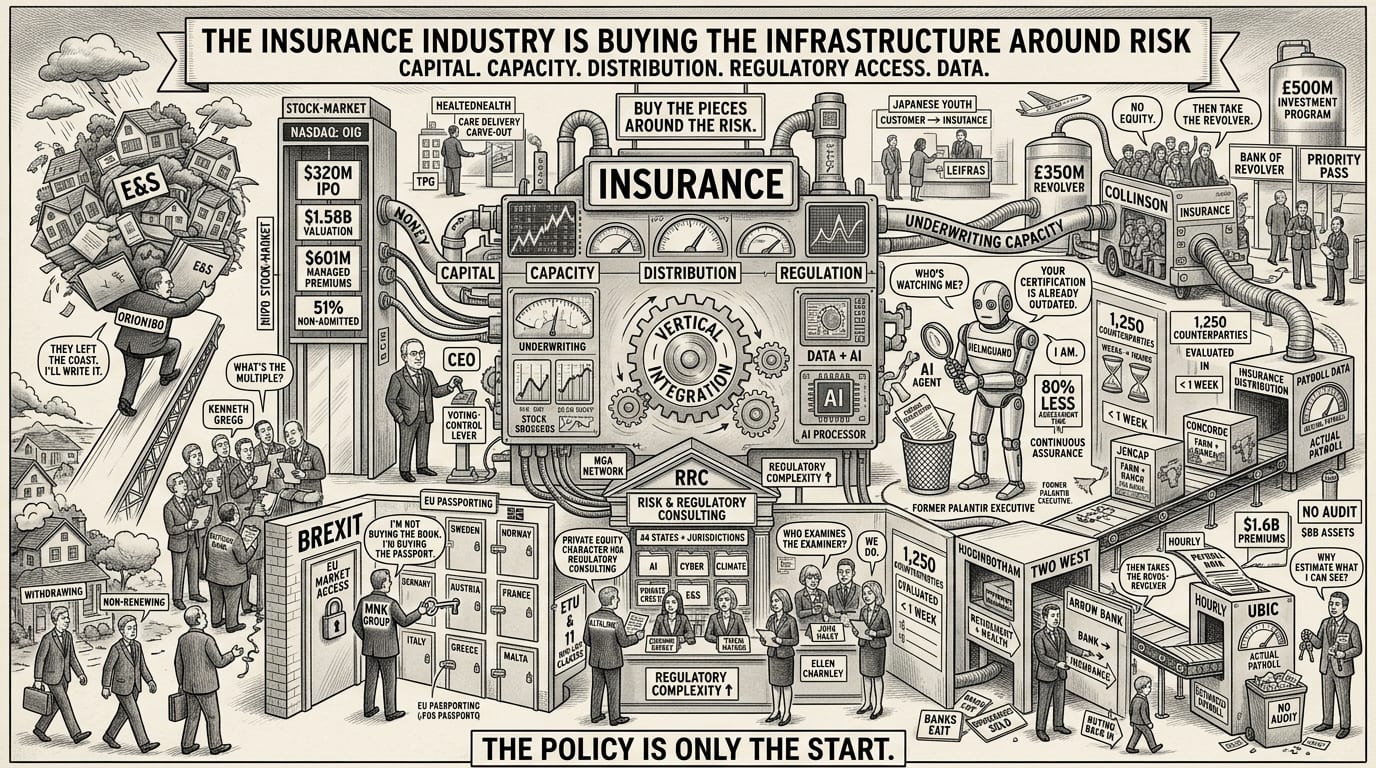
$327M+ in disclosed equity capital plus £350M in debt financing | 8 current-week transactions + 1 missed-last-week addition + 2 market context items | An E&S homeowners insurer prices its IPO at a $1.58 billion valuation, a Lloyd’s broker buys its way into EU passporting, and private equity buys the firm that examines insurers for regulators
Orion180 launched the roadshow for a $320 million IPO that would value the company at roughly $1.58 billion, taking public the second-largest excess and surplus homeowners insurer in the United States at a moment when standard carriers continue withdrawing from catastrophe-exposed property. MNK Group acquired Danish carrier ETU Forsikring, and the strategic asset is not the balance sheet but the freedom-of-services passports carrying admitted access into eight additional EU markets. Altaline Capital Management took a growth stake in Risk & Regulatory Consulting, the firm state insurance departments hire to conduct their financial and market conduct examinations. HelmGuard raised $7.3 million led by a former Palantir executive to put AI agents on the assurance side of compliance. Collinson secured a £350 million revolving facility to fund a £500 million investment program. And three brokerages changed hands across wholesale, retirement advisory and, notably, a community bank returning to insurance distribution.
GILAD SHAI ON THE WEEK'S DEALS — WHAT THE NUMBERS DON'T SAY
1. Orion180 Insurance Group (USA)
~$320M IPO at ~$1.58B Valuation | Second-Largest US E&S Homeowners Insurer Goes Public Date: September 9, 2026
What Happened
Orion180 Insurance Group, the Melbourne, Florida technology-enabled specialty insurer, launched the roadshow for its initial public offering, setting terms at 20 million Class A shares priced between $15 and $17. At the midpoint the offering raises approximately $320 million, rising to roughly $340 million at the top of the range, and implies a market capitalization of about $1.58 billion at midpoint and $1.7 billion at the top. The shares are expected to list on Nasdaq under the ticker OIG. The company originally filed its S-1 on August 20, 2026.
Founded in 2018 and led by founder and chief executive Kenneth Gregg, who retains voting control through Class B shares, Orion180 is the second-largest excess and surplus homeowners insurer in the United States by direct written premiums. It operates across 14 states with approximately $601 million in managed premiums written for the twelve months ended June 30, 2026, has issued more than 670,000 policies since inception, and distributes through more than 14,000 active independent agents.
Approximately 51% of 2025 managed written premiums were non-admitted, reflecting a deliberate concentration in coastal and catastrophe-exposed property that standard markets have been exiting. The financial trajectory turned sharply: first-half 2026 net income of roughly $13.2 million on revenue of $80.1 million, against a net loss of approximately $3 million on revenue of $50.4 million in the prior-year period.
The underwriting syndicate is unusually deep for an offering of this size. RBC Capital Markets, UBS Investment Bank, Raymond James and Goldman Sachs are joint bookrunner leads, with Deutsche Bank Securities, Citizens Capital Markets and Texas Capital also serving as joint bookrunners.
- Founder and CEO: Kenneth Gregg, retaining voting control via Class B shares
- Offering: 20 million Class A shares at $15 to $17, Nasdaq: OIG
- Joint bookrunner leads: RBC Capital Markets, UBS Investment Bank, Raymond James, Goldman Sachs
- Additional joint bookrunners: Deutsche Bank Securities, Citizens Capital Markets, Texas Capital
Use of Funds
- Support continued growth in managed premiums across the 14-state footprint
- Strengthen capital position for catastrophe-exposed underwriting
- Provide liquidity and public currency for a founder-controlled specialty insurer
Strategic Thesis
The timing is the argument. Standard carriers have spent three years restricting or withdrawing from coastal and wildfire-exposed homeowners property. Those risks did not disappear. They migrated to excess and surplus, where rate is not filed and terms can be set against the exposure. Orion180 built a $601 million book in precisely that migration, with roughly half of it non-admitted.
The financial inflection is what makes the offering viable now rather than a year ago. A swing from a $3 million loss to $13.2 million of net income while revenue grew roughly 59% suggests the book reached the scale where fixed technology and distribution costs are absorbed. Public markets will price a specialty insurer on demonstrated underwriting result, not on narrative, and Orion180 waited until it had the former.
Kenneth Gregg retaining voting control through Class B shares tells investors the founder is not selling the business, he is financing it. That is a different proposition from a sponsor-backed insurer using an IPO as an exit, and it usually attracts a different shareholder base.
Why It Matters
- A $1.58 billion valuation on a company founded in 2018, built almost entirely in catastrophe-exposed property, is a direct market test of whether public investors will underwrite the E&S migration or discount it as concentrated risk.
- Seven underwriters on a $320 million offering is a notably deep syndicate, which signals either broad institutional demand or a deliberate effort to build one across multiple distribution channels.
- Roughly 51% non-admitted premium means the majority of the book is written outside filed-rate regulation, giving Orion180 pricing flexibility that admitted competitors in the same geographies do not have.
Competition
- Direct competitors: Kin Insurance, Slide Insurance and HCI Group’s TypTap write catastrophe-exposed homeowners property in overlapping coastal states through comparable technology-enabled models.
- Category competitors: Admitted homeowners carriers including Universal Insurance Holdings and Heritage Insurance compete for the same properties where they retain appetite, on filed rates rather than E&S terms.
- Emerging dynamic: Continued admitted-market withdrawal from coastal and wildfire property is expanding the E&S homeowners segment structurally, and public markets are now being asked to capitalize that expansion directly.
Market Consequences
For E&S property competitors, a listed Orion180 creates a public comparable where none existed at this scale, which will set the valuation reference for the next private raise or sale in the category. For independent agents placing coastal homeowners business, a better-capitalized Orion180 should mean more consistent capacity in markets where admitted options keep narrowing. For investors, the offering is the cleanest available instrument for taking a position on catastrophe-exposed property pricing without buying a diversified carrier.
Bottom line: Standard carriers spent three years walking away from coastal homeowners property. Orion180 built a $601 million book catching it, and is now asking public markets to value that at $1.58 billion.
2. MNK Group / ETU Forsikring (UK / Denmark)
Undisclosed | A Lloyd’s Broker Buys EU Passporting Rights Into Eight Markets Date: September 9-10, 2026, Danish FSA approval September 4
What Happened
MNK Group, the privately owned international insurance and reinsurance group led by founder and group chief executive Manoj Kumar, completed the acquisition of 100% of ETU Forsikring A/S, a Danish non-life insurance carrier. The Danish Financial Supervisory Authority (Finanstilsynet) approved the transaction on September 4. Financial terms were not disclosed.
Established in 2006 and headquartered in Rødekro, Southern Jutland, ETU Forsikring is authorized across eleven non-life classes including property covering fire and other damage, general liability, motor, marine hull and liability, goods in transit, accident, legal expenses and assistance.
The asset that matters is regulatory. ETU holds freedom-of-services passports into eight markets beyond Denmark: Sweden, Norway, Germany, Austria, France, Italy, Greece and Malta. ETU becomes MNK Group’s first EU-domiciled risk carrier.
MNK Group operates across the UK, continental Europe, the US, Latin America, Bermuda, the Middle East and Asia. Its businesses include MNK International, the Lloyd’s broker formerly known as MNK Re, a specialty MGA network spanning the UK, Italy, the US and the Middle East, and risk carriers Mekong Re, Florida Re and MNK Seguros. The group launched a unified brand in April 2025, opened a São Paulo operation in February 2026, and appointed its first group treasury director in January 2026.
- Acquirer: MNK Group; Manoj Kumar, Founder and Group CEO
- Target: ETU Forsikring A/S, Rødekro, Denmark
- Regulatory approval: Danish FSA (Finanstilsynet), September 4, 2026
Use of Funds
- Establish MNK Group’s first EU-domiciled risk carrier
- Deploy ETU’s freedom-of-services passports across eight additional European markets
- Provide owned capacity to complement the group’s Lloyd’s broking and MGA network
Strategic Thesis
This is a Brexit-structural transaction wearing the clothes of a small carrier acquisition. A UK-headquartered group with a Lloyd’s broker and an MGA network in Italy and elsewhere cannot passport into the EU from London. Buying a modestly sized Danish carrier that already holds freedom-of-services rights into eight markets solves that problem in one transaction, at a fraction of what establishing eight local entities would cost in capital, time and regulatory process.
The eleven authorized classes matter as much as the geography. Property, general liability, motor, marine and cargo cover most of what MNK’s existing MGA network underwrites, meaning the carrier can support the group’s own distribution rather than requiring a separate capacity hunt for each product line.
Owning paper also changes MNK’s economics. A broker and MGA group earns commission. A group with its own carrier retains underwriting margin on the business it chooses to keep, and gains negotiating leverage with third-party capacity on the business it does not.
Why It Matters
- Freedom-of-services passports into eight EU markets are the operative asset, and acquiring them through an existing authorized carrier is materially faster than applying for authorizations market by market.
- ETU is MNK Group’s fourth risk carrier alongside Mekong Re, Florida Re and MNK Seguros, completing a structure where the group holds paper in Asia, the US, Latin America and now the EU.
- The Danish FSA approving the change of control on September 4, days before announcement, indicates the regulatory work was substantially complete before the transaction became public.
Competition
- Direct competitors: Danish non-life carriers including Tryg and Topdanmark compete for the same domestic commercial property and liability business ETU writes.
- Category competitors: Accelerant, Bridgehaven and other capacity providers serving MGAs compete to supply the European paper MNK will now partly self-supply.
- Emerging dynamic: UK-headquartered brokers and MGA groups continue acquiring small EU-domiciled carriers specifically for passporting rights, a structural consequence of losing single-market access.
Market Consequences
For MGAs currently sourcing European capacity from third parties, a group that owns both distribution and paper becomes a more integrated competitor. For small EU-domiciled carriers with broad class authorizations and multi-market passports, ETU establishes that such entities carry strategic value well above their premium base. For ETU’s Danish policyholders and brokers, ownership by an international group brings scale but also a parent with ambitions beyond the Danish market.
Bottom line: MNK did not buy a Danish insurer for its Danish book. It bought admitted access to eight European markets, which London has not been able to passport into since Brexit.
3. Altaline Capital Management / Risk & Regulatory Consulting (USA)
Undisclosed | Private Equity Buys the Firm That Examines Insurers for Regulators Date: September 7, 2026
What Happened
Funds advised by Altaline Capital Management, the Los Angeles-based private equity firm, completed a strategic growth investment in Risk & Regulatory Consulting (RRC), the Farmington, Connecticut firm that provides outsourced regulatory services to US state insurance departments. Financial terms were not disclosed.
Founded in 1988, RRC employs approximately 160 professionals and serves regulators across 44 states and jurisdictions. Its services include financial and information technology examinations and analysis, market conduct examinations, actuarial services, insolvency and receivership support, market studies and investment analysis. In practical terms, when a state insurance department examines a carrier’s solvency, reserves, IT controls or market conduct, RRC is frequently the firm doing the work.
Co-chief executives LeeAnne Creevy and Tricia Matson continue to lead the business. The transaction establishes a broad-based employee ownership program.
The board additions are notable. Altaline’s Sebastian O’Neill and Rafael Telahun join alongside John Haley, former chief executive of Willis Towers Watson, and Ellen Charnley, former president of Marsh Captive Solutions.
This is Altaline’s fourth platform investment in twelve months within its Compliance, Safety and Risk thematic initiative.
- Investor: Altaline Capital Management; Sebastian O’Neill and Rafael Telahun joining the board
- Target: Risk & Regulatory Consulting; LeeAnne Creevy and Tricia Matson, Co-CEOs, continuing
- Independent board additions: John Haley (former CEO, Willis Towers Watson), Ellen Charnley (former President, Marsh Captive Solutions)
Use of Funds
- Expand actuarial and specialist examiner staffing
- Build capacity to serve regulators addressing climate exposure, cyber risk and artificial intelligence
- Fund a broad-based employee ownership program
Strategic Thesis
The demand drivers Altaline cites read as a list of everything this report has covered all year, viewed from the regulator’s side of the table: climate exposure, cyber risk, private credit in insurer investment portfolios, AI and automation inside insurer operations, the migration of risk into excess and surplus, and the proliferation of fronting and captive structures.
Every one of those developments makes examining an insurer harder. A state department of insurance with a fixed headcount and a civil service pay scale cannot readily hire actuaries who understand private credit marks, or IT examiners who can assess an AI underwriting model. So it outsources, and the firm it outsources to becomes a beneficiary of exactly the complexity that makes the industry harder to supervise.
That is a genuinely countercyclical revenue profile. RRC’s work increases when insurers are under stress, when new risks emerge faster than regulatory capacity, and when solvency questions multiply. Most insurance services businesses are correlated to premium growth. This one is correlated to supervisory difficulty.
The board construction reinforces the thesis. John Haley ran Willis Towers Watson. Ellen Charnley ran Marsh Captive Solutions. Both bring direct familiarity with the structures, captives and fronting arrangements especially, that regulators increasingly need help examining.
Why It Matters
- Serving 44 states and jurisdictions makes RRC embedded infrastructure in US insurance supervision, a position that is difficult to displace because it depends on credentialed examiners and accumulated regulatory relationships rather than technology.
- The revenue profile is countercyclical to insurer health, growing with supervisory complexity and market stress rather than with premium volume.
- A broad-based employee ownership program addresses the binding constraint directly, since the scarce asset is credentialed actuaries and examiners who can otherwise be recruited by carriers and consultancies at higher pay.
Competition
- Direct competitors: Examination Resources, INS Regulatory Insurance Services and Noble Consulting Services perform the same outsourced financial and market conduct examinations for state departments.
- Category competitors: Milliman, Oliver Wyman and the insurance practices at Deloitte and EY compete for actuarial and regulatory advisory work, generally serving carriers rather than regulators.
- Emerging dynamic: Regulatory complexity around AI, cyber, climate and private credit is expanding an investable services layer positioned between insurers and their supervisors.
Market Consequences
For state insurance departments, private equity ownership of a primary examination vendor raises questions about independence and pricing that regulators will need to satisfy themselves on. For competing examination firms, a capitalized RRC with an employee ownership program becomes a stronger competitor for the credentialed examiners the whole category is short of. For carriers, a better-resourced examination vendor means more capable scrutiny, particularly on the private credit and AI questions where regulatory capability has lagged.
Bottom line: Altaline bought the firm that 44 states hire to examine their insurers. Its revenue grows with regulatory complexity, which means it grows when everything else in the industry gets harder.
4. HelmGuard (UK / USA)
$7.3M Seed | A Former Palantir Executive Puts AI Agents on the Assurance Side Date: September 9, 2026
What Happened
HelmGuard, the London-headquartered agentic governance, risk and compliance platform, raised $7.3 million in seed funding co-led by Infinity Ventures and Frontline, with participation from FinTech Collective, Stage 2 Capital and Entrepreneurs First, which also incubated the company.
Co-founder and chief executive John Daley spent eight years as an executive at Palantir. Co-founder and chief technology officer Jack Miller leads the product. The platform serves security and compliance teams in regulated sectors including financial services, insurance, healthcare and industrials, with users across the US, Canada, UK, Hong Kong and South Africa.
HelmGuard’s approach inverts the usual compliance automation model. Rather than generating documentation faster, its AI agents collect and assess risk signals directly from source systems, cutting assessment cycles from weeks to hours and reducing assessment time by up to 80%. The platform provides transparent citations, reasoning traces and human-in-the-loop mechanisms to produce a defensible basis for reporting to auditors and regulators.
The insurance proof point is specific. For one US-based insurance customer, HelmGuard performed a full risk assessment of 1,250 counterparties in less than a week, after which the client migrated entirely from its legacy platform, a migration HelmGuard’s forward-deployed engineers completed in under 10 days.
Daley framed the distinction directly: most compliance platforms were built to document a process rather than reach a conclusion, and using AI to produce those documents faster does not help anyone decide anything.
New capital funds US expansion including New York and San Francisco offices, engineering and go-to-market hiring, and development of an agent assurance layer that evaluates AI agent behavior at runtime, alongside the Verified Risk Network, which replaces exchanged documents with continuously verified claims passed between counterparties’ agents.
- Co-founder and CEO: John Daley, previously eight years as a Palantir executive
- Co-founder and CTO: Jack Miller
- Co-leads: Infinity Ventures (Jay Ganatra, Co-founder and Managing Partner) and Frontline (George Radford, Partner)
- Participating: FinTech Collective, Stage 2 Capital, Entrepreneurs First
Use of Funds
- US expansion with New York and San Francisco presence alongside London headquarters
- Hiring across engineering and go-to-market
- Build the agent assurance layer evaluating AI agent behavior at runtime
- Extend the Verified Risk Network for agent-to-agent assurance exchange
Strategic Thesis
Jack Miller identified the structural problem that makes this investable for insurance specifically: an AI vendor’s risk profile changes with every model update and every new tool its agents can call, which means a certification issued months ago describes a reality the buyer cannot rely on.
That is a genuine and growing exposure for carriers. Insurers are deploying AI across underwriting, claims and distribution, and simultaneously buying from vendors who are themselves embedding agentic capability into products that were diligenced before AI was part of the offering. The vendor risk assessment signed at purchase no longer describes what is running in production.
George Radford at Frontline made the same point from the investor side: every company in his portfolio is running agents that make far more decisions, far faster, than the workflows they replaced, and the legacy assurance model was never built for something that decides what to do at runtime.
The supporting data is not trivial. EY research found a third of businesses rank third-party and supply chain risk as a major threat, and 41% of those have limited or no confidence in their compliance team’s ability to manage it.
For insurance, this connects to a thread running through this report since Week 25. Norm AI, Trussed AI, dodoAI, Klaimee and Alice all approach the same territory from different angles. HelmGuard’s angle is continuous verification of counterparty and agent behavior rather than periodic certification.
Why It Matters
- Assessing 1,250 counterparties in under a week for an insurance client is a concrete, checkable performance claim in a category where vaguer assertions are the norm.
- The agent assurance layer addresses a gap that barely existed eighteen months ago: verifying that an AI agent deployed inside a regulated workflow is behaving within its defined scope.
- A Palantir-trained founding team building forward-deployed engineering into the delivery model is an unusual go-to-market for a seed-stage compliance company, and it is what enabled a 10-day platform migration.
Competition
- Direct competitors: Drata, Vanta and Secureframe automate security and compliance evidence collection for the same regulated buyers.
- Category competitors: AuditBoard and ServiceNow’s risk and compliance products address adjacent enterprise governance workflows at larger account sizes.
- Emerging dynamic: AI agents are moving compliance from periodic certification toward continuous assurance, and the agent-to-agent verification model would change what counterparty diligence means if it is adopted at scale.
Market Consequences
For carriers diligencing insurtech vendors and MGAs, continuous verification raises the standard from an annual certification to demonstrable ongoing controls. For legacy GRC platforms, a migration completed in 10 days indicates switching costs are lower than incumbents have historically assumed. For insurtech companies selling into carriers, the diligence bar rises, particularly for anyone deploying agents in underwriting or claims.
Bottom line: A certification issued six months ago describes an AI vendor that no longer exists. HelmGuard’s bet is that regulated buyers will pay for verification that happens continuously rather than annually.
5. Collinson Group (UK)
£350M Revolving Credit Facility | Debt Capacity Behind a £500M Investment Program Date: September 7, 2026
What Happened
Collinson Group secured a new £350 million unsecured revolving credit facility from a syndicate comprising HSBC, Barclays, Citibank, Bank of America and Fifth Third Bank. The facility doubles the size of the group’s previous financing arrangements and supports a stated £500 million investment program over five years.
Collinson operates across airport experiences, loyalty, customer engagement and insurance, and is best known for Priority Pass. The group reported approximately £2 billion in revenue for its latest financial year and employs more than 2,500 people across 14 countries.
Stated uses include expanding the global airport lounge footprint, continued Priority Pass development, growth of its insurance portfolio, and investment in new technology, products, markets and personnel.
- Borrower: Collinson Group
- Syndicate: HSBC, Barclays, Citibank, Bank of America, Fifth Third Bank
- Structure: Unsecured revolving credit facility, doubling prior arrangements
Use of Funds
- Expand the global airport lounge footprint
- Continue Priority Pass development
- Grow the insurance portfolio
- Fund technology, product, market entry and hiring
Strategic Thesis
This is balance sheet capital for an insurance-adjacent platform rather than a venture round, and the structure is the point. An unsecured revolving facility gives Collinson the ability to fund insurance growth and pursue bolt-on opportunities without issuing equity or accepting a financial sponsor.
The strategic logic rests on owning distribution. Collinson reaches consumers through Priority Pass and its loyalty programs at the moment they are travelling, which is precisely when travel insurance, assistance and related protection products are relevant. That is embedded distribution with a captive audience, and it is why an insurance business inside a travel and loyalty group can grow without competing for attention through conventional broker channels.
Five lenders participating in an unsecured facility of this size against £2 billion of revenue indicates the banks are underwriting the diversified platform rather than any single segment.
Why It Matters
- Doubling available financing while remaining unsecured gives Collinson meaningful acquisition capacity in insurance and adjacent categories without diluting ownership.
- Insurance is explicitly named among the four stated uses, positioning it as a growth engine rather than an ancillary product attached to travel services.
- The Priority Pass ecosystem provides distribution that traditional travel insurers must buy through partnerships, making Collinson a structurally different competitor in the category.
Competition
- Direct competitors: AIG Travel, Allianz Partners and Zurich Cover-More underwrite and administer travel insurance and assistance for the same travellers.
- Category competitors: Airline and OTA embedded insurance offerings, and competing lounge and loyalty programs that control the same consumer touchpoint.
- Emerging dynamic: Insurance capital is increasingly deployed through membership and loyalty ecosystems that own the customer relationship, rather than through standalone product distribution.
Market Consequences
For travel insurers relying on airline and OTA partnerships for distribution, a better-capitalized Collinson competing from inside its own ecosystem is a structural disadvantage rather than a pricing one. For potential acquisition targets in travel insurance and assistance, Collinson now has committed capacity to move. For the lenders, an unsecured facility to a diversified consumer platform with an insurance arm reflects how the category is increasingly underwritten.
Bottom line: Collinson doubled its financing without issuing equity. A travel and loyalty group that owns the customer at the moment of travel can grow an insurance book without buying distribution.
6. Jencap Group / Concorde General Agency (USA)
Undisclosed | Regional Wholesaler With Farm and Ranch Specialty Date: September 10, 2026
Jencap Group, one of the largest US wholesale insurance distributors, acquired Concorde General Agency, a Fargo, North Dakota-based regional wholesaler specializing in personal lines, commercial lines, and farm and ranch insurance. Financial terms were not disclosed.
The farm and ranch capability is the strategic element. Agricultural property and liability is a specialist placement line, and this report has now tracked four separate agricultural insurance transactions in six weeks, following Amynta’s acquisition of Southern States Underwriters, Marsh McLennan Agency’s purchase of The Accel Group, Stone Point’s acquisition of Ever.Ag’s risk management business, and now Jencap’s move into the same territory through wholesale distribution.
Jencap separately announced this week that it selected OIP Insurtech to accelerate AI-enabled underwriting operations, indicating the firm is investing in both distribution reach and processing capability simultaneously.
Bottom line: Four agricultural insurance transactions in six weeks, from an MGU platform, a retail brokerage, a financial sponsor and now a wholesaler. The buyer types differ. The conviction does not.
7. Higginbotham / Two West Capital Advisors (USA)
Undisclosed | Retirement and Wealth Advisory Into an Insurance Brokerage Date: September 9, 2026
Higginbotham, the Fort Worth-based independent insurance brokerage, acquired Two West Capital Advisors, a Kansas City, Kansas retirement plan and wealth management firm. The full team, experience and operating platform join Higginbotham’s retirement planning and wealth management business. Terms were not disclosed.
The transaction reflects a continuing convergence. Independent brokerages have been assembling benefits consulting, retirement planning and wealth advisory around the same employer relationships they already serve for property and casualty and employee benefits. The commercial logic is that an employer relationship built on insurance placement can support several additional advisory revenue lines without new client acquisition cost.
Bottom line: Higginbotham is converting insurance relationships into broader employer and wealth advisory relationships. The client was already there.
8. Arrow Financial / Skene Valley Agency (USA)
Undisclosed | A Community Bank Returns to Insurance Distribution Date: September 11, 2026
Arrow Financial Corporation announced that Upstate Agency, LLC, a subsidiary of Arrow Bank National Association, agreed to acquire Skene Valley Agency, Inc., an independent insurance agency in Washington County, New York. Terms were not disclosed.
The structural interest here exceeds the transaction size. US banks largely retreated from insurance distribution over the past decade, with several large institutions selling their brokerage arms outright. A community bank holding company expanding its insurance agency through acquisition runs against that trend, and suggests the fee income and relationship-deepening arguments that drove bank-owned insurance distribution in the first place retain force at community scale even where they failed at national scale.
Bottom line: Large banks spent a decade selling their insurance brokerages. A community bank in upstate New York just bought another agency, which is a reminder the economics work differently at different scales.
Missed Last Week: weSure / Utah Business Insurance Company (USA)
Undisclosed | Payroll Data Meets Workers’ Compensation Underwriting Date: September 4, 2026
This transaction was announced on September 4, inside the Week 36 reporting window, and was not caught in that report. It is included here as a flagged late addition.
What Happened
weSure Digital Insurance Services, Inc., the New York-based multi-line international digital insurance group writing approximately $1.6 billion in premiums and managing more than $8 billion in assets, acquired Utah Business Insurance Company (UBIC), a workers’ compensation carrier based in South Jordan, Utah. Financial terms were not disclosed.
The acquisition follows weSure’s September 2025 acquisition of Hourly, Inc., the California-based digital payroll company, and the combination of the two is the strategic point. Through Hourly, weSure connects digital payroll directly to pay-as-you-go workers’ compensation, aligning premium with actual payroll rather than estimated payroll and removing audit friction. Bundled policies under $5,000 in premium qualify for no audit, and payroll referrals create an additional revenue stream for agents.
UBIC serves construction, transportation, professional services, agriculture, manufacturing, retail, hospitality and medical industries, and is known for workplace safety, loss control, claims management and long-term independent agent relationships.
Ron Nielsen, founder and chief executive of UBIC, continues to lead the company. Tyler Nielsen, UBIC’s chief operating officer, emphasized that continuity for agents and policyholders was central to the transaction. Emil Vainshel, Chairman of the Board at weSure, framed the acquisition around expanding workers’ compensation capability and investing in carrier partnerships.
- Acquirer: weSure Digital Insurance Services; Emil Vainshel, Chairman of the Board
- Target: Utah Business Insurance Company; Ron Nielsen, Founder and CEO (continuing), Tyler Nielsen, COO
- Related asset: Hourly, Inc., digital payroll, acquired September 2025
Why It Matters
The payroll-to-premium connection is the substance. Workers’ compensation premium is calculated on payroll, which means the single largest source of friction in the product, the annual audit and the resulting true-up, exists because insurers estimate payroll rather than observe it. A carrier that owns the payroll system observes it in real time.
Owning the carrier rather than fronting through one gives weSure control over underwriting, product design, claims handling and distribution economics. Combined with Hourly’s payroll data, that produces a structurally different cost basis than a digital MGA writing on someone else’s paper.
Bottom line: Workers’ compensation premium is calculated on payroll, and the annual audit exists because insurers estimate payroll instead of seeing it. weSure now owns the payroll system and the carrier.
Market Context
UnitedHealth Group / TPG (September 9, USA): UnitedHealth sold an interest in certain Optum Health operations in Florida, including its WellMed clinics, to private equity firm TPG, as the health conglomerate works to recover from a collapse in profits. The transaction is included as context rather than a primary deal because it is a health services carve-out rather than an insurance transaction, though it reflects a major managed care organization divesting care delivery assets under earnings pressure.
Leifras (September 10, Japan): The Japanese youth sports company announced plans to enter the non-life insurance agency business. This is a stated strategic intention rather than a financing or acquisition, and is noted only as an example of a consumer business adding insurance distribution to an existing customer relationship.