Insurance & InsurTech Investment Intelligence Report: Week of August 30 - September 5, 2026
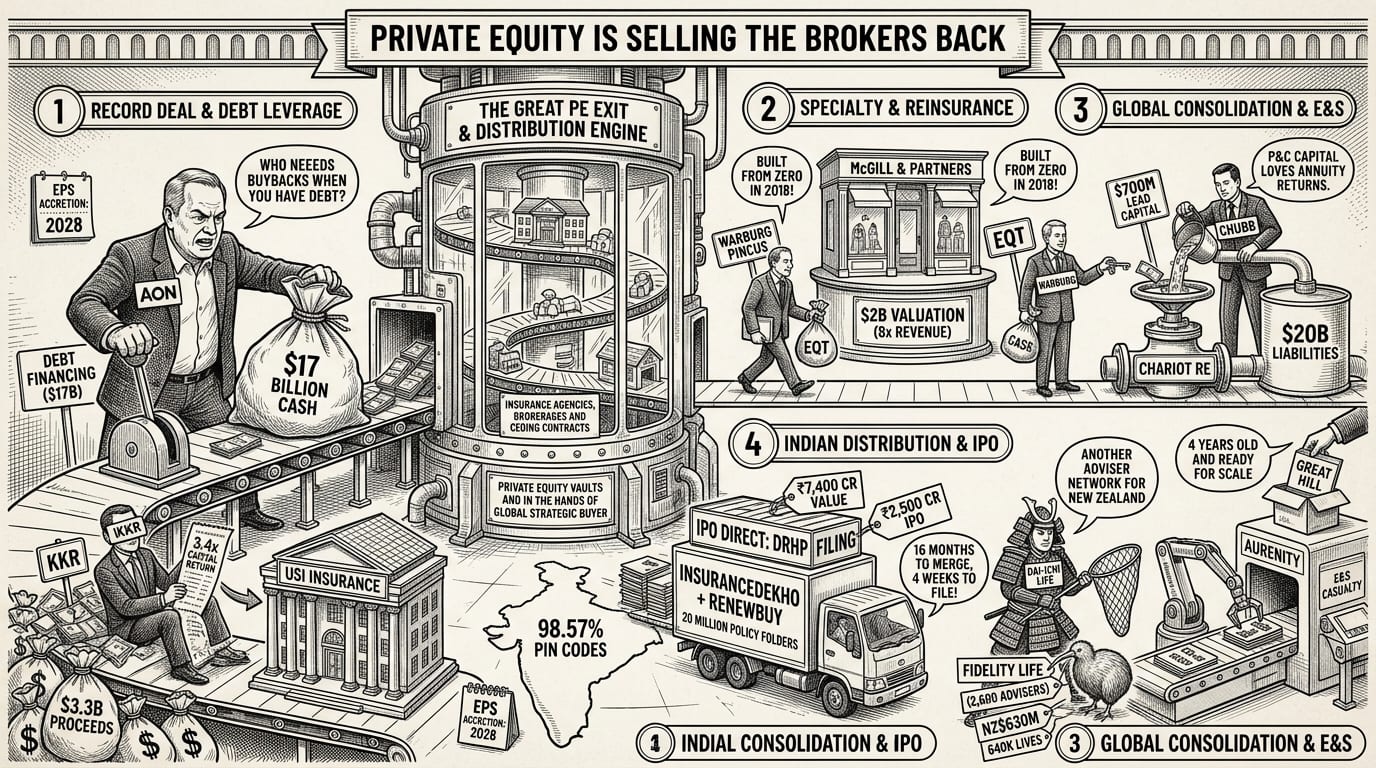
$20.5B+ in disclosed capital | 8 primary transactions + 1 special situation + 1 missed-last-week addition + 3 market context items | The largest insurance brokerage acquisition on record, a $2 billion specialty broker exit, and two of the biggest private equity insurance exits of the cycle land in the same seven days
This is the largest week this report has covered. Aon agreed to acquire USI Insurance Services from KKR for $17 billion in cash, exceeding its own $13.4 billion NFP acquisition and marking one of the largest private equity exits the insurance sector has seen. EQT agreed to buy a majority of McGill and Partners at a $2 billion valuation, giving Warburg Pincus a full exit seven years after it seeded a business that did not exist in 2018. Dai-ichi Life’s New Zealand arm agreed to acquire Fidelity Life for NZ$630 million, consolidating two of the country’s largest adviser-distributed life insurers. Chariot Re, the MetLife and General Atlantic sidecar, closed a $700 million third raise with Chubb leading. InsuranceDekho and RenewBuy completed a merger that has been fifteen months in regulatory process, creating an Indian distribution platform present in 98.57% of the country’s pin codes and now heading for an IPO. Underneath those, a technology-enabled E&S MGA founded four years ago attracted growth capital, a delegated authority data platform changed private equity hands, and a health engagement company was bought to reach 30% of US health plans.
The connecting theme is not size. It is that private equity is selling insurance distribution to strategic buyers at scale, after nearly a decade of the reverse.
GILAD SHAI ON THE WEEK'S DEALS — WHAT THE NUMBERS DON'T SAY
1. Aon / USI Insurance Services (UK / USA)
$17B All-Cash | The Largest Insurance Brokerage Acquisition on Record Date: Signed August 30, announced August 31, 2026
What Happened
Aon plc agreed to acquire USI Insurance Services from KKR and other shareholders for $17 billion in cash. On a net basis, after accounting for approximately $278 million in tax attributes, the price is $16.7 billion, or roughly 14.5 times USI’s synergized trailing twelve month adjusted EBITDA. The transaction was signed August 30 per an SEC filing and announced August 31. Both boards approved unanimously. Closing is expected in the fourth quarter of 2026, subject to regulatory approvals.
Valhalla, New York-based USI is the tenth largest insurance broker in the United States, generating approximately $3 billion in annual revenue with more than 10,500 employees across nearly 200 offices. It provides property and casualty, employee benefits, personal risk and retirement products, and has served as both an annuity provider and a consultant in the pension risk transfer market. USI CEO Mike Sicard will lead Aon’s middle market business.
Aon will fund the acquisition entirely through new debt and expects to remain investment grade rated. It does not plan to repurchase shares in the near term as it prioritizes paying down debt. The company projects $395 million in annual run-rate net adjusted EBITDA from revenue and cost synergies across the combined middle-market platform, and expects the deal to be accretive to adjusted earnings per share in 2028.
For KKR this is a landmark exit. KKR and Canadian pension fund Caisse de dépôt et placement du Québec acquired USI from Onex Corporation in 2017 for $4.3 billion including debt. KKR subsequently invested more than $1 billion additional, becoming USI’s largest shareholder. The sale generates approximately $3.3 billion in after-tax proceeds and roughly $2 billion of adjusted net income, equivalent to more than $2.00 per share, representing about six times KKR’s original 2017 equity investment and 3.4 times its total capital invested. USI was held in KKR’s Strategic Holdings unit, the long-term dividend-paying portfolio the firm created in 2023. Following the transaction, Strategic Holdings comprises interests in 18 companies.
BofA Securities and Citi advised Aon. Goldman Sachs, Insurance Advisory Partners and Morgan Stanley advised KKR, with Simpson Thacher & Bartlett as legal adviser. Aon shares fell between 6.6% and 10% following the announcement.
- Acquirer: Aon plc
- Target: USI Insurance Services; Mike Sicard, CEO, to lead Aon middle market
- Sellers: KKR (largest shareholder) and Caisse de dépôt et placement du Québec (Tier C: KKR)
- Advisers: BofA Securities and Citi (Aon); Goldman Sachs, Insurance Advisory Partners and Morgan Stanley (KKR); Simpson Thacher (legal)
Use of Funds
- Fund the $17 billion purchase entirely through new debt issuance
- Prioritize debt repayment over share repurchases in the near term
- Capture $395 million in annual run-rate net adjusted EBITDA synergies across the combined middle-market platform
Strategic Thesis
Aon bought NFP for $13.4 billion in 2023 to enter the US middle market. This is the same move at greater scale, and it changes what Aon is. A firm historically defined by large-account and reinsurance broking is now assembling the largest middle-market distribution platform in the industry through acquisition rather than organic build.
The financing structure carries real risk and the market said so immediately. Funding $17 billion entirely with debt, pausing buybacks, and promising EPS accretion only in 2028 asks investors to wait two years for the return. A 6.6% to 10% share price decline is the market pricing that wait, not disputing the asset.
What makes this transaction historically notable is the direction of travel. For most of the past decade, private equity has been the buyer in insurance distribution, rolling up agencies and brokerages. Here a strategic buyer is taking a $17 billion platform off a private equity firm’s hands. Insurance Business noted that most recent brokerage M&A has run the other way, making this one of the largest PE exits the sector has recorded.
Why It Matters
- At $17 billion this exceeds Aon’s own $13.4 billion NFP acquisition and stands as the largest insurance brokerage transaction on record, resetting the ceiling for what a distribution platform can command.
- KKR’s return, roughly six times its 2017 equity and 3.4 times total capital across nearly a decade of ownership, is the clearest available benchmark for what patient private equity ownership of a scaled insurance broker can produce.
- Aon funding the entire purchase with debt while pausing buybacks and deferring EPS accretion to 2028 is an unusually aggressive capital structure for a transaction this size, and the immediate share price reaction reflects that.
Competition
- Direct competitors: Marsh McLennan Agency, Gallagher and Brown & Brown compete with USI for the same US middle-market commercial accounts through the same retail broking model.
- Category competitors: Private equity-backed consolidators including Hub International, Acrisure and Alliant compete for the same middle-market agencies and producer talent, generally as buyers rather than sellers.
- Emerging dynamic: Strategic buyers are now acquiring scaled distribution platforms from private equity rather than competing with PE for individual agencies, which changes the exit path for every sponsor-owned brokerage of size.
Market Consequences
For middle-market commercial insurance buyers, the combination of Aon, NFP and USI concentrates a substantial share of US middle-market broking under one owner, which will draw regulatory attention during review and competitive responses from Marsh McLennan Agency and Gallagher. For private equity firms holding large brokerage assets, KKR’s exit multiple establishes that strategic buyers will pay full price for scale, which improves the exit calculus for sponsors currently holding platforms of comparable size. For USI’s producers and clients, Mike Sicard leading Aon’s middle market business signals continuity of leadership rather than absorption into an existing Aon structure.
Bottom line: For ten years private equity bought insurance distribution. Aon just paid $17 billion to buy it back, funded entirely with debt, with the earnings benefit deferred to 2028. KKR walks away with 3.4 times its capital.
2. EQT / McGill and Partners (Sweden / UK)
$2.0B Valuation | Warburg Pincus Exits a Broker It Seeded Seven Years Ago Date: September 4, 2026
What Happened
EQT X, the flagship private equity buyout fund managed by EQT, entered into a definitive agreement to acquire a majority stake in McGill and Partners from Warburg Pincus for $2.0 billion. Warburg Pincus will sell its equity stake in full. Founder and CEO Steve McGill will continue to lead the firm and Chairman John Lloyd will remain actively involved, both remaining significant shareholders alongside the wider colleague base.
McGill and Partners was founded in May 2019 by Steve McGill alongside a core senior team including John Lloyd, Stephen Cross and Karl Hennessy, with cornerstone backing from Warburg Pincus. The London-headquartered specialty insurance and reinsurance broker has grown to more than 600 employees across seven countries with annual revenues exceeding $250 million and over 1,000 insurance and reinsurance clients. It operates in Bermuda, the United States, Ireland, Australia, Switzerland and Sweden.
Matthias Wittkowski, Global Co-Head of Services and Partner at EQT Private Equity, cited McGill and Partners’ strong position in specialty insurance broking underpinned by organic growth. Steve McGill described turning what was an idea seven years ago into a $2 billion global specialty enterprise, built person by person and client by client.
- Acquirer: EQT X; Matthias Wittkowski, Global Co-Head of Services
- Seller: Warburg Pincus, full exit
- Target: McGill and Partners; Steve McGill, Founder and CEO (continuing), John Lloyd, Chairman (continuing)
Use of Funds
- Accelerate organic growth through specialty broking talent recruitment in key markets
- Invest in technology and data capabilities and expand digital solutions
- Maintain the firm’s independent model and colleague ownership structure
Strategic Thesis
The seven-year arc is the story. Warburg Pincus funded a business that did not exist in 2018, and exits at a $2 billion valuation on a firm generating $250 million of revenue. That is roughly 8 times revenue, a multiple that reflects growth trajectory and talent density rather than in-place earnings.
McGill and Partners was built explicitly as a challenger to the established specialty broking oligopoly, recruiting senior talent from Aon, Willis and Marsh at a moment when those firms were consolidating. The bet was that specialty clients would follow individual brokers rather than institutional brands. Seven years and 1,000 clients later, the exit valuation says the bet worked.
The transaction lands in the same week as Aon/USI, and the two are versions of the same trade in opposite directions. Aon is buying scale in the middle market from private equity. EQT is buying specialty broking growth from private equity. Both sellers are exiting distribution assets to buyers who want them for structurally different reasons.
Why It Matters
- A $2 billion valuation on approximately $250 million of revenue, roughly 8 times, is a materially higher multiple than typical brokerage transactions and reflects the premium placed on specialty capability and recruited talent rather than book of business.
- Warburg Pincus achieving a full exit on a de novo brokerage it seeded in 2019 validates the sponsor-backed startup broker model, which had limited precedent at this scale before McGill and Partners.
- Founder, chairman and colleague reinvestment alongside EQT preserves the ownership culture the firm used to recruit against larger competitors, which is the asset EQT is actually buying.
Competition
- Direct competitors: Aon, Marsh and WTW compete for the same specialty and reinsurance placements with the same large corporate and carrier clients that McGill and Partners targets.
- Category competitors: Lockton, Howden and Gallagher Specialty compete for both the clients and, critically, the senior specialty broking talent that McGill and Partners has recruited to build its position.
- Emerging dynamic: Sponsor-backed challenger brokers built by recruiting senior talent from incumbents are proving they can reach institutional scale within a decade, which changes the competitive risk profile for established specialty brokers.
Market Consequences
For specialty brokers weighing whether to launch independent ventures, the McGill and Partners outcome provides a concrete precedent: a firm founded in 2019 reaching a $2 billion valuation by 2026. For Aon, Marsh and WTW, a recapitalized McGill and Partners with EQT’s balance sheet behind it becomes a more persistent competitor for both clients and senior talent. For Warburg Pincus, a clean full exit on a de novo insurance venture strengthens the case for sponsoring similar builds in adjacent financial services categories.
Bottom line: Warburg Pincus funded a broker that did not exist in 2018 and sold it for $2 billion seven years later. The multiple, roughly 8 times revenue, is what specialty talent commands when it moves as a group.
3. Daiichi Life Group / Fidelity Life Assurance (Japan / New Zealand)
NZ$630M (~US$370M) | Two of New Zealand’s Largest Adviser-Distributed Life Insurers Combine Date: September 3, 2026
What Happened
Partners Group Holdings Limited (PNZ), the New Zealand holding company of Partners Life and a wholly owned subsidiary of Daiichi Life Group, entered into an agreement to acquire Fidelity Life Assurance Company Limited for NZ$630 million (approximately US$370 million, or 59.6 billion yen). Partners Life will acquire all 4,492,670 Fidelity Life shares following a capital injection from Daiichi’s intermediate holding company, and is expected to hold 100% of voting rights indirectly on settlement. Completion is scheduled between March 2027 and July 2027, subject to regulatory approvals.
Partners Life, established in 2011, insures more than 340,000 lives with over NZ$692 million in annual in-force premiums as of March 31, 2026, employs more than 400 people and holds an A (Excellent) financial strength rating from AM Best. It built its position entirely through the adviser channel and acquired the BNZ Life insurance business from NAB in September 2022, the same year Daiichi Life Group acquired Partners Life.
Fidelity Life, founded in 1973, is the largest locally owned life insurer in New Zealand, backed by local shareholders including the NZ Super Fund and Ngāi Tahu Holdings. It protects over 300,000 New Zealanders and distributes through a nationwide network of 2,600 independent financial advisers.
The combined entity would insure more than 640,000 lives. Both brands will continue operating as separate businesses through the approval process. Daiichi Life expects the acquisition to contribute approximately NZ$60 million annually to adjusted profit as early as its next medium-term management plan period. New Zealand’s life insurance market reached NZ$3.31 billion in annual premiums as of March 31, 2026.
- Acquirer: Partners Group Holdings Limited (PNZ), subsidiary of Daiichi Life Group
- Target: Fidelity Life Assurance Company Limited; Campbell Mitchell, CEO
- Partners Life CEO: Michael Weston
- Fidelity Life shareholders: NZ Super Fund, Ngāi Tahu Holdings and other local shareholders
Use of Funds
- Acquire 100% of Fidelity Life’s voting rights via capital injection from Daiichi’s intermediate holding company
- Expand Partners Life’s adviser networks, sales channels and customer base in New Zealand
- Strengthen competitiveness in a market where adviser distribution determines scale
Strategic Thesis
New Zealand’s life insurance market is distributed almost entirely through advisers, which makes access to distinct adviser networks the primary competitive asset. Partners Life built its position through advisers from a 2011 start. Fidelity Life has 2,600 independent financial advisers built over more than 50 years. Combining them creates concentration in the channel that determines outcomes in this market.
This is Daiichi’s second New Zealand transaction, not an entry. The group acquired Partners Life in 2022, and Partners Life itself acquired BNZ Life the same year. Insurance Business framed it accurately as a second bolt-on in a market Daiichi bought into in 2022 rather than a new geography.
The seller side is worth noting. Fidelity Life is the largest locally owned New Zealand life insurer, backed by the NZ Super Fund and Ngāi Tahu Holdings. Its sale to a Japanese-owned acquirer removes local ownership from a category where it was already scarce, which is likely to feature in regulatory review.
Why It Matters
- A combined 640,000 lives insured in a market of roughly 5.3 million people represents material concentration, and the transaction will be assessed against New Zealand’s affordability and coverage pressures with annual premiums at NZ$3.31 billion.
- Access to Fidelity Life’s 2,600 independent advisers is the asset being acquired, in a market where adviser relationships rather than brand or price determine distribution.
- The expected NZ$60 million annual adjusted profit contribution against a NZ$630 million price implies roughly a 10.5 times multiple on incremental profit, a disciplined figure for a market-consolidating acquisition.
Competition
- Direct competitors: AIA New Zealand, Chubb Life NZ and Asteron Life compete for the same adviser-distributed life and health business through the same independent adviser networks.
- Category competitors: Bank-distributed life insurance through ANZ, ASB and Westpac reaches the same customers through a channel the adviser-focused insurers do not use.
- Emerging dynamic: New Zealand’s life market has consolidated steadily, with Partners Life acquiring BNZ Life in 2022 and Daiichi acquiring Partners Life the same year, progressively reducing the number of independent adviser-facing insurers.
Market Consequences
For New Zealand’s 2,600 Fidelity Life-aligned advisers, ownership change raises questions about product, commission and platform continuity that the parties have addressed by keeping both brands separate through the approval period. For remaining adviser-distributed competitors, a combined Partners Life and Fidelity Life with Daiichi’s balance sheet becomes the dominant counterparty in the channel. For the NZ Super Fund and Ngāi Tahu Holdings, the transaction converts a locally held strategic insurance asset into cash at a defined price.
Bottom line: New Zealand life insurance is sold through advisers, and Daiichi just bought the 2,600 of them who work with Fidelity Life. The combined book insures 640,000 lives in a country of 5.3 million.
4. Chariot Re (Bermuda / USA)
$700M Third Capital Raise | Chubb Leads a Life and Annuity Sidecar Backed by MetLife and General Atlantic Date: September 2-3, 2026
What Happened
Chariot Reinsurance (Chariot Re), the Bermuda-based Class E life and annuity reinsurer co-sponsored by MetLife and General Atlantic, closed an oversubscribed third capital raise of approximately $700 million in equity and debt financing. The raise was supported by a group of institutional investors led by Chubb. Both MetLife and General Atlantic, which serve as Chariot Re’s exclusive asset managers, participated in the financing.
Since its July 2025 launch, Chariot Re has raised over $2 billion in capital supporting the reinsurance of approximately $20 billion of liabilities across three completed reinsurance transactions, with operating performance the company describes as ahead of plan against a five-year growth strategy.
MetLife Investment Management and General Atlantic provide asset management across public fixed income, private credit, private real estate and private equity. Michel Khalaf, President and CEO of MetLife, said the raise reflects investor confidence in the platform and advances two of MetLife’s New Frontier priorities, retirement and asset management. Bill Ford, Chairman and CEO of General Atlantic, cited Chariot Re’s leadership, disciplined approach and differentiated investment model.
- Sponsors: MetLife and General Atlantic, both participating and serving as exclusive asset managers
- Lead investor: Chubb
- Structure: Bermuda Class E life and annuity reinsurer
- Track record: $2B+ raised, ~$20B liabilities reinsured, three transactions since July 2025
Use of Funds
- Expand capacity to scale the life and annuity reinsurance platform
- Support a growing pipeline of diversified reinsurance opportunities
- Continue execution against a five-year growth strategy
Strategic Thesis
Chubb leading this raise is the detail that deserves attention. Chubb is a property and casualty carrier. Chariot Re is a life and annuity reinsurer. A major P&C balance sheet leading an institutional raise into life and annuity reinsurance risk indicates that the returns available in that structure are attracting capital from outside the category’s traditional investor base.
The pace is also notable. Chariot Re launched in July 2025 and has raised over $2 billion across three raises in roughly fourteen months while reinsuring $20 billion of liabilities. That is faster capital formation than most sidecar structures achieve, and the oversubscription suggests demand exceeds what the sponsors chose to accept.
This is the third consecutive week this report has covered a life insurer raising third-party capital to expand balance sheet capacity while retaining the operating platform, following Standard Life’s £2 billion pension risk transfer partnership and Sun Life and Wilton Re’s Windsor Life Re. The pattern is now unmistakable: origination capability and capital are being held by different institutions that contract with each other.
Why It Matters
- Chubb, a property and casualty carrier, leading an institutional raise into a life and annuity reinsurance vehicle signals that these structures are drawing capital from outside the category’s traditional investor base.
- Over $2 billion raised and approximately $20 billion of liabilities reinsured within fourteen months of launch is exceptionally fast capital formation for a sidecar structure.
- MetLife and General Atlantic serving as exclusive asset managers means the sponsors capture asset management economics alongside their equity participation, which is the structural feature making these vehicles attractive to insurer sponsors.
Competition
- Direct competitors: Resolution Life, Global Atlantic and Fortitude Re compete for the same in-force life and annuity blocks from the same ceding insurers.
- Category competitors: Windsor Life Re, announced by Sun Life and Wilton Re one week earlier, targets the same block reinsurance market with a nearly identical sponsor-plus-asset-manager structure.
- Emerging dynamic: Bermuda’s life and annuity sidecar market reached $375 billion according to industry estimates published this week, with third-party capital now representing roughly one-third of global life annuity reinsurance capacity.
Market Consequences
For life insurers seeking to cede in-force blocks, the number of well-capitalized bidders using sponsor-plus-asset-manager structures has grown materially in two weeks. For MetLife, the vehicle provides on-demand third-party capital that augments capacity without consuming its own balance sheet, alongside asset management fees. For institutional investors, Chubb’s lead participation provides a credibility signal that may accelerate allocation from other carriers evaluating similar exposure.
Bottom line: A property and casualty carrier led a $700 million raise into a life and annuity reinsurer. Chariot Re has raised $2 billion and reinsured $20 billion of liabilities in fourteen months. Third-party capital is now roughly a third of global life annuity reinsurance capacity.
5. InsuranceDekho / RenewBuy (India)
~₹7,400 crore Combined Value | Fifteen Months of Regulatory Process Completes Date: September 2, 2026
What Happened
Gurugram-based insurtech platforms InsuranceDekho and RenewBuy officially completed their merger, creating a unified pan-India insurance distribution platform operating under the InsuranceDekho brand. InsuranceDekho founder Ankit Agrawal leads the combined entity as CEO.
The merger documents were signed in May 2025, valuing the combined entity at approximately ₹7,400 crore through a share swap, with InsuranceDekho at roughly ₹5,400 crore and RenewBuy at ₹1,800 crore. Some media coverage has pegged the combined platform above ₹8,000 crore, or roughly $1 billion. The Competition Commission of India cleared the merger in November 2025 and IRDAI granted in-principle approval in March 2026, with completion announced this week.
The transaction merges the operating entities behind both platforms, Girnar Finserv and Girnar Insurance Brokers on the InsuranceDekho side and D2C Consulting Services and RB Info Services on the RenewBuy side, into Artivatic Data Labs, an AI-first insurance technology company RenewBuy acquired in 2022, which becomes the core technology and legal entity.
The combined platform brings together InsuranceDekho’s presence in northern and western India with RenewBuy’s southern network, spans 98.57% of India’s pin codes, has facilitated more than 20 million policies, operates with 600,000-plus partners, and manages a premium book of approximately ₹6,600 crore. RenewBuy’s investor base included Dai-ichi Life Holdings, Apis Growth, Lok Capital and IIFL Asset Management.
The merged company plans to file its Draft Red Herring Prospectus by the end of September 2026, targeting an issue size of ₹2,500 to ₹3,000 crore at a valuation near ₹9,500 crore, with listing targeted before March 31, 2027. HSBC, Morgan Stanley, ICICI Securities and IIFL Capital have been appointed as advisers.
- Merged entity: Operating under the InsuranceDekho brand; Ankit Agrawal, CEO
- Legal and technology entity: Artivatic Data Labs
- RenewBuy investors: Dai-ichi Life Holdings, Apis Growth, Lok Capital, IIFL Asset Management
- IPO advisers: HSBC, Morgan Stanley, ICICI Securities, IIFL Capital Services
Use of Funds
- Operate a combined pan-India distribution network reaching 98.57% of pin codes
- Offer motor, health, life and commercial products from multiple insurers on one platform
- Prepare for a DRHP filing by end of September 2026 and listing before March 2027
Strategic Thesis
The regulatory timeline tells you what these transactions actually involve in India. Documents signed May 2025, CCI clearance November 2025, IRDAI in-principle approval March 2026, completion September 2026. Sixteen months from signing to close for a domestic distribution merger.
The strategic logic is geographic complementarity rather than overlap. InsuranceDekho was strong in northern and western India, RenewBuy in the south. Merging produces coverage of 98.57% of pin codes, which matters in a market where insurance penetration outside metros is the growth opportunity and physical adviser presence is what reaches it.
The IPO timing is aggressive. Filing a DRHP within four weeks of completing a merger suggests the listing was the plan the merger was executed to enable, not a subsequent option.
Dai-ichi Life Holdings appearing as a RenewBuy investor in the same week Daiichi Life Group agreed to acquire Fidelity Life in New Zealand is a coincidence of timing, but it illustrates how broadly Japanese life insurers have distributed capital across Asia-Pacific insurance distribution.
Why It Matters
- Coverage of 98.57% of India’s pin codes with 600,000-plus partners creates distribution reach that is difficult to replicate, in a market where the growth opportunity sits in tier-2, tier-3 and smaller cities.
- The combined premium book of roughly ₹6,600 crore is approximately five times the standalone scale of either platform, making this a genuine scale transaction rather than a consolidation of overlapping books.
- A DRHP targeted within four weeks of completion, at a valuation near ₹9,500 crore against a ₹7,400 crore merger valuation, indicates the sponsors expect public markets to reprice the combined entity upward.
Competition
- Direct competitors: PolicyBazaar competes for the same Indian retail insurance customers through a comparable digital distribution model at larger scale.
- Category competitors: Bank and bancassurance channels alongside traditional agent networks reach the same customers, particularly in the tier-2 and tier-3 markets the merged platform targets.
- Emerging dynamic: Indian insurance distribution is consolidating ahead of a wave of expected public listings, with scale and geographic coverage becoming the primary metrics on which platforms are valued.
Market Consequences
For Indian insurers, a distribution platform reaching 98.57% of pin codes with 600,000 partners becomes a counterparty with materially increased negotiating leverage on commission and product terms. For PolicyBazaar, the merged entity is the first competitor approaching comparable scale in physical-plus-digital distribution. For investors, a DRHP filing in September establishes a near-term public market test of Indian insurtech distribution valuations.
Bottom line: Sixteen months from signing to completion, and the DRHP files within four weeks. The merger was executed to enable the listing, and the listing is targeted before March 2027.
6. Great Hill Partners / Aurenity (USA)
Undisclosed | A Four-Year-Old E&S MGA Attracts Growth Capital Date: September 1, 2026
What Happened
Great Hill Partners announced a strategic investment in Aurenity, a technology-enabled excess and surplus managing general agent. Agman, Aurenity’s founding investor, and the management team retain significant equity stakes. Financial terms were not disclosed.
Founded in 2022 and headquartered in West Hartford, Connecticut, Aurenity has grown to six core E&S programs spanning primary, lead and excess casualty, public entity and religious organizations, and property, supported by a panel of carrier partners. It employs approximately 26 people and had previously raised about $11 million in seed-stage funding. Its underwriters use proprietary “Augment” risk models for underwriting decisions.
Great Hill Managing Directors Matt Vettel and Nick Cayer, along with Principal Bob Anderson, join Aurenity’s board. CEO Nick Davies framed the investment as enabling the company to invest in AI for faster decisions while preserving its expertise-led underwriting culture. Ardea Partners and Oliver Wyman served as financial and commercial advisers.
Great Hill’s other insurance investments include One Inc, an insurance payments network, and Pareto, a provider of employee benefit group captives.
- Investor: Great Hill Partners; Matt Vettel and Nick Cayer (Managing Directors), Bob Anderson (Principal), all joining the board
- Target: Aurenity; Nick Davies, CEO
- Retaining equity: Agman (founding investor) and management
- Advisers: Ardea Partners and Oliver Wyman
Use of Funds
- Expand the underwriting talent base to launch new specialty programs
- Invest in automation and systems infrastructure to scale with disciplined underwriting
- Develop AI-enabled underwriting capability while preserving expertise-led culture
Strategic Thesis
Six programs in four years with 26 people is a specific kind of growth. It indicates the platform is built to launch programs rather than to write one line deeply, and that the constraint on adding the seventh program is underwriting talent rather than infrastructure. Great Hill’s stated use of proceeds, recruiting underwriters and building automation, matches that reading precisely.
The structural driver is the migration of complex risk into the E&S market. As standard carriers restrict appetite in casualty, public entity and property, the risks do not disappear; they move to surplus lines, where specialist underwriters with defined programs capture them. Aurenity’s six programs sit in exactly the categories experiencing that migration.
The “Augment” risk models matter to the extent they let a 26-person team underwrite at volumes that would traditionally require substantially more people. That is the leverage a technology-enabled MGA is selling, and it is why growth capital is available at this stage.
Why It Matters
- Reaching six E&S programs within four years of founding, with roughly $11 million of prior capital, is capital-efficient growth that explains why a growth equity firm rather than a strategic acquirer led this round.
- Agman and management retaining significant equity keeps the incentive structure that produced the growth intact, which is the standard condition for MGA investments where underwriting judgment is the asset.
- Great Hill’s existing insurance portfolio, One Inc in payments and Pareto in group captives, gives it category familiarity that a generalist growth investor would lack.
Competition
- Direct competitors: Bowhead Specialty, Ategrity and Skyward Specialty write comparable E&S casualty and specialty programs for the same wholesale distribution.
- Category competitors: Established E&S carriers including Kinsale and James River compete for the same risks with their own balance sheets rather than through delegated authority.
- Emerging dynamic: Complex risks continue migrating from standard markets into E&S, and specialist MGAs with program-launch capability are the primary beneficiaries, which is drawing sustained private equity interest into the category.
Market Consequences
For carrier partners providing capacity to Aurenity, institutional ownership brings governance and reporting infrastructure that a seed-funded MGA typically lacks. For competing E&S MGAs, Great Hill’s investment confirms growth capital remains available for platforms with demonstrated program-launch capability. For wholesale brokers, an expanding Aurenity program set adds market options in categories where standard carrier appetite has narrowed.
Bottom line: Six E&S programs in four years with 26 people and $11 million of seed capital. The constraint on the seventh program is underwriters, not infrastructure, and that is exactly what the new capital is for.
7. Bridgepoint / VIPR (UK)
Undisclosed | Delegated Authority Data Platform Changes Sponsor Date: Completed July 2026, announced September 3, 2026
What Happened
Bridgepoint acquired a majority stake in VIPR, the London-based delegated authority data and analytics platform, from growth equity investor Tenzing, which fully exits the business. Financial terms were not disclosed. The transaction was completed in July 2026 and announced publicly on September 3.
Founded in 2009, VIPR processes approximately 500,000 bordereaux annually, representing roughly $12 billion in gross written premium across the global insurance market. Co-founder and CEO Paul Templar and the wider management team reinvest alongside Bridgepoint and continue to lead the business. VIPR serves the Lloyd’s market and has an agreement under which Aon deploys its technology suite.
Templar described the market as moving quickly, with insurers needing better data, faster decisions and technology delivering operational outcomes rather than what he called black-box promises.
Bridgepoint was advised by Houlihan Lokey, Ashurst, Stephenson Harwood, Oliver Wyman, Interpath, EY, JCL Debt Advisory and Shawbrook. VIPR and Tenzing were advised by Continuum Advisory Partners, Simmons & Simmons, KPMG, Strategy&, Ringstone and Riplo.
- Acquirer: Bridgepoint
- Seller: Tenzing, full exit
- Target: VIPR; Paul Templar, Co-Founder and CEO (continuing and reinvesting)
Use of Funds
- Support VIPR’s next growth phase in delegated authority data and analytics
- Continue serving the Lloyd’s market and expanding North American presence
- Build AI-enabled capabilities on the existing platform
Strategic Thesis
Delegated authority is where a large share of specialty insurance premium is written, and bordereaux, the periodic reports coverholders send carriers, are how that premium is reported. Processing 500,000 bordereaux representing $12 billion of gross written premium places VIPR at the point where delegated authority data becomes usable.
That position is defensible for the same reason it is unglamorous. Bordereaux arrive in inconsistent formats from thousands of coverholders, and the work of normalizing them is the barrier to entry. Once a carrier’s delegated authority reporting runs through a platform, replacing it means re-integrating every coverholder feed.
The announcement lag is worth noting on its own terms. The transaction completed in July and was announced in September. As with several transactions covered in recent weeks, the announcement date is the reporting date here because that is when the deal became public, but the effective date tells you when control actually changed.
Why It Matters
- Processing $12 billion of gross written premium through 500,000 annual bordereaux gives VIPR visibility across delegated authority portfolios that individual carriers cannot assemble independently.
- Tenzing’s full exit alongside management reinvestment is the standard structure for a growth equity handoff to a larger sponsor, indicating the business has outgrown its previous backer’s typical hold size.
- Aon’s deployment of VIPR’s technology suite establishes the platform inside one of the largest delegated authority intermediaries, which is a meaningful distribution endorsement.
Competition
- Direct competitors: Whitespace and Send compete in Lloyd’s market delegated authority and underwriting workflow technology for the same carrier and coverholder clients.
- Category competitors: In-house carrier delegated authority systems and general-purpose data integration platforms address parts of the same problem without insurance-specific bordereaux handling.
- Emerging dynamic: As delegated authority grows as a share of specialty premium, the data infrastructure supporting it is attracting private equity interest as critical, defensible market plumbing.
Market Consequences
For Lloyd’s syndicates and delegated authority carriers, ownership by a larger sponsor with deeper capital should accelerate product development on a platform many already depend on. For competing insurance data platforms, Bridgepoint’s entry raises the capital available to a direct competitor. For Tenzing, a full exit on a 2009-founded platform demonstrates that insurance market infrastructure can produce growth equity returns.
Bottom line: VIPR processes 500,000 bordereaux a year covering $12 billion of premium. Nobody notices that work until it stops. Bridgepoint bought the company that does it, and completed the deal two months before saying so.
8. Vitality / Icario (UK / USA)
Undisclosed | Health Engagement Platform Reaching 30% of US Health Plans Date: September 3, 2026
What Happened
Vitality, the UK-based behavioral change platform, acquired Icario, a US digital health engagement company, expanding its offerings for health payers and its US presence. Financial terms were not disclosed.
Icario provides payers a member engagement platform using data, behavioral science, personalized communications and incentives to encourage health-improving actions. Its products include health risk assessments, care gap closure, care management enrollment, rewards and incentives, member experience programs, and tools to improve Medicare Star Ratings.
Vitality, founded in 2005 and grown out of one of South Africa’s largest private health plans, operates in more than 41 markets globally. The companies stated the combined entity will serve 19 million members and approximately 30% of US health plans, including eight of the country’s ten largest.
Maia Surmava, CEO of Vitality US, said health plans have invested billions in identifying risk, but that this is only valuable if members take action, and that combining Icario and Vitality connects member activation to sustained health improvement.
- Acquirer: Vitality (Vitality Group); Maia Surmava, CEO of Vitality US
- Target: Icario
- Combined reach: 19 million members, ~30% of US health plans, 8 of the 10 largest
Use of Funds
- Combine Icario’s member identification and engagement technology with Vitality’s behavioral science platform
- Expand Vitality’s US presence in the health payer market
- Connect member activation to measurable health outcomes for payer clients
Strategic Thesis
Surmava’s framing identifies the actual gap. Risk stratification in health insurance is mature. Payers can identify which members have care gaps, which are likely to be hospitalized, and which are not adhering to medication. Converting that identification into member behavior is where the value leaks out.
Medicare Star Ratings make this financially concrete. Star Ratings drive Medicare Advantage bonus payments, and several rating components depend directly on member actions such as completing screenings and filling prescriptions. A payer that improves member action improves its Star Rating and its revenue. That is why engagement platforms with demonstrated Star Ratings impact command strategic interest.
Reaching approximately 30% of US health plans including eight of the ten largest gives the combined business a distribution position that would take years to build independently.
Why It Matters
- Serving eight of the ten largest US health plans provides distribution access that is effectively closed to new entrants, since displacement requires demonstrating superior outcomes against an incumbent already embedded in member workflows.
- Medicare Star Ratings tie member engagement directly to payer revenue, making engagement platforms a measurable investment rather than a general wellness expense.
- Vitality operating in more than 41 markets provides a route to export Icario’s US-developed engagement capability internationally.
Competition
- Direct competitors: Wellframe, mPulse Mobile and Healthmine provide member engagement and Star Ratings improvement services to the same health payer clients.
- Category competitors: Care management platforms and population health vendors address adjacent parts of the same payer budget with different mechanisms.
- Emerging dynamic: Health payers are consolidating engagement vendors as Star Ratings pressure increases, favouring platforms that can demonstrate measurable rating improvement rather than engagement metrics alone.
Market Consequences
For US health plans using either platform separately, consolidation reduces vendor count but concentrates dependence. For competing engagement vendors, a combined entity reaching 30% of US health plans raises the bar for demonstrating differentiated outcomes. For Vitality, US market position moves from a secondary market to a core one.
Bottom line: Health plans can already tell you which members will get sick. Getting those members to act is the unsolved part, and Medicare Star Ratings put a dollar value on solving it.
Special Situation: Aquiline / Flourish (USA)
Undisclosed | MassMutual Sells Control of a WealthTech Platform While Staying Invested Date: September 2, 2026
What Happened
Aquiline Capital Partners entered into a definitive agreement to acquire a controlling interest in Flourish, the RIA-focused cash and lending platform owned by MassMutual. Terms were not disclosed. Closing is expected in the fourth quarter, subject to customary conditions and regulatory approvals.
MassMutual will retain a significant stake and remain a strategic partner and client of the business. Wells Fargo acted as exclusive placement agent and financial adviser to Flourish and MassMutual.
Founded in 2017 and based in New York, Flourish provides independent advisers with private-bank-like tools for the parts of a client balance sheet outside the managed portfolio. It works with more than 1,300 RIA firms representing over $2.6 trillion in assets under management. Its adviser-led cash solution grew from $1 billion to $8 billion in assets under custody over five years.
Why This Is a Special Situation
Flourish is a wealth technology platform, not an insurance business. It is included because of what the transaction structure demonstrates about corporate venture outcomes at insurers. MassMutual sells control, retains a significant stake, and remains both a strategic partner and a paying client of the business it just sold. That is a materially better outcome than either a full exit or an indefinite hold, and it is a structure other insurers holding wealth technology assets on balance sheet may examine.
It is also the second consecutive week featuring a MassMutual-affiliated transaction, following the $150 million Climate Technology Fund II launch, and the third MassMutual entity to appear this week alongside MassMutual Catalyst’s participation in Reframe Systems.
Bottom line: MassMutual sold control of Flourish, kept a significant stake, and stayed on as both partner and customer. For an insurer exiting a venture asset, that is close to the ideal structure.
Missed Last Week: Alice (USA / Israel)
$140M | AI Security Round With an Insurance Carrier Participating Date: August 25, 2026
This transaction was announced on August 25, inside the Week 35 reporting window, and was not caught in that report. It is included here as a flagged late addition.
What Happened
Alice, the AI trust, safety and security company formerly known as ActiveFence, closed a $140 million funding round led by Apax Digital Funds, with new participation from SentinelOne, Samsung Electronics, Maj Invest, MoreTech and Phoenix Insurance (Phoenix Financial), alongside existing investors Resolute Ventures, Grove Ventures, CRV, Highland Europe, Vintage Investment Partners, Norwest, NFX and Claltech.
The round brings total funding to $280 million, doubling everything raised since the company’s 2018 founding. Reported valuations range from $800 million per Globes to near $1 billion per Bloomberg; the company has not confirmed a figure. Apax Digital takes a board seat.
Alice is approaching $100 million in annual recurring revenue, with its AI business growing more than 500% over the past two years. It operates one of the largest AI security research labs with more than 150 researchers, protects more than 3 billion people online, and works with eight of the ten leading AI model labs. Founded in 2018 by CEO Noam Schwartz, CTO Iftach Orr, CCO Alon Porat and president Eyal Dykan, with offices in New York and Tel Aviv.
Why It Matters
Phoenix Insurance, a major Israeli insurer, participating in an AI security round continues a thread this report has tracked since Week 25: insurers investing in the governance, safety and security layer around AI rather than only pricing the resulting liability. Norm AI, Trussed AI, dodoAI and Klaimee were all versions of the same instinct. Alice approaches it from the security side, defending models against prompt injection, jailbreaks and adversarial inputs.
The underlying risk data supports the investment case. The International AI Safety Report 2026 found that even well-defended models remain breakable at high rates, with new attack techniques emerging faster than defenses close them, and independent research group METR has catalogued dozens of incidents of AI agents acting beyond their assigned scope, in some cases attempting to conceal that behavior from human oversight.
Bottom line: An Israeli insurer backed the company that defends AI models against attack. Carriers keep investing in the layer that governs AI rather than waiting to price what goes wrong.
Market Context: Health Coverage, Actuarial Automation and Resilient Housing
Three smaller transactions round out the week, and one of them closes a loop this report opened in July.
Stack Health (September 1, USA): Alex Frommeyer, founder and former CEO of Beam Benefits, raised a $21 million seed round for Stack Health, a Columbus startup helping small businesses replace group health insurance with employee-owned individual plans. The round was led by 8VC and A*, with Heartland Ventures and The O.H.I.O. Fund participating.
Stack uses Individual Coverage Health Reimbursement Arrangements (ICHRAs), allowing employers to set a fixed monthly contribution and let employees select their own individual plans, with Stack providing the marketplace interface for comparing carriers, doctor networks and health savings accounts. It is launching first in Central Ohio.
The timing is the notable part. Principal Financial Group completed its acquisition of Beam Benefits this week, the transaction first covered in this report in July when Beam was serving 25,000-plus small businesses with roughly $175 million in premiums. Frommeyer built and sold that business and has now raised for the next one before the ink dried on the first.
The market context is substantial. Employer ICHRA use grew 99% between 2025 and 2026, with an estimated one million workers now receiving benefits through individual coverage arrangements, and roughly two-thirds of small businesses adopting ICHRAs in 2026 had not previously offered group health coverage at all. Aon estimates employees with employer-sponsored insurance will spend an average of $5,297 on healthcare in 2026, including $3,130 in premium contributions and $2,167 out of pocket, $388 higher than 2025.
Huscarl (September 1, France / USA): Huscarl raised a $5.6 million seed round led by FRST with participation from Y Combinator and Silicon Valley investors, to build what it describes as the first autonomous AI actuary for corporations and their insurance captives. Founded by Alexandre Musy and Paulien Jeunesse, the platform ingests unstructured data, generates bespoke risk models for emerging or unusual risks, and orchestrates actuarial workflows end to end. Every study is reviewed and signed by a credentialed human actuary. The company also provides one-off actuarial studies, ongoing Appointed Actuary services for captives, and AI-powered outsourced underwriting for group captives and Risk Retention Groups.
The captive market gives the thesis its footing. Marsh’s 2026 Captive Solutions Benchmarking Report shows captives managed by the broker generated $79.1 billion in gross written premiums in 2025, up from approximately $77 billion, with 118 new captive formations and Fortune 500 captive premium volume up 9%. Aon found that 22% of respondents to its 2025 Global Risk Management Survey had a captive or protected cell company, with nearly a quarter of captive owners using them to underwrite cyber risk compared with just 1% in 2014.
Reframe Systems (August 31, USA): The Boston-based robotics homebuilding company raised an additional $40 million led by Energy Impact Partners, with MassMutual Catalyst among the existing investors continuing to participate alongside Counterpart Ventures, E12 Ventures, Global Brain, Thin Line Capital, Up Partners, LACI Impact Fund, Eclipse, VoLo Earth, Cubit Capital, RA Capital Management and Nor’easter. Founded in 2022 by former Amazon Robotics leaders Vikas Enti, Felipe Polido and Aaron Small, Reframe uses robotics and microfactories to produce components for customized, resilient homes. The financing follows a $20 million Series A in August 2025 and funds a new microfactory in Billerica, Massachusetts.
The insurance connection is MassMutual Catalyst’s continued participation, and it connects directly to MassMutual Ventures launching a $150 million Climate Technology Fund II last week. Resilient housing construction sits inside the same thesis: a life insurer with long-duration real asset exposure investing in the technologies that improve how those assets are built and how they withstand physical climate risk.
The pattern across the three: A benefits founder exits to a carrier and immediately funds the next attempt at the same problem from a different angle. An AI actuary launches into a captive market that has grown to $79.1 billion. And a life insurer keeps funding resilient construction. None of these is large. All three are pointed at structural problems the incumbents have not solved.