Insurance & InsurTech Investment Intelligence Report: Week of September 20-26, 2026
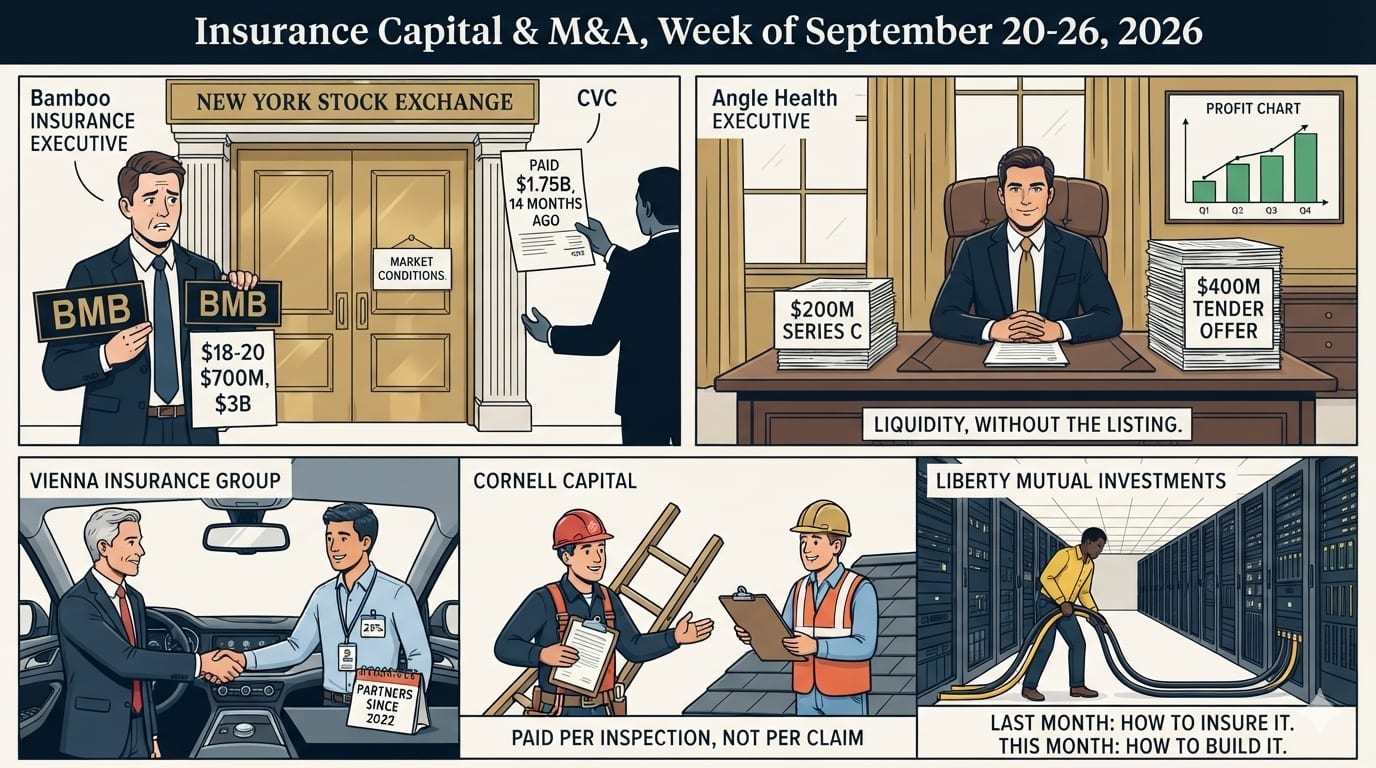
$1.1B+ in disclosed capital | 5 primary transactions + 3 special situations + 2 capital formation items + 2 distribution deals | An insurtech pulls a $700 million IPO at a $3 billion valuation while a health benefits platform closes $600 million privately at $2.7 billion in the same week
Two transactions tell the story, and they point in opposite directions.
Bamboo Insurance set terms on September 14 to raise up to $700 million at a valuation above $3 billion, applied to list on the NYSE, and was slated to begin trading September 23. On September 22 it postponed, citing market conditions. CVC Capital Partners had bought control from White Mountains at a $1.75 billion valuation last year, so the listing was an attempted markup that public investors declined to confirm.
Four days earlier, Angle Health announced $600 million at a $2.7 billion valuation. It closed. And $400 million of that total was a tender offer, meaning private capital performed the exact function an IPO performs, providing liquidity to existing shareholders, without any of the public market’s pricing discipline.
Nearly identical amounts. Nearly identical valuations. One got done privately and one did not get done publicly.
That contrast defines the week. Orion180 is still trading below the $12 it priced at, itself 25% under its roadshow range. Safepoint withdrew an IPO in June. Holtec Nuclear postponed one the same week as Bamboo. Meanwhile Snorkel AI raised $350 million at $3.5 billion, Savvy Wealth raised $100 million, Corridor launched with $25 million from Bain Capital Ventures, and Crane Venture Partners closed $484 million in fresh fund capital while deepening its relationship with MassMutual Ventures.
Underneath the financing story, strategic buyers kept acquiring capability rather than premium. Vienna Insurance Group converted a four-year telematics partnership into a 25% ownership stake. Cornell Capital bought the field services business that determines how fast property claims become decisions. And Liberty Mutual Investments led a preferred investment into data center power infrastructure.
GILAD SHAI ON THE WEEK'S DEALS — WHAT THE NUMBERS DON'T SAY
1. Angle Health (USA)
$600M at a $2.7B Valuation | $200M Series C Plus a $400M Tender Offer | Date: September 18, 2026
What Happened
Angle Health, the San Francisco AI-native healthcare benefits platform, announced a $600 million equity financing at a $2.7 billion valuation, structured as a $200 million Series C financing and a $400 million tender offer.
The round was led by Vitruvian Partners, with new investor Town Hall Ventures and existing investors Blumberg Capital, Portage Ventures, PruVen Capital and Y Combinator. Closing was expected within the month.
The company was founded in 2021 by former Palantir engineers Ty Wang, chief executive, and Anirban Gangopadhyay. It now serves more than 5,000 employers with customized health plans available in 47 states, and reports nearly $1 billion in annualized premium equivalents.
The financial profile is unusual for a company at this stage. Angle Health reports 120% year-over-year growth alongside four consecutive quarters of both EBITDA and GAAP net income profitability. Its renewal pricing runs at median year-over-year increases of 5% to 7%, against a median increase of 18% for small and midsize businesses per a June 2026 Morgan Health study. The financing comes less than ten months after its Series B.
The company’s Benefit Builder platform allows brokers to generate firm, underwritten quotes in minutes from a census alone, customize plans in real time, and access what the company describes as the industry’s first Health Scorecard.
Jeremy Gelber, partner at Vitruvian, said Angle Health had replaced the archaic systems and manual workflows of a century-old industry with a platform built for the AI era. Vitruvian manages over $23 billion in active funds and has backed CFC, Darktrace, Wise and Skyscanner.
- Lead investor: Vitruvian Partners; Jeremy Gelber, Partner
- New investor: Town Hall Ventures
- Existing investors: Blumberg Capital, Portage Ventures, PruVen Capital, Y Combinator
- Founders: Ty Wang (CEO), Anirban Gangopadhyay, both former Palantir engineers
Use of Funds
- Continue investment in the AI-native technology platform and care navigation
- Rebuild underlying infrastructure and pathways to care
- Provide liquidity to existing shareholders through the $400 million tender offer
Strategic Thesis
The structure is the most interesting element, and it is the reason this transaction belongs at the top of the report rather than in a funding roundup.
Two thirds of the $600 million is a tender offer. That is not growth capital. It is liquidity for existing shareholders and employees, which is the single function an initial public offering performs that private rounds historically could not replicate. Angle Health got it without listing, without a roadshow, without quarterly reporting, and without submitting its valuation to public market discipline.
Bamboo Insurance attempted the public version of the same thing in the same week and could not complete it.
The underlying business explains why investors were willing. Four consecutive quarters of GAAP profitability at 120% growth is a rare combination, and it removes the question that sank the insurance listings this month. Orion180 and Bamboo both asked public markets to fund growth toward profitability. Angle Health is already there.
The pricing data is the operating proof. Median renewal increases of 5% to 7% against a market median of 18% is either genuinely better risk selection and care management, or it is underpricing that will surface later. Four quarters of profitability argues for the former, though the test is another two renewal cycles.
Why It Matters
- A $400 million tender offer inside a private round is private capital directly substituting for the liquidity function of an IPO, at a moment when three insurance-adjacent listings have been pulled or priced below range.
- Four consecutive quarters of EBITDA and GAAP net income profitability at 120% growth is the profile the failed insurance IPOs did not have, and it is why this round cleared while theirs did not.
- Renewal increases of 5% to 7% against an 18% market median is a concrete, checkable operating claim in a category where most differentiation claims are unfalsifiable.
Competition
- Direct competitors: Gravie, Sidecar Health and Collective Health offer alternative health benefit structures to the same small and midsize employer market.
- Category competitors: Traditional carriers including UnitedHealth, Aetna and Cigna compete for the same employer groups through conventional fully insured and level-funded products.
- Emerging dynamic: Employers face the largest increase in health insurance costs in two decades per the Wall Street Journal, which is expanding the addressable market for alternatives faster than incumbents are repricing.
Market Consequences
For small and midsize employers, an alternative carrier with four quarters of profitability behind it is a materially more credible counterparty than a venture-funded competitor burning capital. For brokers, a platform generating firm underwritten quotes in minutes from a census changes the economics of quoting small groups. For competing health benefits platforms, a $2.7 billion private mark set by a profitable company raises the bar on what growth alone will command.
Bottom line: Bamboo tried to raise $700 million publicly at $3 billion and pulled it. Angle Health raised $600 million privately at $2.7 billion and closed it, including $400 million of shareholder liquidity. The private market did the job the public market refused.
2. Bamboo Insurance (USA)
IPO Postponed | $700M at a $3B+ Valuation, Pulled the Day Before Trading | Date: September 22, 2026
What Happened
Bamboo Insurance Services, Inc., the Midvale, Utah homeowners managing general underwriter controlled by CVC Capital Partners, postponed its initial public offering, citing market conditions. Bloomberg first reported the decision on September 22, one day before the company was slated to begin trading.
Bamboo had set a target price range of $18 to $20 on September 14 for an offering of 35 million shares, which would have raised up to $700 million at a valuation above $3 billion. It had applied to list on the New York Stock Exchange under the symbol BMB. The offering consisted of secondary shares to be sold by affiliates of CVC Capital Partners and White Mountains Insurance Group, meaning no proceeds would have reached the company.
The valuation arc matters. Bamboo was founded in 2018 and valued at $1.75 billion when CVC-advised funds purchased a controlling stake from White Mountains last year. The IPO sought to establish a mark above $3 billion, roughly a 71% step up in under a year.
Bamboo declined to comment on the rationale. Sources indicated the decision was tied to market conditions and that the company would continue to evaluate options, with the listing potentially revived later.
The context is a broader stall. Holtec Nuclear Corp postponed its own IPO within days, also citing market conditions. Florida carrier Safepoint withdrew a planned IPO in June. Only three companies debuted in the typically active period after Labor Day.
- Issuer: Bamboo Insurance Services; John Chu, CEO
- Controlling shareholder: CVC Capital Partners
- Selling shareholders: Affiliates of CVC Capital Partners and White Mountains Insurance Group
- Terms set September 14: 35 million shares at $18 to $20, NYSE: BMB
Strategic Thesis
This report covered Bamboo’s roadshow launch last week and observed that it would price days after Orion180 broke issue in the same sector, with very little room to argue the comparison away. It did not price at all.
The structural problem was the secondary structure. Every dollar would have gone to CVC and White Mountains rather than to Bamboo. Public investors were being asked to fund a sponsor’s exit at a 71% markup to the price that sponsor paid fourteen months earlier, in a sector where the most recent comparable had just priced 25% below its range and traded down.
The Insurer reported an additional factor worth weighing: concerns that softening insurance rates could produce prolonged pressure on industry returns. That is a different objection from valuation. It questions whether homeowners underwriting results hold at all as rate adequacy erodes, which affects every insurance listing in the queue rather than just this one.
The 2026 IPO market overall has been strong in volume and weak in performance. US listings raised $161.4 billion this year, the highest since 2021, yet five of the ten largest trade below their offer prices and the cohort’s weighted average return of roughly 13% trails the S&P 500’s 15%.
Why It Matters
- A pure secondary offering asking public markets to fund a 71% sponsor markup in fourteen months was always the most demanding structure to bring in a soft window, and the window closed before it priced.
- Three insurance-adjacent listings have now been pulled, withdrawn or priced well below range in four months, which effectively closes the near-term IPO path for private insurance platforms seeking sponsor liquidity.
- Concerns about softening insurance rates, as distinct from valuation, question underwriting durability across the sector rather than the pricing of any single deal.
Competition
- Direct competitors: Orion180, Kin Insurance and Slide Insurance write comparable catastrophe-exposed homeowners business through technology-enabled platforms.
- Category competitors: Admitted homeowners carriers competing for the same properties where appetite remains.
- Emerging dynamic: Hellman & Friedman-backed Hub International filed confidentially in June and now faces a materially less receptive market than when it filed.
Market Consequences
For CVC, the position remains illiquid at a private mark that public markets declined to validate. For Hub International and other sponsors with filings in progress, Bamboo’s outcome is the second clear signal in two weeks. For homeowners platforms weighing a listing, the practical conclusion is that public markets currently require demonstrated profitability rather than growth toward it.
Bottom line: CVC paid $1.75 billion for control fourteen months ago and asked public markets to confirm $3 billion. They declined, and the deal never priced.
3. Vienna Insurance Group / Dolphin Technologies (Austria)
Undisclosed | 25% Stake Converting a Four-Year Telematics Partnership Into Ownership | Date: September 23, 2026
What Happened
Vienna Insurance Group (VIG) acquired a 25% stake in Vienna-based Dolphin Technologies, a telematics provider. The investment builds on a partnership that began in 2022 and is intended to advance AI-powered telematics across VIG’s Central and Eastern European operations. Closing remains subject to approval by the Austrian Federal Competition Authority.
- Investor: Vienna Insurance Group
- Target: Dolphin Technologies, Vienna
- Structure: 25% minority stake, partnership dating to 2022
Strategic Thesis
A 25% stake is a deliberate structure rather than a compromise. It gives VIG influence over Dolphin’s product roadmap and priority access to telematics capability across CEE markets, while leaving Dolphin free to serve other customers and retain the scale that makes its data valuable.
The pattern is familiar from this report. AXA XL bought S-RM after fifteen years as a client and investor. FM acquired FortressFire. Munich Re bought At-Bay after nine years of reinsuring it. In each case a carrier converted a supplier relationship into an ownership position once the capability proved central rather than peripheral. VIG is doing the same at a smaller scale and with a lighter structure.
Telematics specifically sits at the intersection of risk segmentation, claims response and product design. For a group operating across Central and Eastern European markets with varied motor regulation and data infrastructure, owning a quarter of the supplier is a way to align development priorities with its own underwriting needs.
Why It Matters
- Four years of partnership before taking equity means VIG is buying a capability it has already validated in production, which removes most of the diligence risk in a technology investment.
- A 25% stake preserves Dolphin’s independence and third-party customer base, protecting the data scale that makes the platform useful, which full acquisition would likely have damaged.
- Central and Eastern European motor markets have lower telematics penetration than Western Europe, making this a position in an expanding rather than mature category.
Competition
- Direct competitors: Octo Telematics, Cambridge Mobile Telematics and LexisNexis Risk Solutions supply connected vehicle data and telematics to the same insurer customers.
- Category competitors: Fleet management and mobility data platforms serving insurers and automotive manufacturers through adjacent channels.
- Emerging dynamic: Insurers are taking minority stakes in technology suppliers rather than acquiring them outright, securing influence and access without absorbing the supplier’s other customer relationships.
Market Consequences
For standalone telematics vendors, VIG’s structure suggests insurers will pay for influence without demanding exclusivity, which preserves the multi-carrier model most of these businesses depend on. For competing CEE insurers, VIG now holds a privileged position with a regional telematics supplier. For Dolphin, a 25% insurer shareholder brings distribution and validation while leaving it free to sell elsewhere.
Bottom line: VIG spent four years as Dolphin’s customer before buying a quarter of it. Twenty-five percent buys influence over the roadmap without breaking the third-party data scale that makes the product work.
4. Cornell Capital / Hancock Claims Consultants (USA)
Undisclosed | Buying the Field Services Layer of Property Claims | Date: September 23, 2026
What Happened
Cornell Capital acquired Hancock Claims Consultants, a national provider of outsourced field services for residential property and casualty claims. Financial terms were not disclosed. Hancock supports carrier claims operations through field inspections and related services. Cornell described the acquisition as an investment in a category leader within financial services and insurance-enabled outsourced operations.
Strategic Thesis
Property claims run on field data, and field data runs on someone physically getting onto a roof. Hancock sits at that point in the process, between first notice of loss and the adjuster’s decision, which means the speed and quality of its work directly affects cycle time, loss adjustment expense and settlement accuracy.
That position is attractive to private equity for the same reason Altaline’s acquisition of Risk & Regulatory Consulting was two weeks ago: it is operational infrastructure rather than risk. Hancock does not underwrite anything. It gets paid per inspection regardless of whether the claim is paid, which makes revenue a function of claims volume rather than claims outcome. In a period of elevated catastrophe frequency, claims volume is the more reliable variable.
The consolidation logic follows. Field inspection networks are fragmented, regional and labor-constrained. A capitalized platform can acquire geographic coverage, standardize data capture, and sell carriers a single national vendor rather than a patchwork.
Why It Matters
- Field services revenue scales with claims volume rather than claims outcome, which makes it countercyclical to carrier profitability in the same way regulatory examination services are.
- Standardized inspection data captured at scale becomes an underwriting input over time, not merely a claims cost, which is where the strategic value exceeds the services margin.
- This is the second private equity acquisition of insurance operational infrastructure this month, following Altaline and Risk & Regulatory Consulting, suggesting a deliberate category thesis rather than isolated opportunism.
Competition
- Direct competitors: OnSightPRO, Sedgwick’s field services operation and regional independent property inspection networks serve the same carrier claims departments.
- Category competitors: Claims third-party administrators, independent adjuster platforms and geospatial property risk providers address overlapping parts of the same workflow.
- Emerging dynamic: Aerial imagery and AI-assisted damage assessment are compressing demand for some physical inspections while raising the value of the ones that still require a person on site.
Market Consequences
For carriers, a consolidating field services market means fewer, larger vendors and a likely shift from per-inspection pricing toward platform arrangements. For competing inspection networks, a capitalized acquirer raises the bar on geographic coverage and technology investment. For adjusters and independent contractors supplying these networks, consolidation typically compresses per-job economics while increasing volume stability.
Bottom line: Hancock gets paid whether or not the claim is paid. That makes field inspection a volume business attached to a loss business, which is exactly the risk profile private equity wants next to insurance without being in it.
5. Corridor (USA)
$25M Seed | An AI-Native Benefits Brokerage for Employers With 1 to 500 Workers | Date: September 21, 2026
What Happened
Corridor, a New York AI-native benefits brokerage built for small businesses, launched with $25 million in seed funding led by Bain Capital Ventures, with participation from BoxGroup and Definition Capital and angel investors including founders and executives from OpenAI, Modal, Ramp, Scale AI, Oscar, Rogo, Decagon, Medallion, Reducto and Tennr.
Corridor was founded by chief executive Nikhil Aggarwal, who previously led growth at ICHRA platform Venteur; Jason Dong, a co-founder of pharmaceutical payments company Mural Health; and Jackson Wagner and Eric Qian, who built AI and data products at Scale AI. Aggarwal and Dong were partners at Cold Start when Wagner and Qian pitched them an earlier clinical AI startup, and the four chose the larger opportunity instead.
The company sells to employers with 1 to 500 workers. An owner describes the team, budget and goals to a licensed Corridor advisor; AI agents then gather quotes, compare viable options and flag risks, and employees choose their own plans. Agents also check provider networks, help schedule care and keep insurance details current.
Corridor cites nearly 6 million US businesses with fewer than 50 employees, employing more than 36 million Americans, whose workers pay 57% higher deductibles than employees of large companies. Only about half of small employers offer health benefits at all.
- Founders: Nikhil Aggarwal (CEO), Jason Dong, Jackson Wagner, Eric Qian
- Lead investor: Bain Capital Ventures (Ryan Kim, Partner)
- Participating: BoxGroup, Definition Capital, angel investors
Use of Funds
- Scale the licensed advisor team supported by AI agents
- Prepare for the fourth quarter, when Aggarwal says 80% of small businesses choose their health plans
- Extend agent coverage across quoting, placement and year-round employee support
Strategic Thesis
The problem Corridor names is economic, not technical. A 20-person account pays a brokerage a fraction of a large account’s commission while consuming roughly the same hours to quote, place and service. Traditional brokerages responded rationally, by giving small accounts less attention.
Ryan Kim of Bain Capital Ventures put the thesis in one sentence: administrative cost is the part of a premium that buys no care, and distribution is where much of it accumulates because the work is still manual. If agents do the quoting and servicing, a licensed advisor can profitably carry accounts the incumbent model writes off.
Corridor pairs directly with Angle Health this week. Angle Health raised $600 million to be the health plan for small and midsize employers. Corridor raised $25 million to be their broker. The same cost problem is funding both sides of the transaction.
Why It Matters
- It tests whether AI changes the unit economics of a service business rather than only its interface; the evidence will be margin per small account, not product features.
- A $25 million seed with angels from OpenAI, Scale AI, Ramp and Oscar gives Corridor depth in exactly the AI, financial operations and health insurance skills the model requires.
- Launching into fourth quarter open enrollment puts the model under real volume immediately.
Competition
- Direct competitors: Ignition Benefits and Nava Benefits pursue small and midsize employers with comparable AI-assisted brokerage models; Alliant Insurance Services agreed to acquire Nava in August.
- Category competitors: Gallagher, Marsh McLennan Agency and regional benefits brokers serve the same employers through conventional advisory models, generally prioritizing larger accounts.
- Emerging dynamic: Incumbents are buying the capability rather than building it, as Alliant did with Nava, which gives venture-backed AI brokerages a visible exit path.
Market Consequences
For small employers, an advisor model supported by agents promises the plan comparison and year-round support usually reserved for larger accounts. For traditional brokers, a lower-cost service model threatens the small-account business they underserved rather than abandoned. For acquirers, Alliant’s purchase of Nava suggests Corridor will be watched as a future target as much as a competitor.
Bottom line: Small accounts were never unprofitable because of the customers. They were unprofitable because of the paperwork. Corridor is betting agents can remove it.
Special Situation: Snorkel AI (USA)
$350M Series E at $3.5B | Insight Partners Leads an AI Data Infrastructure Round | Date: September 22, 2026
What Happened
Snorkel AI announced a $350 million Series E financing at a $3.5 billion valuation, led by Insight Partners and S32, with participation from Third Point, March, Blumberg Capital, Allegis, Standard VC, Frontline, and existing investors including Addition, Lightspeed, Greylock, GV, P7, Wells Fargo, Walden Catalyst Ventures and Factory.
Snorkel AI develops training data and simulated environment infrastructure for AI labs and enterprises.
Why This Is a Special Situation Rather Than a Core Insurance Deal
Snorkel is not an insurance company, and the insurance relevance is indirect. Its platform supports AI development across regulated industries, and the company’s earlier materials identify insurance among the enterprise sectors using its technology. QBE Ventures invested in Snorkel in 2024, not in this round, so the insurance investor connection is historical rather than current.
It is included for two reasons. Insight Partners, a tracked investor, led it one week after leading Luzern Risk’s $45 million captive infrastructure round, which indicates an active deployment period at a firm whose insurance activity this report follows. And the training data layer is where model quality for regulated underwriting and claims applications is actually determined, which makes it infrastructure the insurance industry depends on without owning.
Bottom line: Insight Partners led a $350 million round in the training data layer one week after leading a captive infrastructure round. The insurance connection is indirect, but the dependency is not.
Special Situation: Savvy Wealth (USA)
$100M Series C at a $600M Valuation | Allianz Life Ventures Among Existing Investors | Date: September 9, 2026
Why this is a Special Situation rather than a core insurance deal: Savvy Wealth is an AI-native registered investment advisor platform. It is not an insurance company, does not underwrite risk and does not distribute insurance products. It is included because two insurance-affiliated investors hold positions, Allianz Life Ventures in this round and Brewer Lane Ventures in the prior one, and because the advisor relationships Savvy is consolidating are the same ones carriers depend on to distribute annuity and life products.
What Happened
Savvy Wealth, the AI-native registered investment advisor platform, raised $100 million in Series C funding at a $600 million valuation, led by Halo Fund, the investment firm of Qualtrics founder Ryan Smith and Accel general partner Ryan Sweeney.
Existing investors participating included Thrive Capital, Industry Ventures, Canvas Prime, Index Ventures, Vestigo Ventures, Allianz Life Ventures, Euclidean Capital, House Fund and Alumni Ventures.
Founded in 2021 by Ritik Malhotra and Muller Zhang, the company has raised approximately $205.8 million in total. It reports being on track to reach $100 million in annual recurring revenue by year-end 2026, up from $10 million in January 2025.
Its prior $72 million Series B, led by Industry Ventures, included Brewer Lane Ventures, a tracked insurance investor, among participants.
Why It Matters
Growth from $10 million to a projected $100 million in ARR inside 24 months is the kind of trajectory that attracts insurance-affiliated capital into wealth platforms. Allianz Life Ventures and, in the prior round, Brewer Lane both hold positions in a business that competes for the same advisor relationships insurers rely on for annuity and life distribution. That is a hedge as much as an investment: if advice migrates to AI-native platforms, the carriers backing those platforms retain a distribution path.
Bottom line: An insurer-affiliated investor holds a position in the platform that may reshape how advisors distribute the products that insurer sells. That is a distribution hedge.
Special Situation: Liberty Mutual Investments / Mission Critical Group (USA)
Undisclosed Preferred Investment | Insurance Capital Into Data Center Power Infrastructure | Date: September 18, 2026
Why this is a Special Situation rather than a core insurance deal: Mission Critical Group builds electrical infrastructure for data centers, manufacturing plants and energy facilities. It is not an insurance company. It is included because Liberty Mutual Investments, the asset manager for Liberty Mutual Group’s insurance float, led the round.
What Happened
Mission Critical Group (MCG), the Frisco, Texas provider of electrical infrastructure for data centers, manufacturing plants and energy infrastructure, closed a preferred investment led by Liberty Mutual Investments (LMI), the investment firm for Liberty Mutual Group. Invesco Senior Secured Management, Aventail Capital Group and Brigade Capital Management also participated. Financial terms were not disclosed.
MCG is a portfolio company of Emerald Lake Capital Management. It combines engineering, US manufacturing and lifecycle support across electrical equipment, modular power solutions, power generation systems and transformers. Jeff Drees, CEO, said the investment endorses the platform and the growth opportunities ahead.
LMI’s Energy & Infrastructure team led the financing. LMI oversees more than $130 billion of long-term capital globally for Liberty Mutual Group. Jefferies served as exclusive placement agent, Kirkland & Ellis advised MCG, and BDO served as financial adviser to LMI, with Paul Hastings and Davis Polk also advising.
Why It Matters
The distinction worth drawing is between Liberty Mutual Investments and Liberty Mutual Strategic Ventures. LMI is the asset manager deploying more than $130 billion of insurance float. LMSV is the corporate venture arm running a $200 million Fund II. This is float deployment into infrastructure, not a strategic technology bet.
That makes it the more consequential of the two activities. Insurance float has to be invested somewhere, and the duration profile of data center power infrastructure, long-lived assets with contracted demand, matches long-tail insurance liabilities well. Marsh launched a $10 billion data center property exchange one month ago because traditional capacity could not absorb the risk. Now insurance capital is financing the buildout itself, on the asset side rather than the liability side.
Bottom line: A month ago the industry was working out how to insure data centers. Now insurance float is financing the power infrastructure they run on. Same exposure, opposite side of the balance sheet.
Capital Formation
Crane Venture Partners (September 16): Crane Venture Partners announced $484 million raised across four vehicles: Crane III at $169 million, Crane APAC I at $150 million, Crane US I at $100 million, and Crane Opportunity Fund I at $65 million. The announcement, issued through MassMutual, describes the firm deepening its strategic relationship with MassMutual Ventures while building a global inception-to-seed platform spanning Europe, North America, India and Asia-Pacific.
Salty (Form D filed September 22): Salty reported approximately $4 million of equity financing in a Form D filed with the SEC on September 22, indicating 24 investors. The offering began in March 2026, so the filing date is not the financing date. Salty describes itself as an AI-native insurance provider for households with car payments, operating as a digital agency and distribution platform that compares coverage, monitors rates and supports customers through the policy lifecycle. Insurance products are offered through Embedded Insurance Agency LLC, a wholly owned licensed producer subsidiary. The company reacquired the Salty brand after its earlier acquisition by CDK Global and relaunched in August as an AI-native platform.
Brokerage and Distribution
Maridea Wealth Management / River Cities Financial Services and Dietz, Futrell & Walters Insurance (September 22, USA): Maridea acquired both firms, establishing its first Ohio presence. The affiliated businesses are based in the Marietta area and provide personal, business and benefits insurance alongside wealth, retirement and estate planning. Maridea manages approximately $2 billion in assets across 12 offices. Michael Anthony joins as senior investment advisor and managing partner, and Dustin Becker becomes director of insurance.
The convergence theme continues. Higginbotham acquired a retirement and wealth firm two weeks ago. Maridea is running the same trade from the opposite direction, a wealth manager acquiring insurance distribution rather than a broker acquiring wealth advisory. Both are assembling the same combination around the same client.
Nord Insuretech Group / Sum-it (September 24, Norway): Nord Insuretech Group AB acquired Norwegian insurance distributor Sum-it AS, which offers a portfolio spanning vehicle, property and other insurance products. The transaction expands Nord Insuretech’s Norwegian distribution footprint and adds local insurance relationships to its Nordic platform.
FINRA disclosure: This report is for informational purposes only and does not constitute investment advice or a solicitation.