Insurance & InsurTech Investment Intelligence Report: Week of July 19-25, 2026
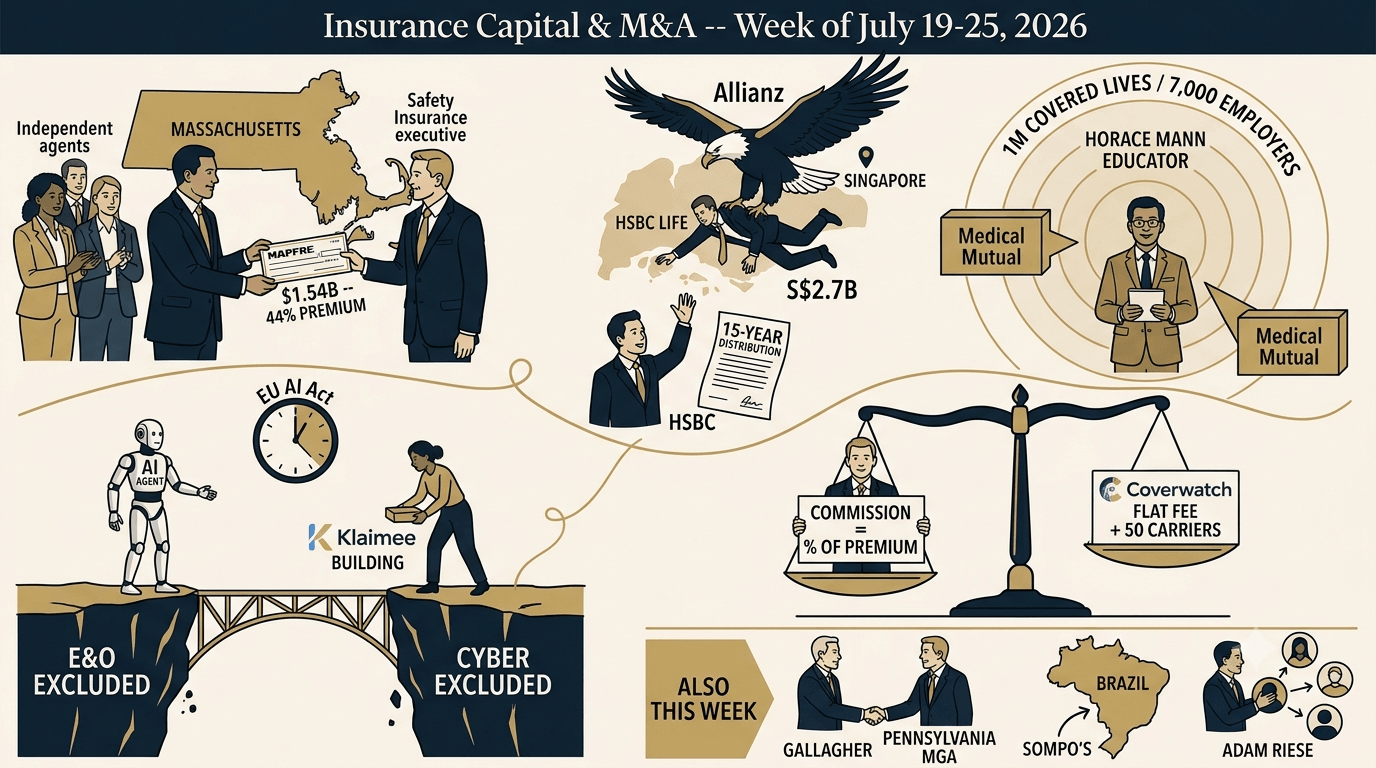
$4.09B+ in disclosed capital | 5 transactions | Two global carrier M&A deals, two education and teacher-focused benefits, two AI insurance platforms at seed stage
The week’s capital split cleanly between two layers. At the top: Mapfre acquiring Safety Insurance Group for $1.54 billion, giving Spain’s largest insurer a dominant position in New England P&C; and Allianz acquiring HSBC Life Singapore for €2 billion, adding bancassurance distribution in Asia’s wealthiest market. In the middle: Horace Mann acquiring two Medical Mutual of Ohio businesses for $240 million, extending its educator-focused benefits platform to one million covered lives. At the seed layer: two AI-native insurance startups raised capital in the same week to solve adjacent but distinct problems: Klaimee insuring autonomous AI agents against liability exposure, and Coverwatch replacing commission-based commercial brokerage with a flat-fee AI platform. Together they describe an industry where global carriers are acquiring distribution scale through M&A while early-stage companies attack the structural conflicts embedded in how insurance is sold and governed.
GILAD SHAI ON THE WEEK'S DEALS — WHAT THE NUMBERS DON'T SAY
1. Mapfre / Safety Insurance Group (Spain / USA)
$1.54B All-Cash Acquisition | New England P&C Market Consolidation Date: July 23, 2026
What Happened
Mapfre S.A.: Spain’s largest insurer, the largest Spanish-owned insurance company in the world, and sixth largest insurer in Europe by revenue, with more than 30,000 employees and €34.5 billion in 2025 revenue: agreed to acquire Safety Insurance Group, Inc. (NASDAQ: SAFT) in an all-cash transaction valued at approximately $1.54 billion. Safety shareholders will receive $105 per share in cash, representing a 44% premium to Safety’s closing stock price on July 23, 2026. The transaction was unanimously approved by the boards of both companies. Safety is one of the leading property and casualty insurers in Massachusetts and across New England, operating primarily in personal auto, homeowners, and commercial lines in Massachusetts, New Hampshire, and Maine. Following the acquisition, Safety will become a wholly owned subsidiary of Mapfre U.S.A. Corp., operating as a sister company to Mapfre’s existing U.S. subsidiaries and continuing under its established brand. George Murphy, Safety’s Chairman and CEO, confirmed the management team is expected to remain actively involved post-close. The deal is expected to close in Q1 2027, subject to Safety shareholder approval and regulatory clearances including the Massachusetts Commissioner of Insurance and HSR antitrust review. The deal was announced alongside Mapfre’s strong H1 2026 results: net profit of €624 million (up 9.4% year-on-year), premiums exceeding €16.1 billion, non-life combined ratio of 92.8%, and shareholders’ equity of approximately €9.6 billion.
- Acquirer: Mapfre S.A. (via Mapfre U.S.A. Corp.): Antonio Huertas, Executive Chairman
- Safety CEO: George Murphy (Chairman and CEO, Safety Insurance Group)
- Target: Safety Insurance Group, Inc. (NASDAQ: SAFT), Massachusetts/New England P&C
Use of Funds (for Mapfre)
- Strengthen leadership position across New England P&C markets
- Expand Mapfre USA’s market presence in Massachusetts and adjacent states
- Generate value through combined underwriting discipline and distribution capabilities
Strategic Thesis
Mapfre’s H1 2026 results gave it the confidence and the capital to move. With €9.6 billion in shareholders’ equity, a 92.8% non-life combined ratio, and net profit up 9.4%, Mapfre entered the second half of 2026 with a strong balance sheet and a clear strategic gap: despite being the largest Spanish insurer globally and a major Latin American player, its U.S. footprint has been limited. Safety fills that gap precisely. Safety is not a distressed asset being sold at a discount: it is a 44% premium transaction, but it has faced headwinds. AM Best revised Safety’s outlook in early 2026 after consecutive storms produced $42.7 million in property claims in Q1 2026, contributing to a 113.4% combined ratio for the quarter. The board had been under pressure and insiders had been selling. Mapfre is buying a platform with established brand recognition, deep independent agent relationships, and a market leadership position in Massachusetts, at a moment when that platform’s near-term results are weaker than its long-term franchise value. Antonio Huertas described the rationale directly: the U.S. acquisition will “strengthen our leadership position in several states in the Northeast, generating greater value for our clients and shareholders.”
Why It Matters
- The 44% premium reflects Safety’s franchise value and the scarcity of established, independent regional P&C carriers in New England. Mapfre is paying for the brand, the agent relationships, and the market position, not for the trailing quarterly results.
- Mapfre’s strong H1 2026 results: 92.8% non-life combined ratio, €624 million net profit: demonstrate that the acquirer has the underwriting discipline to absorb a platform with near-term loss ratio pressure and manage it toward its long-term earnings potential.
- Safety continues under its established brand, preserving its identity, policyholder relationships, and independent agency distribution network. The integration model mirrors what carriers have learned from prior regional P&C acquisitions: the brand is the asset.
Competition
- Direct competitors (New England P&C): Amica Mutual, Arbella Insurance, Hanover Insurance Group, Progressive, State Farm, The Hartford
- Category competitors: National carriers competing in Massachusetts personal lines (Geico, Allstate, Liberty Mutual in its home state)
- Market dynamic: Massachusetts auto and homeowners markets are among the most regulated and competitive in the US. Safety’s established independent agent relationships are difficult to replicate quickly for new entrants.
Market Consequences
Mapfre becomes a meaningful New England P&C market participant through the acquisition, entering with Safety’s brand recognition and agent relationships rather than building from scratch. For independent agents in Massachusetts, New Hampshire, and Maine, Mapfre’s ownership provides a better-capitalized carrier backer while preserving the brand and commission structures they know. For competing regional carriers in New England, Mapfre’s ownership of Safety brings a better-capitalized and internationally diversified balance sheet behind a competitor that was previously a standalone public company with limited capital flexibility. The deal also sets a benchmark for New England regional P&C carrier valuations: 44% premium to trading price for a carrier facing near-term weather headwinds suggests robust demand for regional market positions from international carriers seeking U.S. distribution access.
Bottom line: Mapfre paid a 44% premium for Safety Insurance’s New England franchise at a moment when quarterly results were under pressure. The price reflects the franchise value, not the trailing combined ratio. International carriers seeking U.S. distribution access are paying significant premiums for established regional platforms.
2. Allianz / HSBC Life Singapore (Germany / Singapore)
€2B (~$2.3B) | Life and Health Insurance with 15-Year Bancassurance Distribution Date: July 24, 2026
What Happened
Allianz SE agreed to acquire HSBC Life (Singapore) Pte. Ltd. from HSBC Insurance (Asia-Pacific) Holdings Limited for S$2.7 billion ($2.09 billion / €1.8 billion), with an additional S$200 million ($155 million) upfront payment for a 15-year exclusive bancassurance distribution partnership with HSBC Bank (Singapore). Total combined consideration: approximately €2 billion (~$2.3 billion). The deal was announced on July 24, 2026, and is expected to close in H1 2027, subject to approval from the Monetary Authority of Singapore (MAS). Allianz Asia Holdings, an Allianz subsidiary, is the acquiring entity. The 15-year exclusive partnership grants Allianz the right to distribute life, health, protection, and retirement products to HSBC Bank Singapore’s retail banking and wealth customers, providing access to HSBC Singapore’s established affluent and mass-affluent client base. HSBC Life Singapore generated approximately €80 million in operating profit in 2025 and has approximately €1.2 billion in comprehensive equity. Allianz expects to generate a double-digit return on investment in the medium term. Oliver Bäte, Allianz CEO: “Singapore serves as our Asia-Pacific headquarters and is central to our global growth strategy.” HSBC CEO Georges Elhedery’s strategy of simplifying HSBC’s business model and focusing on its core banking and wealth management strengths drives the divestiture.
- Acquirer: Allianz SE (via Allianz Asia Holdings); Oliver Bäte, CEO
- Target: HSBC Life Singapore Pte. Ltd. (life and health insurance, Singapore)
- Seller: HSBC Insurance (Asia-Pacific) Holdings Limited
- Bancassurance partner: HSBC Bank (Singapore): 15-year exclusive distribution
Use of Funds (for Allianz)
- Expand Allianz’s customer base in Singapore and broader APAC life and health markets
- Distribute protection, health, and retirement products through HSBC Singapore’s affluent client relationships
- Leverage PIMCO and Allianz Global Investors capabilities for the acquired book’s asset management
Strategic Thesis
Singapore is the wealthiest market in Southeast Asia by per-capita income, a global wealth management hub with strong regulatory infrastructure, and the city where Allianz has chosen to base its Asia-Pacific headquarters. The HSBC Life acquisition gives Allianz three things simultaneously: an established life and health insurance carrier with proven local regulatory relationships, a 15-year exclusive bancassurance channel through HSBC Singapore’s retail and wealth banking platform, and a customer base that sits at the intersection of Singapore’s domestic wealth accumulation and its inbound international private banking flows. The S$200 million upfront payment for the distribution agreement is significant: it puts a price on the bancassurance channel explicitly, confirming that Allianz values the distribution access as much as the insurance carrier. The PIMCO and Allianz Global Investors connection is worth noting: the acquired book’s asset management, with €1.2 billion in comprehensive equity, flows naturally into Allianz’s investment management platform. The deal comes after Allianz’s 2024 attempt to acquire Income Insurance collapsed when the Singapore government intervened over social mission concerns. HSBC Life is a different asset type. A bancassurance-focused carrier without the social obligations that made the Income Insurance deal politically complex. Allianz appears to have learned from the earlier episode and structured a transaction designed for clean regulatory approval.
Why It Matters
- The S$200 million explicit payment for 15-year distribution access confirms that bancassurance channels in Asia command independent strategic premium beyond the carrier itself. Allianz is paying for distribution, not just assets.
- HSBC CEO Georges Elhedery’s simplification strategy: divesting non-core insurance in markets where HSBC is not the anchor insurer: creates acquisition opportunities in Hong Kong and potentially other APAC markets where similar dynamics apply. Allianz is well-positioned for the next opportunity.
- Allianz’s ability to leverage PIMCO and Allianz Global Investors for the acquired book’s asset management turns the transaction from a pure insurance deal into an integrated financial services platform play.
Competition
- Direct competitors (Singapore life and health insurance): AIA (dominant market position), Great Eastern Life, Prudential Singapore, Manulife Singapore, Singlife
- Category competitors: Digital-first life insurance entrants targeting Singapore’s technology-forward younger demographics (FWD Life Singapore, Singlife digital products)
- Post-transaction competitive dynamic: Allianz with HSBC’s bancassurance distribution and PIMCO’s investment platform creates a materially different competitive profile from Allianz Singapore pre-acquisition.
Market Consequences
HSBC’s divestiture of its Singapore life insurance unit signals a pattern: global banks that are not structurally committed to being insurance carriers in Asia are optimizing their balance sheets. Standard Chartered, UOB, and DBS all operate bancassurance arrangements with insurance partners rather than owned carriers. HSBC’s divestiture of HSBC Life Singapore, combined with its retention of the 15-year distribution partnership, is the cleaner model: monetize the insurance balance sheet while preserving the distribution economics. For other APAC insurance carriers seeking bancassurance access, the S$200 million explicit pricing for the HSBC Singapore distribution rights sets a market reference for what 15-year exclusive bancassurance access to a top-tier private banking platform is worth.
Bottom line: Allianz paid S$2.7 billion for HSBC’s Singapore life insurance carrier and S$200 million for the right to distribute through HSBC Singapore for 15 years. The two prices reveal the strategic calculus: the carrier and the channel are worth roughly equal weight in Allianz’s acquisition logic.
3. Horace Mann / Medical Mutual of Ohio (USA)
$240M | Teacher and Educator Benefits Platform Expansion: Two Acquisitions and Reinsurance Date: July 21, 2026
What Happened
Horace Mann Educators Corporation (NYSE: HMN), the leading financial services provider for educators in the United States, announced two agreements with Medical Mutual of Ohio with a combined net purchase price of approximately $240 million. Under the first agreement, Horace Mann acquires Employee Services, LLC (ESI), an employee assistance provider serving workers across behavioral health, personal challenges, and workplace issues, through the purchase of ESI membership interests. Under the second agreement, Horace Mann acquires Reserve National Insurance Company (RNIC), an individual supplemental insurance platform operating in 27 states, through purchase of all outstanding capital stock for approximately $125 million, and separately reinsures MedMutual Life Insurance Company’s group life and disability business while Medical Mutual retains the legal insurance entity. Combined, these businesses: generate nearly $200 million in annual revenue, serve more than one million covered lives across approximately 7,000 employer relationships, and distribute through more than 1,000 agents and brokers. The deals add $20-25 million in net core earnings in the first 12 months post-close. The RNIC valuation is approximately 10x estimated full-year 2026 net income. The ESI transaction is expected to close in Q4 2026; the RNIC acquisition and MedMutual Life reinsurance transaction in Q1 2027.
- Acquirer: Horace Mann Educators Corporation (NYSE: HMN); Marita Zuraitis, President and CEO; Ryan Greenier, CFO
- Seller: Medical Mutual of Ohio
- Acquired entities: Employee Services LLC (ESI), Reserve National Insurance Company (RNIC), group life and disability reinsurance (MedMutual Life)
Use of Funds
- Finance through combination of excess capital and revolving credit facility borrowings ($100-150 million credit draw)
- Maintain leverage below 30%; continue dividend and share repurchase strategy
- Integrate ESI and RNIC into Horace Mann’s educator-focused employer solutions platform
Strategic Thesis
Horace Mann serves K-12 educators and school employees with retirement, protection, and benefits products. A specialized niche with high client loyalty and limited mainstream carrier competition. The Medical Mutual acquisitions extend that specialization in two directions simultaneously: ESI adds an employee assistance layer (behavioral health, workplace support, personal crisis services) that complements the financial protection products Horace Mann already provides to school districts, while RNIC adds an individual supplemental insurance platform that reaches one million covered lives through 7,000 employer relationships outside Horace Mann’s existing distribution. Marita Zuraitis described the logic precisely: “These transactions also reflect the disciplined approach we’ve consistently taken to capital allocation.” At approximately 10x net income for RNIC and near-immediate core EPS accretion for both transactions, Horace Mann is paying disciplined multiples for businesses with established distribution relationships rather than growth premium for speculative platforms. Medical Mutual’s divestiture reflects a similar logic to HSBC’s: a mutual carrier optimizing its capital structure by monetizing non-core operations while retaining the MedMutual Life legal entity.
Why It Matters
- The 1 million covered lives and 7,000 employer relationships acquired through ESI and RNIC represent a distribution expansion that would take years to build organically through Horace Mann’s direct sales force.
- The EAP (Employee Assistance Program) acquisition through ESI addresses a growing area of educator wellbeing that school districts are increasingly prioritizing post-pandemic. The timing of this acquisition reflects both market demand and Horace Mann’s strategic positioning as the benefits partner for educators, not just the financial products provider.
- The immediate accretion to core EPS and the 100 basis point ROE improvement in year one confirms the acquisition discipline: Horace Mann is buying proven cash flows, not speculative growth.
Competition
- Direct competitors (educator benefits): Teachers Insurance and Annuity Association (TIAA) for retirement, MetLife group benefits for employer markets, Principal Financial (which recently acquired Beam Benefits) for small employer benefits
- Category competitors: National EAP providers (Lyra Health, Spring Health, Modern Health) competing in the behavioral health and workplace wellbeing segment
- Post-transaction dynamic: Horace Mann adds behavioral health and supplemental insurance distribution to its educator platform, making it a more complete benefits partner for school districts that historically split these relationships across multiple providers.
Market Consequences
For Medical Mutual of Ohio, the divestitures optimize capital allocation away from businesses that are adjacent to its core health insurance focus but not central to it. ESI and RNIC have strong distribution relationships and established revenues, but they are not health insurance carriers: Medical Mutual’s core identity. Retaining MedMutual Life’s legal entity while reinsuring the business to Horace Mann gives Medical Mutual the accounting flexibility to move the economic risk while preserving the regulatory structure. For Horace Mann, the transaction significantly increases scale in the educator market while diversifying into employer relationships beyond the direct school district channel. The combination of EAP services, supplemental insurance, and retirement products positions Horace Mann to compete more effectively for total benefits relationships with school districts that currently split these services across multiple providers.
Bottom line: Horace Mann spent $240 million to add one million covered lives, 7,000 employer relationships, and behavioral health services to its educator platform. The price is disciplined. The strategic fit is exact. Medical Mutual monetized non-core assets at reasonable multiples.
4. Klaimee (USA)
$5.5M Seed | Insurance for Autonomous AI Agents: Y Combinator and FundersClub Date: July 22, 2026
What Happened
Founded by Ines Boutemadja (CEO, ex-General Manager of SafetyWing, previously built and licensed a Tokio Marine MGA, scaled an insurance startup from $5M to $60M in premiums) and Julien Caton (co-founder), San Francisco-based Klaimee raised $5.5 million in seed funding to build the first purpose-built liability insurance and performance warranty platform for autonomous AI agents. The round was led by Alexander Mittal of FundersClub, with participation from ex/ante, Pioneer Fund, Multimodal Ventures, Kima Ventures, Rebel Fund, Robinhood Ventures, Y Combinator, and angel investors. Klaimee’s platform audits the performance and behavior of autonomous AI agents in enterprise environments, certifies them against risk criteria, provides AI-specific liability insurance coverage for the failure modes those agents produce, and generates the documentation that enterprise legal and procurement teams require before approving agentic AI deployments. The problem Klaimee addresses: major carriers including Berkshire, Chubb, and Travelers are winning state approval to exclude AI liability from standard commercial policies. The ISO CG 40 47 / CG 40 48 endorsements are making AI exclusions the default for Commercial General Liability policies. The EU AI Act, which holds AI deployers liable, is enforcing in August 2026. AI-related lawsuits are up 137% between 2024 and 2025. And 80% of Fortune 500 companies are already deploying AI agents: without insurance that covers them.
- Lead investor: Alexander Mittal, FundersClub
- Participating investors: ex/ante, Kima Ventures, Multimodal Ventures, Pioneer Fund, Rebel Fund, Robinhood Ventures, Y Combinator
- Founders: Ines Boutemadju (CEO), Julien Caton (co-founder)
Use of Funds
- Scale operations and build out the certification and insurance platform
- Expand coverage capacity and carrier partnerships for AI-specific liability
- Develop the documentation framework that enterprise procurement requires for agentic AI approval
Strategic Thesis
Klaimee is solving a problem that sits precisely at the intersection of two trends arriving simultaneously. First: autonomous AI agents are being deployed at enterprise scale in consequential workflows: financial decisions, medical advice, customer communications, legal drafting, data management. Second: traditional insurance is explicitly excluding AI agent failures from coverage. The ISO exclusion endorsements, the carrier approval strategies, and the EU AI Act enforcement timeline are converging on the same point: companies deploying AI agents now have no insurance coverage for their failure modes, and within weeks the regulatory framework will hold them liable for those failures without coverage. Ines Boutemadju’s prior track record is the most important element of Klaimee’s differentiation: she built a SafetyWing MGA from $5M to $60M in premiums, structured a Tokio Marine MGA, and obtained a Puerto Rico carrier license. She has run the insurtech playbook before. The team is building insurance-from-scratch with the operational knowledge to actually deliver coverage, not just a marketplace pointing to existing policies that explicitly exclude the risk. The framing of the question: “who pays if your AI agent breaks something?”: is the enterprise procurement question that currently has no good answer. Klaimee is the answer.
Why It Matters
- ISO making AI exclusions the default for 70% of the US CGL market creates an immediate gap that existing carriers are not filling: Klaimee’s purpose-built coverage addresses a void, not a competitive market.
- Ines Boutemadju’s operational track record (SafetyWing GM, Tokio Marine MGA, carrier licensing) gives Klaimee the credibility to build insurance product from scratch rather than relying on carriers who are actively excluding the risk.
- The EU AI Act enforcement starting August 2026 creates a regulatory forcing function: enterprise companies deploying AI agents in the EU face liability exposure within weeks. Klaimee’s certification and documentation platform addresses the compliance requirement that regulatory enforcement creates.
Competition
- Direct competitors: No purpose-built AI agent insurance product exists at commercial scale. The market is currently unserved, which is both the opportunity and the risk.
- Category competitors: Cyber insurance (excluding AI risks), Technology E&O (excluding autonomous agent actions), Director and Officer liability (partial coverage for AI governance failures), specialist Lloyd’s syndicates writing bespoke AI risk
- Emerging dynamic: As major carriers exclude AI liability at the standard policy level, the specialty market fills the gap. Klaimee is building the specialty product before Lloyd’s syndicates commoditize the risk.
Market Consequences
Every enterprise deploying autonomous AI agents in the United States and EU faces the same coverage gap that Klaimee is addressing. The 80% of Fortune 500 companies reportedly deploying AI agents collectively represent an uninsured liability exposure that conventional risk managers are not equipped to address with existing products. For enterprise legal and procurement teams, Klaimee’s certification and documentation platform answers the blocking question in AI procurement: “what is our coverage if the agent causes damage?” The traditional answer: check your cyber and E&O policies: now produces explicit exclusions. Klaimee produces explicit coverage. That is a procurement unblocking capability, not just an insurance product.
Bottom line: Major carriers are excluding AI agent liability from standard policies at the same moment the EU AI Act is enforcing liability on AI deployers. Klaimee built the coverage for the gap that creates. The founder did it before at a Tokio Marine MGA. The market is unserved and the regulatory timeline is measured in weeks.
5. Coverwatch (USA)
$4.5M Pre-Seed | AI-Native Flat-Fee Commercial Insurance Broker Date: July 23, 2026
What Happened
Founded in 2025 by Miquel Llobet (CEO), Kevin Wu (COO), and Wilmer Yan (CTO), San Francisco-based Coverwatch raised a $4.5 million pre-seed round led by CoFound and Restive, with participation from KFund, liquid2 ventures, and others. Coverwatch is an AI-native commercial insurance broker serving three customer segments: homeowner associations, venture-backed technology companies, and ecommerce and consumer packaged goods brands. Its platform evaluates risk using an AI information extraction and summarization pipeline, solicits bids from more than 50 carriers, and manages the full insurance lifecycle including contract reviews, risk reduction recommendations, and claims management assistance. The core structural differentiator: Coverwatch charges clients a flat fee rather than a commission tied to premium size, eliminating the conflict of interest where traditional brokers earn more when client premiums are higher. The company is currently licensed in 17 states and expects licensing in all 48 continental US states by Q3 2026. Revenue has been doubling each month on average since Q2 2026. The team is 6 people and plans to double headcount by end of 2026. Capital will support product development and team growth.
- Lead investors: CoFound and Restive (co-leads)
- Participating investors: KFund, liquid2 ventures, others
- Founders: Miquel Llobet (CEO), Kevin Wu (COO), Wilmer Yan (CTO)
Use of Funds
- Accelerate product development on the AI risk evaluation and carrier benchmarking platform
- Complete licensing across all 48 continental US states (currently in 17)
- Double headcount from 6 to approximately 12 by end of 2026
Strategic Thesis
The commission-based brokerage model creates a structural misalignment: brokers earn more when client premiums are higher, which means a broker acting purely in its own interest would select higher-priced coverage. The $40 billion in annual US commercial broker commissions on $400 billion in premiums is the economic target Coverwatch is addressing. The flat-fee model replaces commission income with a fixed advisory fee, aligning Coverwatch’s incentives with the client’s goal of getting the best coverage at the lowest price. The AI platform does the work that the commission misalignment was hiding: comprehensive carrier comparison across 50+ markets, risk gap analysis, and ongoing risk reduction recommendations throughout the year. Miquel Llobet’s framing: “legacy brokers answer complexity by going back to the same few carriers that pay the best commissions”: is the diagnosis that the flat-fee model addresses structurally. Coverwatch’s three target markets are well-chosen: HOAs (high-complexity, low-tech-savvy buyers), venture-backed tech companies (fast-changing risk profiles, value transparent pricing), and ecommerce/CPG brands (logistics and product liability complexity). All three share a characteristic: they are underserved by the relationship-broker model because they are too complex for commoditized online quoting and too small for priority attention from large broker teams.
Why It Matters
- Revenue doubling monthly since Q2 2026 at a 6-person company with no disclosed prior institutional capital suggests strong product-market fit in the target segments before the institutional round.
- The flat-fee model is a structural competitive positioning, not a pricing tactic. It creates a customer relationship where Coverwatch is explicitly aligned against higher premium outcomes, which is the opposite of every traditional broker’s incentive structure.
- The 50+ carrier bid infrastructure and the AI risk evaluation pipeline are the proprietary technical layers that prevent the flat-fee model from being easily copied by a traditional broker who decides to lower commissions: the model only works at scale with the technology doing the work that commission-motivated broker relationships previously did.
Competition
- Direct competitors (AI-native commercial brokers): Coverwatch enters a market alongside similar positioned companies including Newfront Insurance (Series D, AI-assisted advisory), Embroker (commercial lines digital broker), Vouch Insurance (venture-focused commercial), and traditional commercial brokers beginning AI deployments
- Category competitors: Traditional regional commercial brokers, national brokers (Marsh, Aon small commercial), digital aggregators
- Structural differentiation: The flat-fee model is the hardest element for traditional brokers to replicate because it requires rebuilding the business model, not just the technology stack.
Market Consequences
The commercial insurance brokerage market’s commission structure has been criticized by buyers and regulators for decades but has proven resilient because the alternative: salaried advisory with technology: required a cost structure that pre-AI technology couldn’t support efficiently. Coverwatch’s AI platform makes the flat-fee model economically viable at small-business scale: the AI does the carrier comparison, risk gap analysis, and ongoing monitoring that previously required broker time that commission income funded. If Coverwatch’s monthly revenue growth continues post-funding and the model scales to more states, it applies pressure to the commission model from below. The same segment dynamics that direct-to-consumer insurance applied pressure from above.
Bottom line: Coverwatch charges a flat fee for commercial insurance brokerage. Traditional brokers earn commissions tied to premiums. The conflict is structural. Coverwatch’s AI platform makes the aligned model economically viable. Revenue has been doubling monthly since Q2 2026.
Market Context: Distribution Consolidation: Three Transactions
Three additional verified transactions from the week illustrate the pace of distribution consolidation across geographies and deal sizes.
Gallagher / W.N. Tuscano Agency (July 21, USA) Arthur J. Gallagher’s RPS division (Risk Placement Services, its US wholesale brokerage and programs arm) acquired W.N. Tuscano Agency, a Greensburg, Pennsylvania-based MGA and wholesale insurance broker for independent agents in western Pennsylvania. The Tuscano team, led by Robin Tuscano, remains in place under Northeast Region leader Steve Levin. Terms not disclosed. Source: investor.ajg.com (primary company IR page). This is Gallagher’s standard M&A cadence. RPS has been among the most active wholesale MGA acquirers in the US market for several years.
Sompo International / Fator Seguradora (July 21, Brazil) Sompo International Holdings Ltd. formalized an agreement to acquire Fator Seguradora in Brazil, expanding into Property, Surety, and Financial Lines in the Brazilian corporate insurance market. Sompo already ranks among the five largest insurers in Brazil in Corporate and Agribusiness segments. The transaction strengthens its position in specialty commercial lines where Fator has established expertise. Subject to regulatory approval; no change to operations until approved. Financial advisors: Value Capital (Sompo), Goldman Sachs (Fator). Legal: Mattos Filho (Sompo), Machado Meyer (Fator). Terms not disclosed. Source: sompo.com/about-us/press-releases (primary company press release). Alfredo Lalia Neto, CEO of Sompo Brazil: “This transaction is fully aligned with our sustainable growth strategy.” Alessa Quane, CEO International Markets: “Brazil is a strategically important market for Sompo.”
Adam Riese / Neodigital portfolio (July 20, Germany) Adam Riese, the digital brand of Württembergische Versicherung AG (part of listed W&W Group), acquired the entire property, casualty, and accident insurance portfolio of Neodigital Versicherung AG, alongside a service agreement providing access to Neodigital’s IaaS technology infrastructure. The partnership takes effect retroactively from January 1, 2026. Adam Riese grows from approximately 500,000 to nearly 1 million policyholders. Subject to BaFin regulatory approval. Terms undisclosed. Source: clydeco.com/en/news (legal advisor primary announcement); Clyde & Co advised W&W Group. This is the second significant German digital insurer portfolio transfer in 2026, reflecting continued consolidation among German insurtech platforms.
The pattern across all three: Gallagher continues its RPS wholesale MGA accumulation. Sompo deepens its Brazil corporate lines footprint while actively integrating its Aspen acquisition from February 2026. And in Germany, the insurtech consolidation wave is producing portfolio transfers rather than company-level exits, as digital platforms with strong technology infrastructure (Neodigital’s IaaS) find value in splitting underwriting capacity from technology services.