Insurance & InsurTech Investment Intelligence Report: Week of July 12–18, 2026
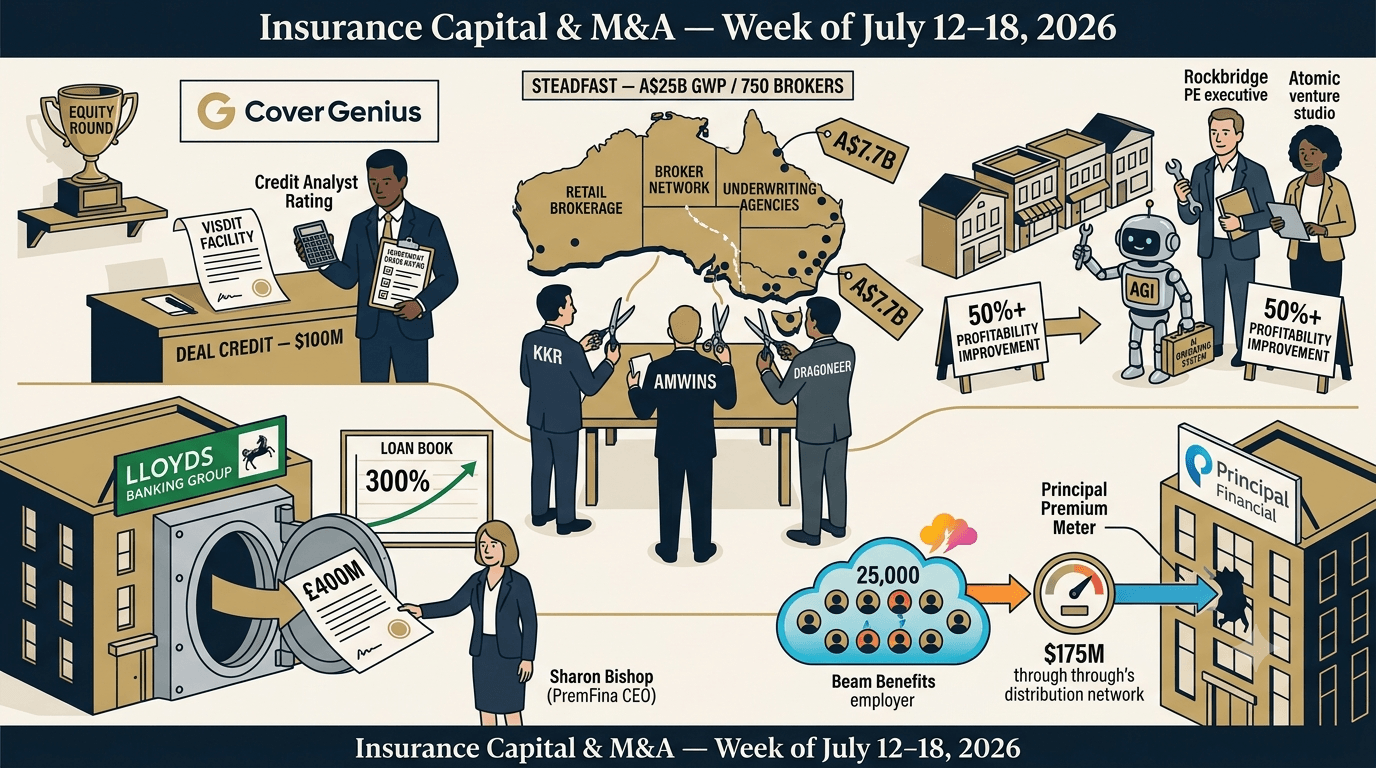
$675M+ in disclosed capital | 4 primary transactions + 1 late addition | Embedded insurance crosses $1.9B, PE bids $5.3B for Australia’s largest broker network, AI brokerage launches with $70M, and premium finance hits institutional scale
Four very different expressions of capital conviction arrived simultaneously this week. Cover Genius reached a $1.9 billion valuation backed by credit capital rather than venture equity — a structural signal that embedded insurance infrastructure has crossed from speculative bet to durable software revenue. KKR joined the A$7.7 billion consortium bidding for Steadfast, Australia’s largest insurance broker network, in a transaction that splits the company into its retail brokerage and underwriting agency components and involves three of the most aggressive insurance distribution acquirers in the world. American Growth Insurance launched with $70 million in committed equity to buy independent agencies and rebuild them as AI-native operations. And PremFina secured a £400 million senior debt facility from Lloyds Banking Group, confirming that institutional bank capital is now available to insurance premium finance platforms at scale. One late addition from the prior window rounds out the week: Principal Financial’s agreement to acquire Beam Benefits, an AI-native employee benefits platform with $175 million in premiums and 25,000+ small business clients.
1. Cover Genius (USA / Global)
$100M at $1.9B Valuation | Credit Capital Backs Embedded Insurance Infrastructure — Vista Credit Partners Date: July 14, 2026
What Happened
Founded by Angus McDonald (CEO) and Chris Bayley, New York and Sydney-based Cover Genius closed a $100 million capital raise backed by Vista Credit Partners — the credit-investing arm of Vista Equity Partners — at a $1.9 billion valuation. The raise follows a $80 million Series D in May 2024. Total funding since founding in 2014: approximately $345 million. Morgan Stanley & Co. LLC acted as exclusive placement agent. Cover Genius operates a B2B2C embedded protection platform connecting more than 200 digital platform partners (Klarna, Revolut, Amazon, Booking.com, Kayak, and others) with 50+ global insurance carriers to protect over 70 million end customers at the point of sale across travel, retail, ticketing, and logistics. The XCover platform dynamically adapts product design, pricing, and presentation in real time to match each partner’s customer journey and geography. The company has processed $3+ billion in cumulative gross written sales and reported 50% year-over-year revenue growth. Vista Credit Partners manages $8.2 billion in AUM and has deployed over $16.2 billion across 700+ transactions since inception. Pete Fisher, Co-Head of Vista Credit Partners, joined Cover Genius’s board as part of the transaction.
- Lead: Vista Credit Partners (Vista Equity Partners subsidiary)
- Existing investors: Spark Capital, Dawn Capital, G Squared, Sompo Holdings, King River Capital
- Financial advisor: Morgan Stanley & Co. LLC (exclusive placement agent)
Use of Funds
- Deepen enterprise partner relationships through enhanced integration capabilities
- Scale AI capabilities: hyper-personalization engines, agentic distribution, automated claims resolution
- Platform scalability and selective strategic acquisitions into new verticals
Strategic Thesis
The structural choice of Vista Credit Partners over a venture firm is the most important element of this transaction. Vista Credit Partners is not a venture investor — it provides non-dilutive capital solutions to mature, non-sponsor-backed enterprise software companies through its FounderDirect platform. Its participation signals that Cover Genius’s revenue is stable, recurring, and sufficient to service institutional credit rather than requiring equity capital to fund ongoing losses. That is a fundamentally different risk profile than a venture-backed platform still burning cash toward eventual profitability. Angus McDonald’s framing — “we’ve spent more than a decade building the trust layer the world’s largest digital companies rely on” — describes the infrastructure positioning accurately: Cover Genius is not competing for consumers. It is selling infrastructure to the platforms that already have them. The 50% year-over-year revenue growth at this scale makes the credit investor’s calculus visible: a company generating durable, growing software revenue from 200+ enterprise partners and 70 million end customers is a credit asset, not a venture bet.
Why It Matters
- Vista Credit Partners backing embedded insurance infrastructure with $100M in credit capital signals that the category has crossed from experimental to institutional — the same transition that SaaS infrastructure categories make when PE credit replaces VC equity as the growth financing vehicle
- The 200+ platform partner network across travel, retail, ticketing, and logistics represents a distribution moat that requires years to build and is effectively irreplicable — each integration is a custom engineering project with the partner’s checkout flow
- Sompo Holdings’ continued presence as an existing investor connects the embedded insurance platform to one of Japan’s largest carriers, providing strategic distribution access in APAC markets where Cover Genius is expanding
Competition
- Direct competitors: Bolttech ($2.1B valuation, embedded insurance across 30+ markets), Qover (European embedded insurance platform), Cover Whale (US commercial trucking embedded)
- Category competitors: Insurance distribution APIs (Bindable, BOLT), white-label carrier programs, traditional affinity distribution partnerships
- Emerging dynamic: Cover Genius’s XCover platform competes directly with Bolttech for global embedded insurance infrastructure dominance; both are now well-capitalized, the competition will play out at the enterprise partner level
Market Consequences
The credit financing structure creates a specific market signal: Vista Credit Partners’ 700+ transaction track record means it has underwritten embedded insurance platform revenue against institutional credit standards. That assessment — that Cover Genius’s contracted revenue from 200+ enterprise partners is credit-quality — raises the bar for what institutional investors expect from embedded insurance platforms seeking capital. Competitors still burning cash on customer acquisition or showing lumpy revenue concentration in a small number of partners will face a higher standard of scrutiny in their next capital conversations. For the enterprise platforms that are Cover Genius’s customers, the Vista credit facility signals long-term financial stability from their insurance infrastructure provider — a procurement consideration that matters when making multi-year integration commitments.
Bottom line: Cover Genius raised $100 million from a credit investor at $1.9 billion. Credit capital only follows where revenue is stable enough to service debt. Embedded insurance infrastructure has crossed that threshold.
2. Steadfast Group / KKR + Amwins + Dragoneer (Australia / USA)
A$7.7B (~$5.3B) | Australia’s Largest Insurance Broker Network — PE Consortium Bids to Split and Acquire Date: July 14, 2026 (KKR joinder confirmed; original proposal June 10)
What Happened
Steadfast Group Limited (ASX: SDF) — Australia’s largest insurance broker network with A$25 billion in gross written premium placed annually across Australia, New Zealand, Singapore, and the United States — confirmed that KKR joined the consortium of Amwins Group and Dragoneer Investment Group as a co-lead investment partner on July 8, 2026, with the joinder publicly confirmed on July 14. The consortium’s proposal values Steadfast at approximately A$7.7 billion ($5.33 billion), at A$6.00 per share in cash — a 51.9% premium to Steadfast’s closing price before the original proposal. The deal structure is a planned split acquisition: KKR and Dragoneer would take control of Steadfast’s retail brokerage business (the network of 750+ member brokers placing A$25B in GWP); Amwins would acquire Steadfast’s underwriting agency business (specialist insurance products across niche segments). Steadfast entered exclusivity with the consortium on June 10 and extended that exclusivity by four weeks. Robert Kelly, who founded Steadfast and has led it for three decades, remains in his role through the process. The proposal is still conditional, non-binding, and indicative — no binding Scheme Implementation Deed has been executed. J.P. Morgan and Citigroup are joint financial advisors to Steadfast; Mallesons is legal advisor.
- Retail brokerage acquirer: KKR (co-lead) + Dragoneer Investment Group
- Underwriting agency acquirer: Amwins Group
- Target leadership: Robert Kelly (Founder and Managing Director, Steadfast)
Use of Funds (proposed)
- KKR/Dragoneer: capitalize and scale Steadfast’s 750+ member broker retail network
- Amwins: integrate Steadfast’s underwriting agency into its global MGA and wholesale distribution platform
- Steadfast shareholders: receive A$6.00 per share in cash at close
Strategic Thesis
The proposed split acquisition is the most architecturally interesting element of this transaction. Amwins and Dragoneer are not buying the same business — they are each buying the component of Steadfast that fits their existing platform. Amwins is the world’s largest insurance distributor by premium volume, primarily a wholesale and MGA business. Acquiring Steadfast’s underwriting agency arm gives Amwins an immediate Australasian specialty underwriting platform with established carrier relationships and niche product capabilities. Dragoneer — with KKR now alongside it — is acquiring the retail brokerage network: 750+ member brokers placing A$25 billion in annual GWP across four markets. For KKR, whose insurance distribution investment track record includes USI Insurance Services, the Steadfast retail network is a familiar asset type: scale distribution with recurring premium flow and high client retention. The combination of KKR’s operational playbook, Dragoneer’s technology investment orientation, and Amwins’ wholesale distribution expertise across three buyers of a single company is an unusually sophisticated transaction structure. For Steadfast, A$6.00 per share represents the third and highest offer after A$5.50 and A$5.83 were both rejected — the board held out and extracted a 51.9% premium.
Why It Matters
- A$7.7 billion for an insurance broker network confirms that global PE firms have re-rated insurance distribution as a category where scale, recurring cash flow, and network effects justify top-quartile buyout multiples
- The split structure — retail brokerage to KKR/Dragoneer, underwriting agency to Amwins — signals that the two components of Steadfast’s business have materially different buyer universes, valuation drivers, and post-acquisition growth strategies
- For Australasian insurance distribution participants, the consortium’s proposal puts every broker network of scale into play: if Steadfast’s retail brokerage is worth a 51.9% premium to a KKR-backed consortium, comparable networks globally are being valued by the same logic
Competition
- Direct competitors (Australasian broker networks): Gallagher (Australia), Aon (Australia), Marsh (Australia), Insurance Brands Australia (Steadfast competitor)
- Category competitors: Global PE-backed broker consolidators (Hub International, NFP, Acrisure, BRP Group) — all evaluating Australasian expansion
- Post-transaction competitive dynamic: Amwins absorbing Steadfast’s underwriting agency creates an Australasian wholesale and MGA platform for Amwins that it did not previously have; the competitive implications for Lloyd’s and domestic Australian underwriting agencies are significant
Market Consequences
The Steadfast proposal accelerates the globalization of insurance distribution M&A in ways that Australian market participants have not yet fully priced. The 750+ member broker network KKR and Dragoneer would control represents the dominant distribution infrastructure for commercial, specialty, and personal lines across Australia and New Zealand. The operational model a KKR-backed platform would apply — technology investment, data infrastructure, cross-selling across member brokers — is the same playbook that has consolidated the US independent agency market over the past decade. For Australian independent brokers outside the Steadfast network, a KKR-backed Steadfast becomes a better-capitalized, technology-invested competitor for talent, client relationships, and sub-broker consolidation. The exclusivity extension and the board’s continued engagement signal that a binding agreement is probable. The proposal remains conditional.
Bottom line: KKR just joined a $5.3 billion bid to buy Australia’s largest insurance broker network. The 51.9% premium reflects what distribution scale is worth when global PE decides to compete for it.
3. American Growth Insurance / AGI (USA)
$70M Committed Equity | AI-Native Specialty Brokerage Roll-Up — Rockbridge Growth Equity + Atomic Date: July 15–16, 2026
What Happened
Atlanta-based American Growth Insurance (AGI Holdings LLC) launched with nearly $70 million in committed equity funding, backed by Rockbridge Growth Equity — a partnership-oriented middle market PE firm — and Atomic — a venture capital studio whose prior builds include Acorns, Hims, and Bungalow. Founded and led by Brian Morgan (CEO), previously Chief Revenue Officer at Keystone Agency Partners with prior experience at Marsh, Willis, Integro, and The Plexus Groupe. AGI is structured as a retail brokerage in specialty commercial and personal lines that acquires independent agencies and rebuilds them as AI-native operations. The company spent the prior year partnering with 10 agencies to develop and test its AI-first operating model, reporting 50%+ average improvement in agency profitability through combined revenue growth and productivity gains. First acquisition closed. Plans to surpass $10 million in annual revenue by end of 2026 through multiple additional acquisitions. The model: acquire agencies, not to rebrand and integrate them conventionally, but to rebuild how the work is done using native AI tools while preserving client relationships.
- Investors: Rockbridge Growth Equity (PE sponsor), Atomic (venture studio)
- CEO: Brian Morgan (ex-Keystone Agency Partners CRO, ex-Marsh, Willis, Integro, The Plexus Groupe)
Use of Funds
- Complete multiple agency acquisitions to build national specialty brokerage footprint
- Deploy AGI’s proprietary AI operating system across acquired agencies
- Target $10M+ in annual revenue by end of 2026 as a base for accelerated 2027 growth
Strategic Thesis
AGI’s model is architecturally distinct from every other PE-backed brokerage consolidator operating in the current market. The conventional model acquires agencies for their books of business, retains producers on earn-outs, and achieves margin improvement through shared service consolidation. AGI’s model acquires agencies specifically to rebuild how the work is done — replacing manual processes with AI agents across the entire brokerage workflow. Brian Morgan’s diagnosis is precise: “Most agencies have been told that AI matters, but they’re never told what to buy or how to make it work.” The 50%+ profitability improvement in the 10 test agency partnerships is the proof of concept. The Atomic partnership is the structural differentiator: Atomic has built and scaled consumer fintech companies (Acorns, Hims) by embedding technology into industries that had not previously adopted it. AGI is applying that venture studio playbook to specialty insurance distribution — a category the top 50 US brokerages dominate with 96% of total industry revenue, leaving the mid-market structurally fragmented and underinvested in technology.
Why It Matters
- The Rockbridge and Atomic partnership is an unusual capital structure that combines PE M&A execution (Rockbridge) with technology company building expertise (Atomic) — giving AGI access to deal origination, integration discipline, and product development simultaneously
- 50%+ profitability improvement across 10 pilot agencies before raising institutional capital provides a verified operating track record, not a hypothesis — the AI-native agency model produced measurable results before the $70M was raised
- MarshBerry data shows the top 50 US insurance brokerage firms account for 96% of total industry revenue and the next 50 account for just 4%; AGI’s target market is the fragmented mid-market below that threshold, where technology leverage creates the most significant efficiency gains
Competition
- Direct competitors (AI-enabled brokerage roll-ups): American Growth Insurance enters a market where ALKEME (national footprint, 80+ acquisitions), Relation Insurance Services, and Patriot Growth Insurance Services are all actively consolidating mid-market agencies
- Differentiating element: AGI’s AI-native rebuild model versus conventional consolidators’ shared services model is a fundamentally different thesis about where the value in mid-market brokerage acquisition comes from
- Emerging dynamic: The combination of Atomic’s technology building expertise with Rockbridge’s PE operational experience creates a capital structure that most pure-PE consolidators cannot replicate organically
Market Consequences
AGI’s launch represents the arrival of a new category of brokerage acquirer: the technology-first operator rather than the premium-growth-first consolidator. For independent agency owners evaluating succession options, AGI’s proposition — receive capital to fund growth while gaining AI infrastructure that improves profitability — is structurally different from the earn-out structures and integration requirements of conventional PE-backed buyers. For existing consolidators (ALKEME, Relation, Patriot Growth), AGI introduces a competitor that competes for the same agencies with a differentiated proposition that may attract technology-oriented agency owners. The 50%+ profitability improvement claim is specific enough to be tested and verified — if AGI’s early acquisitions confirm the model at scale, the competitive pressure on conventional brokerage consolidation approaches will intensify quickly.
Bottom line: AGI launched with $70M to buy agencies and rebuild them as AI-native operations. The venture studio that built Acorns and Hims is the co-backer. The result from 10 pilot agencies: 50%+ improvement in profitability. The institutional capital arrived after the proof, not before it.
4. PremFina (UK)
£400M (~$510M) Senior Debt Facility | Insurance Premium Finance — Lloyds Banking Group Date: July 17, 2026
What Happened
PremFina, the UK’s fastest-growing insurance premium finance provider, secured a £400 million senior debt facility from Lloyds Banking Group — the UK’s largest retail and commercial bank. The facility sits alongside PremFina’s existing £100 million junior capital facility with Waterfall Asset Management (secured March 2026), creating a combined £500 million funding structure. PremFina’s loan book has grown by more than 300% over the past 18 months. CEO Sharon Bishop confirmed the facility “strengthens our funding platform to support continued growth of the loan book.” Lloyds Head of Securitised Products Group Miray Muminoglu stated: “PremFina has built a strong position in the insurance premium finance market and has an established track record of growth.” SpecFin Capital advised PremFina across senior, mezzanine, and junior debt facilities over the past two years. The company is positioning for eventual access to the public asset-backed securities (ABS) market. Total funding across four rounds since founding: approximately $1.05 billion.
- Senior debt facility: Lloyds Banking Group (£400M)
- Junior capital facility: Waterfall Asset Management (£100M, secured March 2026)
- Financial advisor: SpecFin Capital
- Leadership: Sharon Bishop (CEO)
Use of Funds
- Grow insurance premium finance loan book across UK broker partnership network
- Scale toward public ABS market access (future milestone)
- Deepen broker relationships that have driven 300% loan book growth in 18 months
Strategic Thesis
Insurance premium finance is the financing layer that allows policyholders and businesses to spread annual insurance premiums across monthly payments rather than paying in full at inception. For the insurer, the premium is paid upfront by the finance provider. For the policyholder, the cost is spread over 12 months. For PremFina, the loan book generates interest income on the spread between its borrowing cost and the financing rate charged to policyholders, with insurance policy cancellation rights providing a natural security mechanism. The 300% loan book growth in 18 months reflects two structural dynamics: the rapid expansion of PremFina’s broker partnership network, and the broader increase in insurance premium levels that has inflated the volume of financing demand proportionally. A £400 million facility from Lloyds — the UK’s largest bank — is institutional validation that the PremFina credit model meets investment-grade lending standards. Lloyds does not provide £400 million facilities to credit risks it has not underwritten thoroughly. The progression from SpecFin Capital advisory, to Waterfall junior capital, to Lloyds senior debt follows the exact financing maturity ladder that credit-quality lending businesses climb: junior capital confirms the model works, senior bank debt confirms it works at institutional quality.
Why It Matters
- Lloyds Banking Group providing a £400 million senior facility is the highest available standard of institutional credit validation for a UK insurance premium finance platform — Lloyds underwrites credit risk with investment-grade discipline and does not provide this scale of facility to speculative businesses
- The combined £500 million funding structure provides PremFina with the capital depth to pursue ABS market access, which would further reduce its cost of capital and accelerate loan book growth at improved margins
- Insurance premium finance sits at the intersection of insurance distribution and consumer credit, benefiting simultaneously from rising insurance premium volumes (which increase finance demand) and broker network growth (which increases origination reach)
Competition
- Direct competitors (UK insurance premium finance): Premium Credit (Cinven-backed, UK market leader), Close Brothers Premium Finance, First Premium Finance
- Category competitors: Embedded BNPL financing for insurance premiums from fintech providers entering the category
- Emerging dynamic: As insurance premium levels continue rising due to loss inflation and reinsurance cost increases, the premium finance market grows proportionally — all providers benefit from the same structural tailwind
Market Consequences
Premium Credit, as the UK market leader, faces a direct competitive challenge from a PremFina that now has institutional bank debt at Lloyds-comparable rates. The cost of capital differential between PremFina’s £500 million combined facility and Premium Credit’s existing funding structure will influence the financing rates both companies can offer brokers and policyholders. For UK insurance brokers evaluating premium finance partnerships, PremFina’s Lloyds-backed stability and 300% growth trajectory provide both financial confidence and origination incentive.
Bottom line: Lloyds just provided £400 million in senior debt to an insurance premium finance company. That sentence is the credit quality assessment. Lloyds does not lend at this scale unless the underwriting supports it.
Late Addition: Principal Financial Group / Beam Benefits (USA)
Undisclosed | AI-Native Employee Benefits Acquisition — $175M in Premiums, 25,000 Small Business Clients Date: July 7, 2026 (announced Week 28 — not in prior input, included here)
What Happened
Principal Financial Group (NASDAQ: PFG) announced an agreement to acquire Beam Benefits — an AI-native employee benefits company serving 25,000+ small businesses with dental, vision, and ancillary coverage on a cloud-native technology stack. Founded by Alex Frommeyer and led by CEO Tolithia Kornweibel, Columbus, Ohio-based Beam has publicly disclosed $248 million in funding since founding in 2012 and generated approximately $175 million in premiums in 2025. The acquisition is expected to close in the latter half of 2026 subject to regulatory approvals. Financial terms not disclosed. Principal currently serves 180,000 employers across retirement, benefits, and business owner solutions. Principal expects the acquisition to accelerate premium and fee growth for Specialty Benefits to at or above the high end of its 5-9% medium-term target range in 2027. Perella Weinberg Partners advised Principal; Skadden acted as legal counsel. Wilson Sonsini advised Beam.
- Acquirer: Principal Financial Group (NASDAQ: PFG)
- Target: Beam Benefits — AI-native dental/vision/ancillary benefits, $175M premiums
- Beam CEO: Tolithia Kornweibel
- Advisors: Perella Weinberg Partners (Principal financial), Skadden (Principal legal), Wilson Sonsini (Beam legal)
Why It Matters
Principal is buying digital distribution for the small business benefits segment — the fastest-growing, most underserved, and most difficult to reach through traditional broker channels. Beam’s cloud-native platform reaches 25,000+ small businesses directly, generating $175M in premiums through digital enrollment that does not require broker intermediation at each transaction. That distribution capability is the acquisition rationale. Principal’s 180,000 employer relationships are predominantly mid-market and above, served through a wholesaler-driven distribution model. Beam’s 25,000 small business clients are below that threshold, reached through a digital-first direct model. The acquisition adds a channel and a technology stack that Principal would take years to build organically.
Market Consequences
For carriers competing in the small business employee benefits segment — Guardian Life, MetLife, Unum, Lincoln Financial — Principal’s acquisition of Beam signals that digital-first distribution is no longer an experiment. It is a strategic priority that the market’s major players are now acquiring rather than building. The AI-native enrollment and servicing stack that Beam provides is increasingly the threshold capability required to serve small businesses cost-effectively without broker intermediation at each transaction.
Bottom line: Principal just bought the digital distribution layer for small business employee benefits. Beam’s $175M in premiums and 25,000 direct employer relationships are the assets. The cloud-native technology platform is the retention mechanism.