Insurance Capital & M&A: Week of July 26 – August 1, 2026
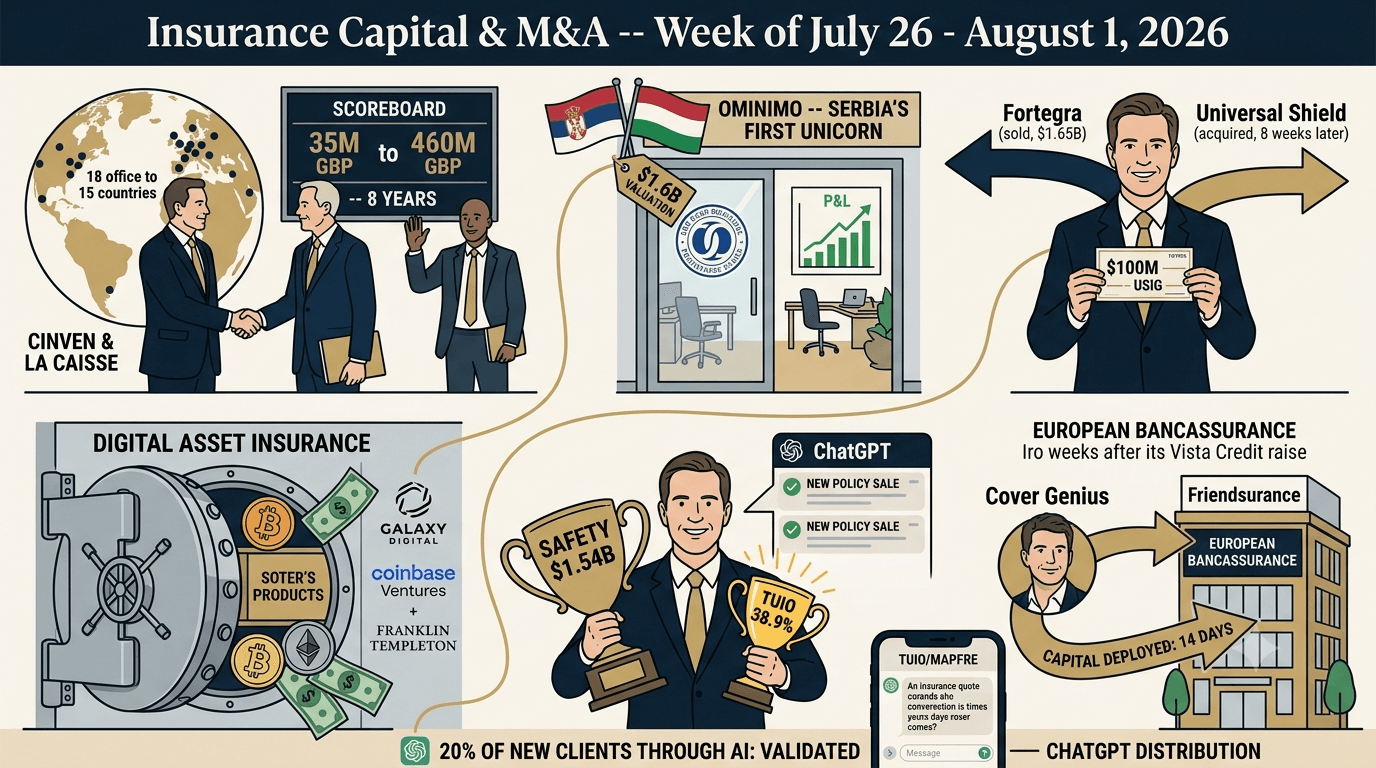
$146M+ in disclosed capital | 5 transactions | A specialty MGA gets PE-backed, Europe’s newest insurtech unicorn emerges from the Balkans, Tiptree recycles Fortegra proceeds, digital asset insurance scales, and Mapfre makes its second deal in two weeks
A week of five structurally distinct transactions with an unusually tight set of connecting themes. Cinven and La Caisse acquired Optio Group, a specialty MGA platform writing £460 million in annual premiums, confirming that PE appetite for delegated authority underwriting platforms has not been satisfied by the transactions covered in prior weeks. Ominimo, a Serbian-Hungarian motor insurtech founded just two years ago, raised its Series B at a $1.6 billion valuation from the EBRD, becoming Serbia’s first technology unicorn, on profitability, not growth burn, which makes it categorically different from most prior insurtech unicorns. Tiptree redeployed $100 million of its Fortegra sale proceeds into Universal Shield Insurance Group, a specialty P&C insurer, completing the most circular capital recycling story in recent insurance M&A. Soter Insure closed the first tranche of its Series B, backed by Galaxy Digital and Coinbase Ventures, scaling the only institutional-grade coverage for digital asset risks. And Mapfre, one week after its $1.54 billion Safety Insurance acquisition, took a 38.9% stake in Tuio, the Spanish insurtech that was the first insurance provider integrated into ChatGPT for policy sales.
GILAD SHAI ON THE WEEK'S DEALS — WHAT THE NUMBERS DON'T SAY
1. Cinven + La Caisse / Optio Group (UK / Canada)
Undisclosed | Specialty MGA: £460M GWP, 15 Countries, PE Ownership Change Date: July 27, 2026
What Happened
Cinven. The London and New York international private equity firm with €40 billion in funds raised since inception, and La Caisse (formerly CDPQ, the Quebec pension fund manager with $473 billion CAD in net assets) jointly announced an agreement to acquire a majority stake in Optio Group, a London-headquartered independent specialty insurance managing general agent, from existing shareholder Preservation Capital Partners (PCP). Optio’s management team, led by CEO Deepak Soni, remains significantly invested and continues to lead the business. Financial terms were not disclosed. Founded in 2018 with PCP’s backing, Optio has grown from a single-product MGA writing approximately £35 million in annual premiums into a diversified platform writing over £460 million across 18 offices in 15 countries through more than ten acquisitions and eight team hires alongside consistent double-digit organic growth. The platform operates across Europe, the US, the Middle East, and Asia with over 30 specialist insurance products. Anchor capacity comes from Hiscox alongside several additional A-rated capacity providers. The transaction is subject to regulatory approvals. Evercore advised Preservation Capital Partners and Optio financially; Skadden acted as legal advisor.
- Acquirer: Cinven (Luigi Sbrozzi, Partner and Co-Head of Strategic Funds) and La Caisse (Martin Longchamps, Executive Vice-President and Head of Private Equity and Private Credit)
- Financial advisor: Evercore (sell-side), Skadden (sell-side legal)
- Seller: Preservation Capital Partners
- Target CEO: Deepak Soni (continuing)
Use of Funds
- Expand specialist underwriting capabilities across new product lines and geographies
- Continue organic growth and M&A execution consistent with PCP-era strategy
- Invest in technology to support underwriting precision and portfolio management
Strategic Thesis
PCP’s exit after eight years is a clean, returns-confirming transaction for the specialty MGA category. The growth Optio achieved under PCP, from £35 million to £460 million in premiums across 15 countries through ten acquisitions: is the investment case that Cinven and La Caisse are buying into at the next stage. Cinven has deep prior experience in the MGA and delegated authority sector; Luigi Sbrozzi described Optio as a “marquee opportunity” where Cinven has both expertise and track record. La Caisse’s participation reflects the pension fund’s conviction in specialty insurance as a long-duration asset class with structural growth characteristics. The capital-light model of delegated underwriting. Optio takes no balance sheet risk, originating and managing risk on behalf of capacity providers: is precisely the financial profile that pension capital finds attractive: recurring fee and profit commission economics, high return on equity, and exposure to specialty insurance premium growth without carrier volatility. The PCP investment established the proof of concept. Cinven and La Caisse are funding the scale phase.
Why It Matters
- The £460 million to £35 million growth under PCP demonstrates that the specialty MGA roll-up model creates compounding value when disciplined underwriting talent is combined with patient capital and systematic M&A execution
- La Caisse’s entry alongside a traditional PE firm signals that the pension capital long-duration ownership model is arriving in the specialty MGA category, which has historically been PE-funded on 5-7 year horizons
- Cinven’s prior specialty insurance experience means Optio does not need to educate its new owners on how the delegated authority business model works, which reduces execution risk in the transition
Competition
- Direct competitors (specialty MGA platforms at similar scale): Volante Global (Acrisure-acquired), Rokstone, Nexus Group, Markerstudy, Acasta Group
- Category competitors: Lloyd’s syndicates writing the same specialty lines directly, traditional managing agency operators, direct-capacity specialty insurers
- Emerging dynamic: Multiple specialty MGA platforms are being PE-backed simultaneously (Carbon Underwriting/FTV Capital was covered last week), creating a competitive talent market for specialty underwriters
Market Consequences
Preservation Capital Partners’ clean exit at a premium validates the specialty MGA category at scale and at consistent double-digit organic growth rates. Competing MGA owners: other PE firms, family offices, and founder-owned platforms: now have a data point for specialty MGA valuations at £460 million in premium volume. For Lloyd’s capacity providers, a Cinven and La Caisse-backed Optio is a more financially stable long-term capacity partner than a PE-backed platform with a 5-year exit horizon. The combination of Cinven’s operational expertise and La Caisse’s patient capital suggests Optio will be held for longer and built more deliberately than a typical PE buyout.
Bottom line: Cinven and La Caisse just paid an undisclosed premium for a specialty MGA that grew 13x in eight years. The delegated authority category’s institutional ownership upgrade is continuing to gather pace.
2. Ominimo (Serbia / Hungary)
€20.1M ($22.5M) Series B at €1.4B ($1.6B) Valuation | European Motor Insurtech Unicorn: Profitable, EBRD-Backed, Serbia’s First Date: July 27, 2026
What Happened
Ominimo, a Budapest-headquartered motor insurtech founded in 2024 by Dusan Komar, Dennis Weinbender, and Laslo Horvath: all former McKinsey consultants: closed a €20.1 million ($22.5 million) Series B round led by the venture capital arm of the European Bank for Reconstruction and Development (EBRD), at a valuation of €1.4 billion ($1.6 billion). The round was announced July 27, 2026. Additional investors are expected at a second close. Ominimo’s annualised gross written premium run-rate has grown 12x in under two years: from approximately €26.3 million in 2024, to €157.8 million in 2025, to approximately €306.8 million currently. The company serves nearly one million customers across four European markets and employs approximately 130 people, of whom around two-thirds work in data science or software development. The company is profitable. An unusual distinction for a Series B insurtech. Ominimo operates as an MGA with partner carriers bearing underwriting risk: Signal Iduna in Hungary and Zurich Insurance Group’s DA Direkt in Poland, Netherlands, and Sweden. Zurich also participated in the Series A as a strategic minority shareholder. The new capital will fund European market expansion (Belgium and Romania immediately, then Spain, Italy, and France), own-license acquisition, new product lines, headcount growth to approximately 150, and a US market entry targeted for 2027.
- Lead investor: EBRD Venture Capital (investment arm of the European Bank for Reconstruction and Development)
- Existing strategic investor: Zurich Insurance Group (Series A minority, distribution partner)
- Founders: Dusan Komar, Dennis Weinbender, Laslo Horvath
Use of Funds
- Enter Belgium and Romania immediately; Spain, Italy, and France to follow
- Pursue own insurance carrier licence to retain more underwriting economics
- New product lines beyond motor insurance
- US market entry in 2027
Strategic Thesis
Ominimo’s Series B is the sharpest rebuke to the prior European insurtech cycle that the market has seen. The last generation of European insurtech unicorns: Wefox (once valued at $4.5 billion, now restructuring), Luko (sold at distressed prices), Coya (shut down): achieved scale through growth without underwriting discipline. Ominimo achieved scale through underwriting discipline first, then growth. The company uses hundreds of data points to price motor risk versus the five or six that traditional carriers use. It has 7% market share in Hungary’s motor insurance market after just 12 months of operation. It is profitable in each market it has entered. The EBRD’s participation carries dual significance: institutional investment validation and development bank mandate alignment. EBRD invests in emerging and transition economies to support economic development. Backing Serbia’s first technology unicorn advances both goals simultaneously. The $1.6 billion valuation on a $22.5 million check is the mathematical consequence of 12x premium growth with profitability. The market is pricing the trajectory rather than the current state. The own-licence pursuit is the strategic step that matters most for future economics: as an MGA, Ominimo shares economics with partner carriers. As a licensed insurer, it retains the full underwriting margin.
Why It Matters
- Profitable at Series B at 12x premium growth in two years is the insurtech financial profile that the prior cycle promised and did not deliver: EBRD’s institutional conviction in this profile is a direct response to the Wefox-style growth-without-discipline cautionary tale
- The EBRD reaching a $1.6 billion valuation faster than any of its prior unicorn exits (PandaDoc, DocPlanner, PicsArt) confirms that Ominimo’s growth rate and margin profile are genuinely exceptional, not merely fast
- Zurich’s role as both distribution partner and shareholder creates a structural alignment: Zurich is simultaneously a customer (buying distribution), an investor (owning equity upside), and a data source (providing underwriting analytics through the DA Direkt partnership)
Competition
- Direct competitors (European AI-native motor insurtech): By Miles (UK), Zego (fleet/gig), Wakam (white-label carrier), Friday (German, Baloise subsidiary)
- Category competitors: Traditional European motor insurers (Allianz, AXA, Generali direct motor lines), price comparison sites as distribution incumbents
- Emerging dynamic: Ominimo’s pursuit of its own carrier licence will bring it into direct competition with the capacity providers it currently partners with, particularly in Hungary where its 7% market share already creates competitive pressure
Market Consequences
The Ominimo valuation sets a new European insurtech benchmark for what disciplined underwriting growth is worth in 2026. WeFox’s collapse created a template for what happens when growth precedes discipline. Ominimo’s rise creates the opposite template. For European insurtech investors who withdrew from the category after the 2022-2024 correction, Ominimo’s EBRD-backed Series B provides a re-entry signal: profitable, data-driven, asset-light MGA models in underpenetrated European markets are investable at meaningful scale. For the Central and Eastern European startup ecosystem, Serbia’s first unicorn is a credibility event for the entire region’s fundraising environment.
Bottom line: A Serbian-Hungarian motor insurtech founded two years ago just became the Balkans’ first tech unicorn: profitable, 12x premium growth, EBRD-backed, and structurally different from every insurtech unicorn that came before it. The prior cycle rewarded growth. This one rewards discipline.
3. Tiptree / Universal Shield Insurance Group (USA)
$100M | Specialty P&C Acquisition: Fortegra Proceeds Recycled into New Platform Date: July 29, 2026
What Happened
Tiptree Inc. (NASDAQ: TIPT) announced it has entered into a definitive agreement to acquire Universal Shield Insurance Group (USIG) for $100 million in cash, redeploying capital generated from its $1.65 billion sale of Fortegra to DB Insurance that closed May 29, 2026. USIG is a Dublin, Ohio and Waterford, Michigan-based multi-line admitted and excess and surplus (E&S) commercial lines specialty P&C insurance holding company. Its insurance entities are Universal Fire and Casualty Insurance Company (UFCIC) and Shield Indemnity, together licensed across 49 US states. USIG’s proprietary technology platforms support data-driven digital underwriting across property, casualty, and surety lines. USIG CEO Chris Timm and the leadership team remain in place and lead the business post-close. The deal is expected to close in Q1 2027, subject to insurance regulatory approvals. Raymond James and Squire Patton Boggs advised USIG; Fenchurch Advisory Partners and Sidley Austin advised Tiptree. Separately, Michael Barnes, Chairman and CEO of Tiptree, noted the transaction is consistent with the company’s stated strategy of continuing to deploy Fortegra proceeds into specialty insurance.
- Acquirer: Tiptree Inc. (NASDAQ: TIPT): Michael Barnes, Chairman and CEO
- Target: Universal Shield Insurance Group: Chris Timm, CEO
- Advisors: Raymond James (USIG financial), Squire Patton Boggs (USIG legal), Fenchurch Advisory Partners (Tiptree financial), Sidley Austin (Tiptree legal)
Use of Funds
- $100 million acquisition price plus additional committed capital to accelerate growth and underwriting capacity
- Organic expansion of admitted and E&S product lines and geographic footprint
- Technology investment in USIG’s existing data-driven underwriting platform
Strategic Thesis
Tiptree sold Fortegra in May 2026 for $1.65 billion, generating $1.12 billion in gross proceeds. Buying USIG for $100 million is the first visible deployment of those proceeds into a new specialty insurance platform. The capital recycling logic is deliberate and stated: Tiptree describes itself as a specialty insurance holding company and the Fortegra sale was described at the time as capital optimization, not an exit from the sector. USIG’s profile fits Tiptree’s historical investment pattern: an operating specialty insurer with disciplined underwriting, a proprietary technology platform, and room to grow with capital behind it. The admitted/E&S hybrid structure is particularly relevant: carriers that can write risk both in the admitted market and in the E&S market have underwriting flexibility that pure-admitted platforms lack. In a market where admitted carriers are restricting in climate-exposed and specialty categories, the E&S channel has been growing faster than admitted lines for three consecutive years. USIG’s dual-track structure positions it to grow into that dynamic.
Why It Matters
- The Fortegra-to-USIG capital recycling within eight weeks is the most direct evidence this year that PE-oriented insurance holding companies have a clear playbook: sell mature platforms at top-cycle multiples, redeploy into earlier-stage platforms with higher growth potential at more modest entry prices
- USIG’s 49-state licensing is a distribution asset that took years to build and creates immediate national market access for any specialty product line Tiptree wants to develop or acquire through USIG’s platform
- The proprietary digital underwriting technology at USIG creates a foundation for data-driven specialty lines expansion that is faster than building a traditional actuarial underwriting model from scratch
Competition
- Direct competitors (specialty admitted and E&S P&C): Ategrity Specialty Insurance (also announcing Q2 results this week), AmTrust Financial Services, Kingsway Financial Services, specialty program divisions of larger carriers
- Category competitors: Wholesale brokers and MGAs competing for E&S placement rather than own-paper underwriting
- Emerging dynamic: The Tiptree-USIG combination positions against the SageSure-Novel-Flexpoint cluster (covered in prior weeks) as another PE-aligned specialty P&C platform with growth capital and a national licensing footprint
Market Consequences
For specialty P&C insurers of USIG’s size: too large to be acquired by an MGA platform, too small to be on the radar of the largest strategic acquirers: Tiptree’s acquisition demonstrates a fourth category of potential buyer: the specialty insurance holding company recycling capital from a prior exit. This buyer type has a known time horizon (Tiptree held Fortegra for years before the DB Insurance exit), a clear strategic preference (disciplined underwriting specialty platforms), and capital discipline (buying at $100 million not $500 million). That profile attracts different sellers than PE firms or strategic carriers and reaches a different segment of the market.
Bottom line: Tiptree sold Fortegra for $1.65 billion in May. Eight weeks later it deployed $100 million of those proceeds into a specialty P&C insurer licensed in 49 states. Capital recycling within the specialty insurance sector, on an eight-week cycle, at disciplined entry prices. That is the Tiptree playbook made explicit.
4. Soter Insure (UAE / Bermuda)
$23.5M Series B (First Close) | Institutional-Grade Digital Asset Insurance Date: July 29, 2026
What Happened
Soter Insure, headquartered in Abu Dhabi and operating out of Bermuda with offices in London, New York, and Dubai, announced the first close of its Series B funding round led by Galaxy Digital (who also led the Series A), with new participation from Coinbase Ventures and Franklin Templeton, and follow-on investment from Brevan Howard Digital and other existing backers. A second close is expected in the coming weeks, with additional strategic investors joining. Final close of the Series B will bring total funding to $23.5 million plus over 500 BTC and 2,000 ETH in cryptocurrency capital. Soter was incubated by Further Ventures and WebN Group. CEO Henson Orser leads the company. Soter provides specialized digital asset insurance for financial institutions, offering D&O, Professional Indemnity, Crime, Specie, Slashing, and Smart Contract Failure coverage: uniquely denominated in both fiat and native digital assets. The company received full regulatory approval from the Dubai Financial Services Authority (DFSA) in 2026. The new capital funds underwriting capability expansion, technology development, global market scaling, and delivery of coverage solutions at institutional scale.
- Lead investor: Galaxy Digital (Chris Ferraro, President and CIO)
- New investors: Coinbase Ventures, Franklin Templeton
- Follow-on investors: Brevan Howard Digital, other existing backers
- CEO: Henson Orser
Use of Funds
- Expand underwriting and technology capabilities for institutional digital asset coverage
- Scale operations across key markets globally
- Complete second close of Series B with additional strategic investors
Strategic Thesis
The digital asset insurance market is a gap that traditional insurers have explicitly chosen not to fill, for the same structural reasons that drove WTW’s Redefind acquisition in Week 23 and Klaimee’s seed round in Week 30: crypto asset risks are volatile in value, technically novel in their failure modes, and underwriting-expertise-scarce. Soter’s approach is the most institutionally sophisticated response to that gap yet seen. It operates from Bermuda (the world’s leading specialty insurance regulatory environment), holds DFSA licensing (regulatory approval for the Middle East’s largest financial center), accepts capital in both fiat and native digital assets (removing currency basis risk for institutional crypto clients), and covers the complete spectrum of institutional digital asset risks including the technically specific categories like Slashing (validator penalties on proof-of-stake networks) and Smart Contract Failure. Galaxy Digital’s repeat lead role: having led both Series A and Series B: is the signal that matters most. Galaxy is one of the world’s largest institutional digital asset firms with direct knowledge of the risks that institutional crypto participants face and deep relationships with the custodians, exchanges, and fund managers that are Soter’s target customers. Coinbase Ventures’ new participation adds the world’s largest publicly listed crypto exchange as both investor and potential distribution channel. Franklin Templeton’s entry as a new investor connects Soter to one of the largest traditional asset managers actively building a digital asset business.
Why It Matters
- DFSA regulatory approval from the Dubai Financial Services Authority gives Soter a regulatory credential that no other digital asset insurer holds, enabling it to serve ADGM and DIFC-regulated financial institutions that require DFSA-recognized coverage
- The BTC and ETH capital alongside fiat denominated investment is structurally novel: it means Soter’s balance sheet has natural currency alignment with its policyholders’ asset exposures, reducing basis risk in the coverage it provides
- Franklin Templeton’s participation signals that traditional asset management giants building digital asset businesses are beginning to treat institutional-grade insurance as a procurement requirement rather than an optional risk management tool
Competition
- Direct competitors (digital asset insurance): Evertas (specialist crypto MGA), Coincover, Lloyd’s syndicates with bespoke digital asset appetite (Chaucer, Hiscox)
- Category competitors: WTW/Redefind (broker-side digital asset infrastructure, covered Week 23), Klaimee (AI agent liability, covered Week 30)
- Emerging dynamic: Soter, Klaimee, and WTW/Redefind represent three different layers of the emerging digital asset/AI liability insurance stack: platform coverage (Soter), agent liability (Klaimee), and brokerage infrastructure (WTW/Redefind)
Market Consequences
Galaxy Digital and Coinbase Ventures’ joint investment in Soter creates a distribution network for digital asset insurance that no traditional broker has. When Galaxy recommends Soter to its institutional clients and Coinbase Ventures’ portfolio companies evaluate risk management, Soter is the natural referral. For institutional digital asset firms: hedge funds, custodians, exchanges, and staking operators. That currently self-insure or patch together bespoke Lloyd’s coverage, Soter offers a purpose-built institutional-grade alternative. The BTC and ETH capital structure is the commercial signal: Soter intends to serve clients whose risks and balance sheets are denominated in crypto, not just fiat.
Bottom line: Galaxy Digital led Soter’s Series A and came back to lead the Series B. Coinbase Ventures joined. Franklin Templeton joined. The institutional digital asset insurance gap is real, the regulatory credentials are real, and the investor stack is the most credible in the category.
5. Mapfre / Tuio (Spain)
Undisclosed | 38.9% Stake in Spain’s Leading AI-Native Insurtech: Mapfre’s Second Deal in Eight Days Date: July 30–31, 2026
What Happened
Mapfre S.A. announced an agreement to acquire a 38.9% stake in Tuio, the leading Spanish AI-native digital insurance distributor, through a combination of a direct share purchase from existing shareholders and participation in a capital increase. The transaction is subject to regulatory authorizations. Financial terms were not disclosed. Tuio was founded in 2021 in Spain by Juan García, Asís Pardo, and Jose María de Lucas. The company specializes in 100% digital home, car, and life insurance products and has more than 100,000 active customers operating through a fully online model applying proprietary technology, automation, and AI across the insurance value chain. Previous investors include BlackRock, Bamcap Ventures, Extension Fund, and Capital Certainty. The investment comes eight days after Mapfre announced the $1.54 billion acquisition of Safety Insurance Group on July 23. Mapfre describes its investment as driven by conviction that “AI in general and agentic AI in particular represent a far-reaching technological change for the insurance industry and for the broader digital economy.” Tuio was the first insurance app globally to integrate into ChatGPT for direct policy sales, generating more than 20% of new clients through AI assistants since that integration launched in February 2026.
- Investor: Mapfre S.A. (Antonio Huertas, Executive Chairman)
- Founders: Juan García, Asís Pardo, Jose María de Lucas
- Prior investors: Bamcap Ventures, BlackRock, Capital Certainty, Extension Fund
Use of Funds
- International expansion beginning 2027 across Europe and Latin America (markets where Mapfre has established presence)
- Continue developing AI and agentic AI distribution capabilities
- Accelerate development of advanced digital model and technology capabilities
Strategic Thesis
Mapfre making two insurance investments in eight days. A $1.54 billion acquisition of a traditional regional P&C carrier in Massachusetts and a minority stake in a 100,000-customer digital insurtech in Spain: tells a clear strategic story. Mapfre is buying for the present (Safety Insurance gives it market position, premium volume, and distribution access in New England immediately) and for the future (Tuio gives it a window into the distribution model that AI assistants are making possible, before that model becomes the industry standard). The ChatGPT integration is the specific element that makes Tuio strategically valuable to Mapfre beyond its current scale. Generating more than 20% of new clients through AI assistants within months of launch demonstrates that conversational AI is a viable insurance distribution channel, not an experiment. Mapfre’s Latin American and European network gives Tuio the exact geographic footprint it needs for its planned 2027 international expansion. The 38.9% stake is large enough to ensure strategic influence and board representation without triggering a full consolidation, which allows Tuio to retain its operational agility and startup culture.
Why It Matters
- Two Mapfre deals in eight days, totaling over $1.5 billion in one case and a strategic minority in another, signals that Mapfre is executing a deliberate dual-track acquisition strategy: scale through traditional M&A and distribution innovation through strategic minorities in digital-native platforms
- The ChatGPT integration generating 20%+ of new clients is the most concrete public data point yet on the commercial viability of conversational AI as an insurance distribution channel, and Mapfre’s investment is a vote of confidence in that channel’s trajectory
- Tuio’s prior BlackRock investment brings institutional investor validation alongside the founder-focused earlier investors, giving the cap table credibility across different investor types
Competition
- Direct competitors (Spanish digital insurance): Lemonade’s Spanish operations, Zurich’s digital channels, traditional Spanish insurers’ digital arms (Axa, Allianz in Spain)
- Category competitors: Spanish insurance price comparison sites (Rastreator, Kelisto), digital insurance brokers targeting Spanish consumers
- Emerging dynamic: Tuio’s ChatGPT distribution model represents the leading edge of agentic AI insurance distribution globally: every traditional carrier is now watching whether the 20%+ client acquisition rate through AI assistants holds as the market matures
Market Consequences
For Spanish insurers, Tuio’s ChatGPT distribution success and Mapfre’s backing of it raises an urgent competitive question: when conversational AI accounts for 20%+ of new policy sales at the leading digital insurer, what does that imply for carriers whose distribution is 100% agent-based or price-comparison-site-based? For Mapfre’s competitors globally, the dual acquisition strategy (Safety for scale, Tuio for digital distribution capability) establishes a template they will need to respond to. For insurtechs globally looking to partner with large carriers, the Tuio deal demonstrates that demonstrable AI distribution results, not just technology claims: are the threshold that moves a traditional carrier from observation to investment.
Bottom line: Mapfre’s second deal in eight days is a minority stake in the Spanish insurtech that generates 20% of new clients through ChatGPT. The Safety Insurance deal bought it distribution for 2026. The Tuio deal is buying it distribution for 2030.
6. Cover Genius / Friendsurance (USA / Germany)
Undisclosed | Embedded Bancassurance Acquisition: European Banking Expansion Date: July 28, 2026
What Happened
Cover Genius: the embedded insurance platform that closed a $100 million Vista Credit raise at a $1.9 billion valuation in Week 29: announced the acquisition of Friendsurance, a Berlin-based provider of digital bancassurance solutions founded in 2010 with approximately $23 million in publicly disclosed funding and approximately 150,000 customers. The acquisition gives Cover Genius direct bancassurance distribution capabilities in European banking, adding to its existing network of 200+ digital platform partners. CEO Angus McDonald: “European banking represents one of the highest-conviction growth opportunities in embedded protection.” Financial terms were not disclosed.
- Acquirer: Cover Genius (Angus McDonald, CEO and Co-Founder)
- Target: Friendsurance (Berlin-based digital bancassurance, ~150K customers)
Why It Matters
The timing is the strategic detail. Cover Genius raised $100 million from Vista Credit Partners on July 14. Two weeks later it deployed capital into a European bancassurance acquisition. The Vista credit facility was explicitly structured to fund “selective strategic acquisitions into new verticals.” Friendsurance is the first visible execution of that strategy, and the target’s bancassurance-specific positioning is significant: bancassurance in Europe is the distribution channel that sits between traditional agency distribution and pure digital, serving retail banking customers at the point of deposit, mortgage, or current account. Cover Genius now has both the embedded checkout distribution layer (XCover) and the bancassurance distribution layer (Friendsurance) in Europe.
Bottom line: Cover Genius raised $100 million on July 14. Two weeks later it acquired a European bancassurance platform. The Vista Credit facility was put to work faster than the press release suggested.