Insurance & InsurTech Investment Intelligence Report: Week of November 16 - 21, 2026
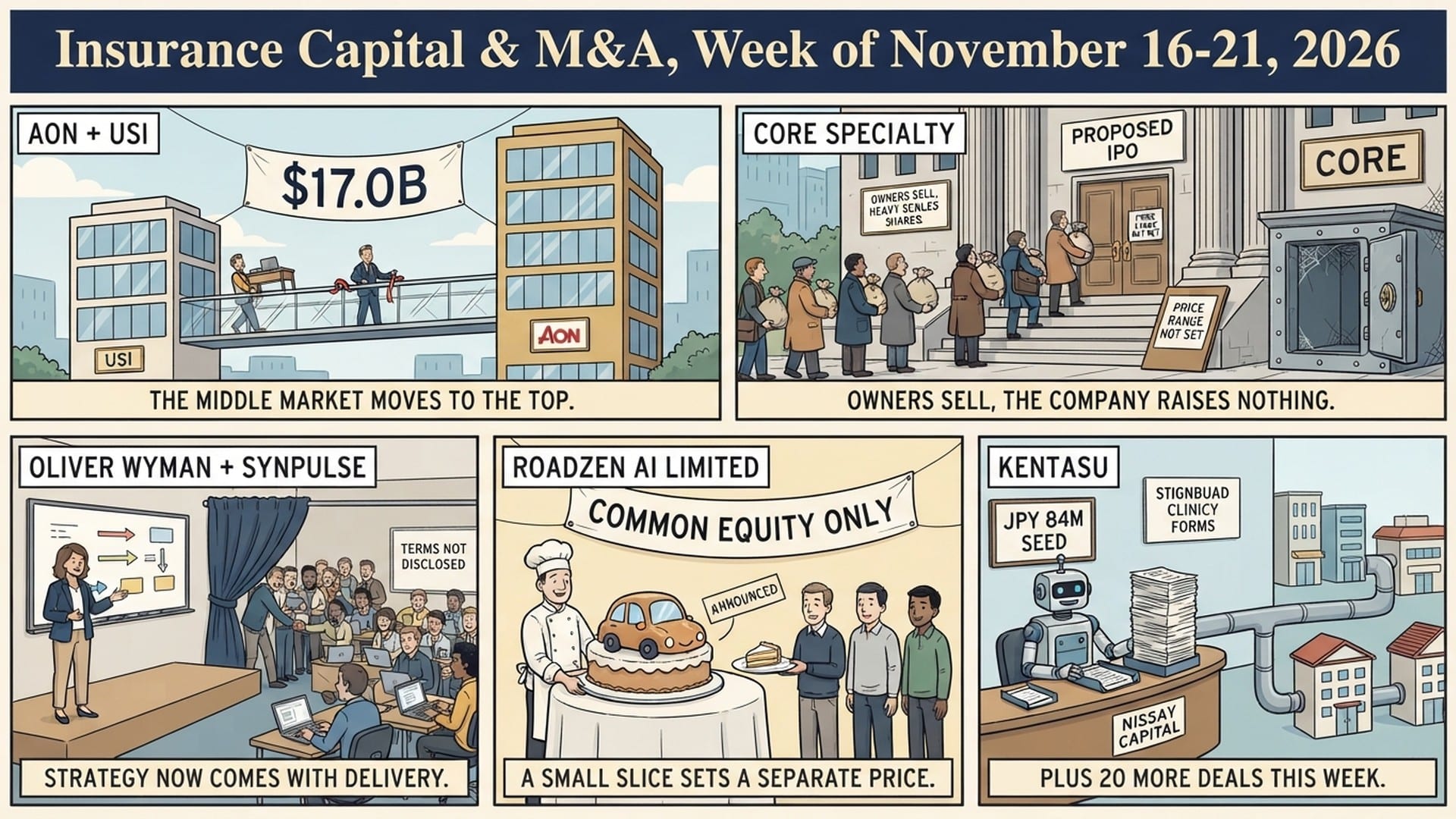
25 transactions | Aon completes its $17.0 billion USI acquisition, Oliver Wyman agrees to buy Synpulse, and Roadzen announces a minority financing of its India subsidiary
This was a week of owners changing hands, not of new venture money. Aon closed its $17.0 billion purchase of USI from KKR and other shareholders, and Oliver Wyman, a Marsh business, agreed to buy the financial services technology consultancy Synpulse. Core Specialty made a public filing for a proposed NYSE IPO in which only existing stockholders sell. Roadzen announced a small minority financing of its India subsidiary at about $300 million post-money, while Gallagher, Burns & Wilcox, Highstreet, Simplicity, McGowan and Miramar kept buying agencies, MGAs and intermediaries. Capital for MGAs came as minority stakes and small rounds: Apis into Alchemy Underwriting, IA Capital Group into Aurora, Mercia Ventures into Napo. The amounts are on different bases (a purchase price, a subsidiary equity round, a debt facility, venture rounds and a Form D sale), so the report gives no combined total.
GILAD SHAI ON THE WEEK'S DEALS: WHAT THE NUMBERS DON'T SAY
1. USI / Aon (Ireland / USA)
$17.0B Total Purchase Price | Aon Completes Its Acquisition of USI | Date: November 16, 2026 (announced August 31, 2026)
What Happened
Aon plc completed its acquisition of USI (legally USI Advantage Corp.) on November 16, according to Aon’s Form 8-K and its completion release. The total purchase price is $17.0 billion, made up of cash and Aon restricted shares issued as substituted awards for USI restricted stock. Aon announced the definitive agreement to acquire USI from KKR and other shareholders on August 31, and this report covered that announcement in its edition for the week of August 31. The deal returns here because the closing of a combination this large is a market event in its own right: two brokers now operate as one.
Per the 8-K, Aon drew in full on November 16 its previously disclosed $4.0 billion of unsecured delayed draw term loan facilities to fund part of the cash consideration. Michael J. Sicard, USI’s Chairman and CEO, was appointed President of Aon and Global Chief Executive Officer of Middle-Market; Gregory Case ceases to be President and remains CEO. Business Insurance also reported the completion.
- Buyer: Aon plc
- Target: USI Advantage Corp. (USI)
- Sellers: KKR and other shareholders, per the August 31 announcement
Use of Funds
- Purchase of USI for a $17.0 billion total price, part of the cash funded by the $4.0 billion of term loans drawn at closing.
Strategic Thesis
Aon describes USI as the tenth largest U.S. insurance broker. What Aon bought is a middle-market franchise and the person who ran it: Sicard now leads a global middle-market business and holds the President title that Case gave up. That is a statement that the middle market, not only large corporate risk, is where Aon expects growth.
The August announcement set closing for the fourth quarter of 2026, subject to regulatory approvals. The deal closed on that schedule, and the 8-K restates the same $17.0 billion total purchase price.
Why It Matters
- KKR’s exit from USI is now complete, at a total purchase price of $17.0 billion.
- USI’s chief executive becomes President of Aon, which puts the acquired business’s leadership at the top of the buyer.
- Aon funded part of the cash with $4.0 billion of term loans drawn on the closing date, so the deal adds debt as well as a business.
Competition
- Direct competitors: Arthur J. Gallagher & Co. and Brown & Brown, which compete for U.S. middle-market commercial and benefits clients.
- Category competitors: Hub International and Acrisure, private equity backed brokers that grow by acquiring agencies.
- Emerging dynamic: Private equity owned brokers exiting to strategic buyers, with the acquired management placed in charge of the buyer’s middle-market business.
Market Consequences
USI’s clients and producers now deal with Aon, and integration is where rival brokers recruit producers and pitch accounts. Gallagher and Brown & Brown face a larger middle-market competitor with a dedicated global leader. Aon’s next quarterly filings will be the first to show USI inside its numbers and the term loans on its balance sheet.
Bottom line: Aon has closed the $17.0 billion USI deal on schedule and handed USI’s chief executive the President title, which makes the middle market the center of Aon’s next phase.
2. Synpulse / Oliver Wyman (Global)
Terms Not Disclosed | Oliver Wyman, a Marsh Business, Agrees to Acquire Synpulse | Date: November 19, 2026
What Happened
Oliver Wyman, a management consulting business of Marsh (NYSE: MRSH), announced on November 19 an agreement to acquire Synpulse, a global technology consulting and AI platform company serving banks, insurers, wealth managers and other financial services organizations. Terms were not disclosed. The deal is expected to close in early 2027 and is subject to customary closing conditions and regulatory approvals. Synpulse’s approximately 1,200 employees will continue to operate from offices in North America, Europe and Asia.
- Buyer: Oliver Wyman, a Marsh business
- Target: Synpulse
Use of Funds
- Purchase of Synpulse; the price was not disclosed.
Strategic Thesis
The insurance link is on both sides. The buyer belongs to Marsh, which describes itself as a global leader in risk, reinsurance and capital, people and investments, and management consulting, and the target counts insurers among its financial services clients. Oliver Wyman sells strategy to banks and insurers; Synpulse brings 1,200 people who build and run the technology and AI that strategy calls for. Owning delivery capacity lets Oliver Wyman keep the implementation work that follows its advice.
Why It Matters
- An insurance broker’s consulting arm is adding technology delivery for insurers and banks, not only advice.
- Insurers that already buy broking from Marsh could buy strategy and implementation from the same group.
- No price was disclosed, so the deal cannot be valued from the release.
Competition
- Direct competitors: Accenture and Capgemini, which sell technology consulting and implementation to banks and insurers.
- Category competitors: McKinsey & Company and Boston Consulting Group, which advise the same financial institutions on strategy.
- Emerging dynamic: Consulting firms buying implementation capacity so they can deliver the AI programs they recommend.
Market Consequences
Until the early 2027 closing, Synpulse remains independent and its clients will want to know how its work fits with Oliver Wyman’s. After closing, Accenture and Capgemini face a competitor that pairs strategy work with delivery inside a broker-owned group. The regulatory approvals are the next milestone.
Bottom line: Marsh, through Oliver Wyman, is buying the people who turn financial services strategy into working technology, and insurers are among the clients it wants to serve with them.
3. Roadzen AI Limited / Roadzen (India)
Approximately $10M (₹94 Crore) Common Equity at About $300M Post-Money | Roadzen Announces a Minority Financing of Its India Subsidiary | Date: November 16, 2026
What Happened
Roadzen, which describes itself as a global leader in AI at the convergence of insurance and mobility, announced on November 16 an equity financing of approximately $10 million (₹94 crore) for its India subsidiary, Roadzen AI Limited (formerly Roadzen Technologies Limited). The company puts the post-money valuation at approximately $300 million on a stand-alone basis. The round is common equity only, with no warrants or preferred rights, and ranks pari passu with Roadzen’s existing holding. Roadzen Inc. retains approximately 89% of Roadzen AI Limited.
The financing is announced, not closed. Roadzen expects it to close over the next two weeks, subject to customary closing conditions, and its release lists the inability to obtain its senior lender’s consent among the risks. The investors are not named: Roadzen describes them as leading family offices and capital markets investors, including several who took part in the subsidiary’s previous financing. Prime Securities Limited is the exclusive investment bank.
- Lead: none named
- Investors: unnamed family offices and capital markets investors
Use of Funds
- Roadzen’s highest-growth priorities in insurance and mobility.
- Strengthening the balance sheet and driving toward its $100 million annual revenue run-rate target, which is the company’s own target.
Strategic Thesis
The parent is using a small minority sale to put a separate price on its India business. Because the shares are plain common equity with no preferences, the $300 million figure is a cleaner mark than a preferred round’s headline valuation. Outside holders own about 11% after the round, so Roadzen keeps control while raising money below the parent.
Why It Matters
- The $300 million post-money is a stand-alone mark for the India operation that the market can compare with the value of the parent.
- Common equity only, with no warrants or preferred rights, means no hidden terms behind the valuation.
- Closing depends on lender consent, which the company itself flags.
Competition
- Direct competitors: PB Fintech, owner of Policybazaar, and InsuranceDekho, which distribute motor and other insurance in India.
- Category competitors: Cambridge Mobile Telematics, which sells driving data and telematics to insurers.
- Emerging dynamic: Insurtech parents raising capital at the subsidiary level to set a separate valuation for one market.
Market Consequences
If the round closes within the two weeks Roadzen expects, the India subsidiary has a priced minority that later rounds will be measured against. The senior lender’s consent is the first thing to watch. The next test of the $100 million run-rate target will be Roadzen’s own reported revenue.
Bottom line: Roadzen sold a small, clean slice of its India business to show it is worth about $300 million on its own.
4. Kentasu (Japan / Malaysia)
JPY 84M Seed | Nissay Capital and Tokyo Wellness Impact Fund Back Kentasu’s Insurance Claims Automation | Date: November 20, 2026
What Happened
Kentasu, based in Shibuya, Tokyo, announced in a PR TIMES release on November 20 that it has raised a JPY 84 million seed round from Nissay Capital, Tokyo Wellness Impact Fund and individual investors. No lead investor is named. Kentasu develops Kentasu RCM, an AI platform that automates insurance claims and collection work for healthcare providers in Southeast Asia, bringing their claims to multiple insurers into one workflow.
Kentasu is adjacent to insurance rather than an insurer: it sells to healthcare providers. The insurance connection is twofold. Its product sits in the medical insurance claims process between providers and insurers, and its investor Nissay Capital is the venture capital firm of the Nippon Life group.
- Investors: Nissay Capital, Tokyo Wellness Impact Fund (Capitalmedica Ventures) and individual investors
Use of Funds
- Expanding the service rollout in Malaysia.
- Product development and a stronger local operation.
Strategic Thesis
Kentasu’s premise is that claims providers send to many insurers are handled by hand, and that every delay is cash a hospital or clinic waits for. It is betting that automation of that work is a product providers will pay for in Malaysia first. For Nippon Life’s venture firm, it is a small position in the claims plumbing of a market outside Japan.
Why It Matters
- A Japanese life insurance group’s venture firm is backing claims infrastructure in Southeast Asia, not an insurer.
- The product serves the provider side of the claim, so faster processing also changes the flow of claims insurers receive.
- The round is seed-sized; Malaysia is the market where the product has to prove itself.
Competition
- Direct competitors: Kentasu’s release names none.
- Category competitors: none named in the release.
- Emerging dynamic: Insurer-group venture arms investing in the systems that move claims between healthcare providers and insurers.
Market Consequences
The Malaysia rollout will show whether providers adopt the platform and whether insurers connect to it. A seed round of this size funds the first market, not several. Further rounds or named insurer partners would be the next signals.
Bottom line: Nippon Life’s venture firm has bought an early seat in Southeast Asian medical claims automation, where providers, not insurers, are the customer.
5. Numa (USA)
Numa, which sells an AI operating system to car dealerships and no insurance product, announced a $45 million Series C led by Blue Cloud Ventures on November 16, and it is adjacent to insurance because Tokio Marine Future Fund invested and a Tokio Marine & Nichido Fire Insurance executive says that, as an insurer, it views dealerships as a critical part of the ecosystem around vehicle ownership.
Market Context
Core Specialty files publicly for a proposed NYSE IPO (November 16). Core Specialty Insurance Holdings, Inc., which writes excess and surplus, admitted, and life, accident and health business through StarStone Specialty Insurance Company and other insurers, announced from Cincinnati that it has filed a registration statement on Form S-1 for a proposed initial public offering of its common stock, and that it intends to apply to list on the New York Stock Exchange under the ticker “CORE”. Existing stockholders identified in the registration statement are expected to sell, and the S-1 shows the proceeds going to them, so the company raises no money. The number of shares and the price range are not set, so there is no offering size or valuation, and the company says the offering is subject to market conditions with no assurance as to whether or when it will be completed. J.P. Morgan and Goldman Sachs are lead-active book-running managers.
Roojai secures an up to $35M debt facility from Lendable (November 16). Lendable says it has provided Roojai, Thailand’s direct-to-consumer digital motor insurer, with a debt facility of up to US$35 million, denominated in Thai baht, to fund the monthly payment plans Roojai offers on motor insurance. It is Roojai’s first institutional debt financing and a borrowing limit, not equity; Lendable gives no tenor or pricing, and it says one in four of Roojai’s car insurance customers is buying insurance for the first time.
Apis Partners agrees to a minority investment in Alchemy Underwriting (November 18). Apis Partners, through Apis Global Growth Fund III, has agreed to make a minority investment in Alchemy Underwriting, a London specialty underwriter and Lloyd’s coverholder founded by Andrew Wallas, Richard Housley and Rupert Cousins; the business remains founder-led and controlled, no amount or stake was disclosed, and the deal is subject to customary regulatory approvals. Alchemy is supported by more than 15 carriers across 9 platforms and a panel of over 45 reinsurers, and Insurance Business quotes CEO Richard Housley as saying it has reached more than US$200 million of gross written premium, which is premium, not deal value.
Napo closes an oversubscribed round led by Mercia Ventures (November 17). Napo, a pet insurance MGA co-founded by Jean-Philippe Doumeng, says existing investor Mercia Ventures led the round, with new investors IW Capital and Advantage Insurance Company Limited and existing investors DN Capital and Companion Fund; the amount was not disclosed. Alongside the round, Napo appointed Great Lakes Insurance UK Limited, part of Munich Re, as its lead capacity provider, and says the money goes to pricing and claims automation and to growing direct distribution.
Aurora secures investment from IA Capital Group (November 17). Aurora, an MGA and algorithmic underwriting-as-a-service business, announced an investment from IA Capital Group without disclosing the amount, round or stake. Rick Viton, Partner at IA Capital Group, and James Orchard, CEO of QBE Ventures, have joined Aurora’s board, and Aurora says its model is already live in production with QBE Insurance.
Previsia raises a €3.8M seed from IRDI and ARIS (November 16). Toulouse-based Previsia, founded by David Salom and Hélie Brouchet, runs an AI risk-prevention platform that brings insured companies, their brokers and their insurers together around prevention data, and says its revenue grew 2.5-fold in one year with more than 40 clients. The money goes to technology (a new policyholder app, natural hazard analysis in Europe and prevention data inside underwriting tools), sales, and international expansion from Hamburg.
Alpine Specialty completes a $3M initial financing led by Will Thorndike (November 18). Alpine Specialty, a newly formed Raleigh, North Carolina MGA for small-account excess and surplus casualty insurance, starting with contractors’ liability, says Will Thorndike led the round, capped at $3 million, alongside financial investors, entrepreneurs and insurance executives investing in their individual capacities; the release does not say whether it is equity or debt. Founder and CEO Connor Leonard has named Allen Clyborne, who spent nearly 17 years at James River Insurance Company, Chief Underwriting Officer, and Alpine targets summer 2027 to begin binding policies through appointed wholesale brokers using its agentic AI underwriting software, Summit.
Eight by Zero closes a $3M seed led by Diagram (November 18). Montréal-based Eight by Zero (8/0) builds an interoperability layer that connects employers, HR systems, carriers and third-party administrators for group and disability insurance, and Canada Life participated in the round. Proceeds go to product development, expansion into new lines of coverage, customer implementation capacity and commercial growth.
Ennabl reports $2.0M of equity sold on a Form D (November 20). Ennabl, Inc. of Greenwich, Connecticut, whose AI does renewal, policy and data work for insurance brokers and agencies and writes the results back to the agency management system, filed a Form D showing $2.0 million of equity sold to a single investor, with the first sale on November 5. A Form D reports a sale, not an announced round, and it names no investor.
Burns & Wilcox is acquiring Mercury Underwriters (November 16). Burns & Wilcox announced it is acquiring Mercury Underwriters, a New Orleans property and casualty MGA and broker that will be absorbed into the Burns & Wilcox New Orleans team; terms were not disclosed. Per the release, the deal follows Burns & Wilcox’s acquisition in May of Mercury’s Garage book and completes the transition of Mercury’s business to Burns & Wilcox.
Miramar Group has acquired Arena Underwriting, Insurance Business AU reports (November 16). According to Insurance Business AU, Miramar Group, the Steadfast-owned underwriting agency group, has acquired Arena Underwriting, an underwriting agency specialising in events and entertainment risks, which joins Miramar’s Specialty division as its ninth agency. The publication reports that terms were not disclosed.
Fort and Consilium combine two Quebec brokerages (November 20). Fort Insurance & Group Benefits and Consilium Insurance announced they are joining forces, and the combined firm will operate as Fort Insurance & Group Benefits with more than 310 professionals and, the companies say, annual premium volume of more than $300 million (the release does not name the currency). Novacap, already a Consilium shareholder, is joining forces with Fonds de solidarité FTQ and Fonds régionaux de solidarité FTQ Montréal as financial partners, terms were not disclosed, and Consilium founder Christian Foisy becomes Fort’s Executive Vice President, Sales & Business Development.
Gallagher acquires AgriServ (November 19). Arthur J. Gallagher & Co. announced the acquisition of AgriServ, Inc. of Panora, Iowa, a specialist crop insurance broker serving farmers and agribusinesses throughout Iowa; terms were not disclosed. The AgriServ team joins Gallagher’s US crop and agricultural brokerage operations.
Gallagher acquires Bay and Basin Insurance Services (November 17). Gallagher announced the acquisition of Bay and Basin Insurance Services, LLC of Salinas, California, a property and casualty agency providing commercial insurance, agricultural insurance, surety and employee benefits services in Northern California; terms were not disclosed. With AgriServ two days later, both of Gallagher’s acquisitions this week added agricultural insurance business.
Highstreet acquires the retail brokerage business of Player’s Health (November 17). Highstreet Insurance Partners of Traverse City, Michigan announced the acquisition of the retail insurance brokerage business of Player’s Health, a specialized agency serving organizations and businesses across the sports and fitness industries, which establishes Highstreet’s new Sports & Fitness practice. Player’s Health founder and CEO Tyrre Burks will continue to lead the business beginning December 1, 2026.
Simplicity Group announces the acquisition of DMI Marketing (November 16). Simplicity Group announced the acquisition of DMI Marketing, an insurance marketing organization in Hingham, Massachusetts, founded in 1989, that provides financial advisors with annuity, life insurance and retirement planning products; no financial terms were disclosed. Founder Brian Donahue becomes a Simplicity Partner and continues to lead DMI, which will rebrand as Simplicity.
McGowan acquires certain assets of GJS Re (announced November 20, effective September 1). The McGowan Companies acquired certain assets, but not the liabilities, of G.J. Sullivan Co. Reinsurance (GJS Re), a reinsurance intermediary that places property facultative reinsurance for carriers, under an asset purchase agreement effective September 1, 2026; terms were not disclosed. The business becomes a new McGowan unit branded McGowan Reinsurance Facultative Division.
Meyer Insurance joins Ansay & Associates as a division (announced November 17, effective August 31). Meyer Insurance, a third-generation family-owned agency in Sauk Prairie, Wisconsin, has entered into a strategic partnership with Ansay & Associates and will operate as “Meyer Insurance, a division of Ansay & Associates”; the partnership became effective on August 31, 2026, and terms were not disclosed. Insurance Journal and Insurance Business report the deal as an acquisition; the release calls it a strategic partnership.
Coast Insurance Brokers joins Rothbury (announced November 20, effective October 5). Rothbury, a New Zealand broker majority owned by Steadfast, announced that Auckland-based Coast Insurance Brokers has joined it. Insurance Business NZ reports that Rothbury acquired Coast in a full acquisition rather than a partial ownership investment, effective October 5, 2026, under its Evolve Pathway 5 programme, with the Coast team joining Rothbury’s North Harbour branch; the publication says terms were not disclosed.
MS&AD prepares to merge its two Japanese life insurers (November 19). MS&AD Insurance Group Holdings decided at its November 19 board meeting to proceed with preparations to merge Mitsui Sumitomo Aioi Life Insurance and Mitsui Sumitomo Primary Life Insurance, with a target date of October 2028.
FINRA disclosure: This report is for informational purposes only and does not constitute investment advice or a solicitation.