Insurance & InsurTech Investment Intelligence Report: Week of October 5 - 10, 2026 (Part 2: Transactions)
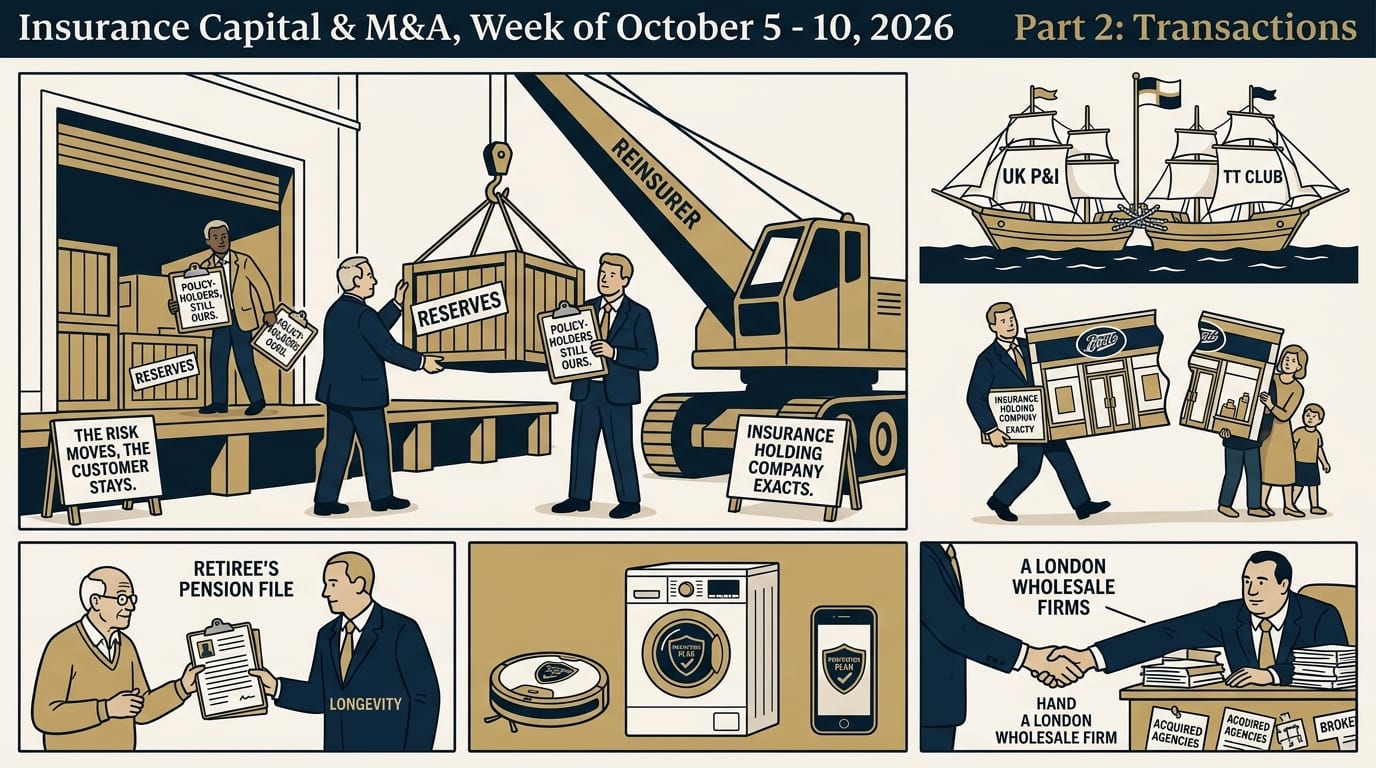
No combined dollar figure: reserves, premium and investment commitments do not add | 12 transactions | Three insurers move billions in reserves to reinsurers and keep the customer, two marine mutuals vote to merge, Fairfax agrees to take half of Boots, and brokers keep buying specialists
This week the insurance industry saw many transactions, so we broke the report into two parts. Part 1 covered the funding rounds: venture capital, AI in underwriting, claims and loss control, and capital for brokers and MGAs. This is Part 2, which covers the transactions: acquisitions, risk transfers, consolidation and how insurers are allocating their own capital.
The three risk transfers share a design. Prudential, Lincoln and American National each moved long-dated liabilities to a reinsurer. In the first two, the original insurer keeps administering the policies and the relationship with the policyholder. The risk moves; the customer stays.
Do not add the headline numbers together. Prismic’s roughly $5 billion and Lincoln’s $5.8 billion are reserves, Pacific Life Re’s $3 billion is pension liabilities whose longevity risk it assumes, the UK P&I and TT Club figure of about $750 million is annual premium, and Fairfax’s up to $2.3 billion is an equity commitment toward a deal valued near $8.9 billion including debt. Each measures something different.
GILAD SHAI ON THE WEEK'S DEALS — WHAT THE NUMBERS DON'T SAY
1. Prismic Life / Prudential Financial (Bermuda / USA)
~$5B of Reserves | Prudential Reinsures Japanese Dollar Whole Life to a Platform It Helped Sponsor | Date: October 5, 2026
What Happened
Prismic Life agreed to reinsure approximately $5 billion of reserves on USD-denominated whole life policies issued by Prudential Financial’s Japanese affiliates. Prudential’s commitments to policyholders are unchanged and Prudential continues to administer the policies. The announcement does not give a closing date or name the Prudential affiliate.
Prismic is a Bermuda-based life and annuity reinsurance platform that draws on the asset management capabilities of Prudential’s PGIM. Counsel to Prudential describes it as sponsored by Prudential and Warburg Pincus and supported by a group of global investors. Including earlier in-force and new business flow arrangements, Prismic says the two companies’ transactions now cover more than $22 billion of USD-denominated liabilities, and it expects to manage about $25 billion of assets supporting the liabilities it has assumed once this deal closes.
Prismic’s Group Executive Chair and CEO is Nandini Mongia. Prudential Chairman and CEO Andy Sullivan said the transaction reflects Prudential’s continued focus on disciplined capital allocation.
- Reinsurer: Prismic Life
- Cedent: Prudential Financial, through its Japanese affiliates’ USD whole life policies
- Advisers: PGIM, Agam Capital Management, Willkie Farr & Gallagher and Appleby advised Prismic; Debevoise & Plimpton advised Prudential
Strategic Thesis
This is a sponsor ceding business to a platform it helped build. Prudential moves a long-dated block to Prismic, whose asset management draws on PGIM, and Prudential keeps the policyholder relationship.
The numbers show a relationship, not a one-off. A $5 billion agreement sits on top of earlier arrangements, which together Prismic puts above $22 billion. A reinsurer that assumes liabilities repeatedly from the same cedent can build the asset base it needs to earn spread.
Why It Matters
- Prudential did not quantify the capital effect. Sullivan’s description, disciplined capital allocation, is the only stated rationale.
- Prismic expects to manage about $25 billion of assets against the liabilities it has assumed once this deal closes. The coverage also mentions a separate Prismic transaction with Daiichi Life, which is not detailed.
- The policies are USD-denominated and were issued by Japanese affiliates. The announcement does not say how the assets backing them will be managed.
Competition
- Direct competitors: Talcott Financial Group and Fortitude Re, the platforms that took Lincoln’s guaranteed universal life blocks in this week’s other large life transfer and in 2023, and that compete for legacy and in-force life blocks from the same cedent universe.
- Category competitors: Other life and annuity reinsurers that bid for flow and in-force blocks alongside asset managers, which compete for the same assets-under-management relationship.
- Emerging dynamic: Sponsor-backed Bermuda reinsurance platforms that take blocks from a parent or affiliated insurer and are supported by that group’s asset manager.
Market Consequences
For Prudential, the transaction reduces what it holds on the block while it keeps administration, and it did not disclose the capital effect. For competing reinsurers, a sponsor-backed platform with a stated $25 billion asset target is a bidder with a built-in source of business. For policyholders in Japan, nothing changes, which is the point of structuring this as reinsurance.
Bottom line: Prudential moved roughly $5 billion of Japanese dollar whole life reserves to a reinsurer it helped create, and kept the customer.
2. Pacific Life Re / American National (Bermuda / USA)
$3B Longevity Reinsurance | Pacific Life Re Enters the US Pension Risk Transfer Market With a Top Participant | Date: October 6, 2026
What Happened
Pacific Life Re, the global reinsurance arm of Pacific Life, executed a longevity reinsurance transaction with American National Insurance Company. It assumes the longevity risk on $3 billion of pension risk transfer liabilities. The announcement was made from Bermuda and gives no pricing, structure or closing detail.
The deal marks the entry of Pacific Life Re’s Savings & Retirement business into the US longevity reinsurance market. The company cites existing pension risk transfer work in the UK, the Netherlands and Canada. American National is described by its counsel as a leading participant in the US pension risk transfer market. Executive Vice President of Savings & Retirement Phill Beach said the deal shows Pacific Life Re can deliver tailored longevity solutions at scale. Eversheds Sutherland advised Pacific Life Re and Debevoise & Plimpton advised American National.
- Reinsurer: Pacific Life Re
- Cedent: American National Insurance Company
- Risk assumed: Longevity risk on $3 billion of pension risk transfer liabilities
Strategic Thesis
A pension risk transfer insurer takes a pension plan’s obligations and then faces the risk that retirees live longer than assumed. Reinsuring that longevity risk lets it keep writing new pension buyouts without holding all the risk. That is the general function of this kind of reinsurance. American National has not said how it will use the capacity.
For Pacific Life Re, the point is geography. It already reinsured longevity in the UK, the Netherlands and Canada, so this is a new market with a client that is active in it. A first US transaction of $3 billion gives it a reference deal.
Why It Matters
- The $3 billion is liabilities whose longevity risk moves, not an amount of assets or premium. It is not comparable to the Prismic and Lincoln reserve figures.
- A reinsurer entering a market with a single large deal gets a credential, but not yet a track record in US plans.
- American National’s counsel and Pacific Life Re’s own announcement agree on the amount and the nature of the risk. Neither discloses terms.
Competition
- Direct competitors: The longevity reinsurers already active in the US pension risk transfer market, which American National could have selected instead. This report did not identify them from the announcements, which name none.
- Category competitors: Insurers that keep longevity risk on their own balance sheets and compete for the same pension buyouts.
- Emerging dynamic: Pension risk transfer insurers sharing longevity risk with reinsurers so they can keep writing new buyouts, a model Pacific Life Re has already used in the UK, the Netherlands and Canada.
Market Consequences
For pension plan sponsors, more reinsurance capacity behind buyout insurers supports continued appetite to take on obligations. For American National, ceding longevity risk on $3 billion of liabilities reduces what it carries on those obligations, and the company has not said what it will do with the capacity. For other US longevity reinsurers, a new entrant with a stated appetite for scale arrives with a first reference deal.
Bottom line: Pacific Life Re’s first US longevity deal is $3 billion with one of the market’s active buyout insurers, which is how a reinsurer buys its way onto the panel.
3. Lincoln Financial / Talcott Financial Group (USA)
$6.3B Completed | Lincoln Cedes Another Block of Guaranteed Universal Life and Keeps Administering It | Date: Completed October 1, 2026; announced July 30, 2026
What Happened
Lincoln Financial completed its reinsurance transaction with Talcott Financial Group, effective October 1. A Talcott subsidiary reinsures about $5.8 billion of in-force guaranteed universal life statutory reserves, roughly 37% of Lincoln’s remaining in-force guaranteed universal life block. The July announcement also covered the reinsurance of about $500 million of funding agreement business, and the closing release puts the transaction at $6.3 billion. Together with Lincoln’s 2023 reinsurance transaction with Fortitude Re, about 60% of Lincoln’s guaranteed universal life block is now reinsured.
The structure is partly coinsurance with funds withheld and partly modified coinsurance, with over-collateralization and agreed investment guidelines protecting Lincoln. Lincoln continues to administer the policies and manage claims. In July Lincoln put the all-in statutory capital impact at about $200 million, lowering its risk-based capital ratio by about 10 percentage points, funded from part of the proceeds of its strategic partnership with Bain Capital. It expects medium-term annual remittances from its subsidiaries to rise by $30 million to $40 million.
Chairman, President and CEO Ellen Cooper called the transaction another deliberate step in a multi-year strategy to fortify Lincoln’s balance sheet.
- Cedent: Lincoln Financial
- Reinsurer: A subsidiary of Talcott Financial Group
- Advisers: Wells Fargo and Skadden advised Lincoln
Strategic Thesis
Guaranteed universal life is the kind of block that ties up capital for decades for a product that is no longer sold. Lincoln’s answer is to reinsure the block in stages: Fortitude Re in 2023, Talcott now. Each transfer reduces what Lincoln holds against policies it does not want to grow.
The cost is visible and was disclosed: about $200 million of statutory capital and a lower risk-based capital ratio, offset by higher remittances and a lighter balance sheet. Lincoln expects to stay well above its stated buffer.
Why It Matters
- About 60% of the guaranteed universal life block is now reinsured. In the Talcott transaction, Lincoln keeps administering the policies and managing claims.
- Funding the capital cost from the Bain Capital partnership proceeds ties this transaction to a separate Lincoln capital event.
- The $6.3 billion headline combines two different kinds of business. Only the $5.8 billion of guaranteed universal life reserves is the 37% block.
Competition
- Direct competitors: Fortitude Re, which took Lincoln’s first guaranteed universal life block in 2023, and Prismic Life, which is taking in-force life reserves from Prudential this week.
- Category competitors: Insurers that retain and run off their own legacy life blocks instead of ceding them.
- Emerging dynamic: Staged reinsurance of legacy blocks by insurers that want to keep the policyholder relationship and the administration.
Market Consequences
For Lincoln, the next question is whether it cedes the remaining roughly 40% of the block. For reinsurers, Lincoln has shown that it will cede in tranches, which is a pipeline. For policyholders, administration and claims stay with Lincoln.
Bottom line: Lincoln has now reinsured about 60% of its guaranteed universal life block, and it still administers the policies in this latest transaction.
4. Asurion / Domestic & General (USA / UK)
Completed, Terms Undisclosed | A Device Protection Giant Takes the UK’s Appliance Protection Leader | Date: October 8, 2026
What Happened
Asurion completed its acquisition of Domestic & General, a provider of appliance protection across the UK, Europe and beyond. Financial terms were not disclosed, and the release does not name the seller.
Domestic & General has partnerships with more than 100 brands, including Whirlpool, Sky, Hoover-Candy and John Lewis. It operates in 12 markets across the UK, Europe and the US, protects more than 22 million appliances, serves more than 7 million subscription customers, employs more than 4,000 people and repairs more than 2.6 million appliances a year.
Domestic & General keeps its brand within Asurion, and neither company expects immediate changes in how it serves customers and partners. Asurion CEO Guru Gowrappan said customers should not have to navigate a different solution for every device or appliance. Domestic & General CEO Matthew Crummack called the combination a compelling fit. The release does not say whether Crummack’s role continues.
- Acquirer: Asurion
- Target: Domestic & General
- Advisers: Goldman Sachs, Morgan Stanley and Hogan Lovells Cadwalader advised Asurion; Rothschild & Co and Latham & Watkins advised CVC
Strategic Thesis
Asurion’s business is protecting and supporting consumer technology. Domestic & General adds white goods and a subscription base: seven million customers paying for appliance cover, sold through brands and retailers.
The pitch is the connected home. Asurion’s release cites a connected-home devices market above $150 billion, and the strategy is one provider for every device and appliance in the house. Domestic & General’s brand partners are the distribution that makes that credible.
Why It Matters
- The deal puts a device and an appliance protection platform under one owner, with partners and subscribers on both sides.
- Terms were not disclosed. Enterprise value figures in the press that came from aggregators are not used in this report.
- Domestic & General keeps its name. For partners that sell its cover under their own brands, that continuity matters.
Competition
- Direct competitors: Assurant and Allstate’s SquareTrade, which sell device and appliance protection through retailers and brands.
- Category competitors: Warranty administrators and embedded protection providers such as Extend, which compete for the same retailer and manufacturer partnerships.
- Emerging dynamic: Retailers and manufacturers bundling protection for connected devices and appliances through one provider.
Market Consequences
For retailers and brands that sell appliance cover, the buyer of their provider is now a technology care company with a device base. For appliance protection rivals, the deal raises the bar on subscription scale.
Bottom line: Asurion bought more than seven million appliance subscribers to add to its device protection business, and the strategy is the whole house.
5. UK P&I Club / TT Club (UK)
~$750M Combined Annual Premium | Two Marine and Transport Mutuals Vote to Merge | Date: October 8, 2026 (members voted October 7 and 8; effective February 20, 2027)
What Happened
Members of the UK P&I Club and the TT Club approved a merger at separate special general meetings on October 7 and 8, creating United Transport Mutual as the parent of both clubs. The merger takes effect on February 20, 2027, subject to regulatory approvals. The two boards had agreed to explore it in November 2025.
The clubs estimate combined annual premium of about $750 million and free reserves of about $888 million, and forecast a 5% improvement in the combined ratio from integration. Each club keeps its brand, market position and service teams, and the group stays within the International Group of P&I Clubs. UK P&I describes it as the first transport mutual to span the entire cargo supply chain.
Separately, United Transport Mutual will be the parent for the clubs’ proposed acquisition of the manager, Thomas Miller Holdings, whose shareholders accepted the clubs’ offer in September. The clubs expect regulatory approval for that transaction in the coming weeks.
Niels Smedegaard is chairman, with Jan Valkier of UK P&I and Morten Engelstoft of TT Club as co-chairs. Andrew Taylor becomes chief executive of United Transport Mutual, William Beveridge succeeds him as chief executive of the UK P&I Club, and Kevin King continues as chief executive of TT Club.
- Parties: UK P&I Club, TT Club
- Parent: United Transport Mutual
- Manager: Thomas Miller, being acquired by the clubs
Strategic Thesis
Both clubs were managed by Thomas Miller, so they already shared people, systems and strategy. A mutual merger needs a member vote, and it got one in two meetings. The remaining step is regulatory.
The case the clubs make is scale against rising claims costs, geopolitical uncertainty, technology change and competition for specialist skills. Putting marine liability and cargo and logistics cover under one roof also gives members a single group across the supply chain.
Why It Matters
- The combined premium and reserves figures are the clubs’ own estimates, and the 5% combined ratio improvement is a forecast.
- Buying the manager in the same structure removes the arm’s-length relationship between the clubs and the firm that runs them.
- The group stays in the International Group, which pools large marine liability claims.
Competition
- Direct competitors: The other International Group P&I clubs, including NorthStandard, formed from the 2023 combination of two clubs, and Gard, which compete with UK P&I for shipowner and charterer members.
- Category competitors: Commercial marine and cargo insurers that compete with TT Club for logistics and transport operator business.
- Emerging dynamic: Mutual clubs consolidating to build capital and technology capacity in a market with rising claims costs.
Market Consequences
For members, the merged group offers one counterpart across shipping and cargo, with brands kept. For other mutuals, the scale argument will be tested over the next renewals. For Thomas Miller, the owners become the two clubs it manages, once regulators approve.
Bottom line: Two mutuals that shared a manager are now one group, and they bought the manager too.
Special Situation: Fairfax Financial / Wittington Investments / Boots (Canada / UK)
~$8.9B Including Debt, Fairfax Equity of Up to ~$2.3B | An Insurance Holding Company Agrees to Take Half of a Pharmacy and Beauty Retailer | Date: October 7, 2026
Why this is a Special Situation rather than a core insurance deal: Boots is a pharmacy, optical and beauty business. It is included because Fairfax Financial Holdings, a Canadian insurance holding company, is the investor taking half of the equity, and the transaction is a use of insurance group capital outside insurance.
In a filing with the SEC, Fairfax said it entered into agreements to partner with Wittington Investments, the Weston family’s Canadian holding company, to acquire the Boots business from The Boots Group. The price is approximately US$8.9 billion, including assumed debt. Fairfax entered into an equity commitment letter to provide, or cause an affiliate to provide, up to approximately US$2.3 billion toward the purchase price, and it is expected to own 50% of Boots’ equity after closing. Wittington will have operational control and Galen Weston will serve as chair. Completion is expected in the first quarter of 2027, subject to customary closing conditions.
The business covers Boots’ retail operations in the UK and Ireland, Boots Opticians, the No7 Beauty Company, and the Thailand and franchised businesses. Boots’ interests in Farmacias Benavides and Alliance Healthcare Deutschland are excluded. Fairfax Chairman and CEO Prem Watsa said Fairfax is very pleased to partner with Galen Weston and the Wittington team.
Bottom line: An insurer agreed to put up to $2.3 billion into half of a drugstore chain and let someone else run it, which is a view on where long-term capital earns a return.
Market Context
Specialty underwriting comes to an agency network (October 5). The Specialty Insurance Alliance of America, whose Agent Alliance includes more than 5,200 independent agency members writing over $18 billion in premium, acquired Canopy Specialty Insurance, a managing general agent in the US and UK that underwrites niche commercial risks including contractors’ liability, excess casualty and legal indemnity programs. Terms were not disclosed. Canopy keeps its underwriting authority, carrier capacity and wholesale relationships, and its CEO Justin Tweedie continues to lead it. SIAA CEO Matt Masiello said the deal gives SIAA access to underwriting and product development capabilities. SIAA already runs retail, wholesale and MGA operations, and this adds underwriting and product development to the group.
Gallagher keeps buying specialists on both sides of the claim. Arthur J. Gallagher announced on October 6 that its claims and risk management subsidiary Gallagher Bassett acquired Winter & Co Solicitors, a London maritime law firm serving P&I clubs, marine insurers, shipowners and charterers. Glenn Winter and his team stay in place under Gallagher Bassett’s head of Europe, the Middle East and Asia. On October 7, Gallagher’s Pen Underwriting acquired Ornella Underwriting, a managing general agent in Wexford, Ireland that distributes through independent brokers and specializes in private car, van, home and motor fleet. Paul Whelan continues to lead the team. Terms were not disclosed for either deal. The Winter & Co purchase adds maritime legal expertise to Gallagher Bassett’s marine claims business.
Clear Group builds a London wholesale arm (October 5). Goldman Sachs Alternatives-backed Clear Group acquired London wholesale broker Commercial Risks (UK), founded in 2002, and its MGA, Troon Underwriting. Commercial Risks has seven employees and places complex and hard-to-place risks into Lloyd’s and the company market, mainly for UK retail brokers, with specialisms in contractors’ risks, casualty and professional risks. Terms were not disclosed. Clear says it is the group’s third London wholesale acquisition in two years and its second in six weeks.
Alliant adds a 164-year-old New England agency (October 8). Alliant acquired Melcher & Prescott, an independent agency in Laconia, New Hampshire, founded in 1862, offering commercial insurance, employee benefits, personal lines and life and health coverage. It will operate as Alliant Insurance Services. Terms were not disclosed. Alliant said the deal strengthens its presence in the Northeast.
Marsh completes Accel Holdings (October 2). Marsh completed its acquisition of Accel Holdings, a diversified insurance and advisory firm in Waverly, Iowa, founded in 1936 that offers commercial and personal insurance, employee benefits, agribusiness solutions, wealth management and retirement advisory services. Accel operates within Marsh Agency, and all Accel colleagues joined Marsh Agency in their current locations. Terms were not disclosed. Marsh Agency President Matt Stadler said the deal continues the expansion of a platform designed to serve the middle market.
FINRA disclosure: This report is for informational purposes only and does not constitute investment advice or a solicitation.