Insurance & InsurTech Investment Intelligence Report: Week of October 5 - 10, 2026 (Part 1: Funding)
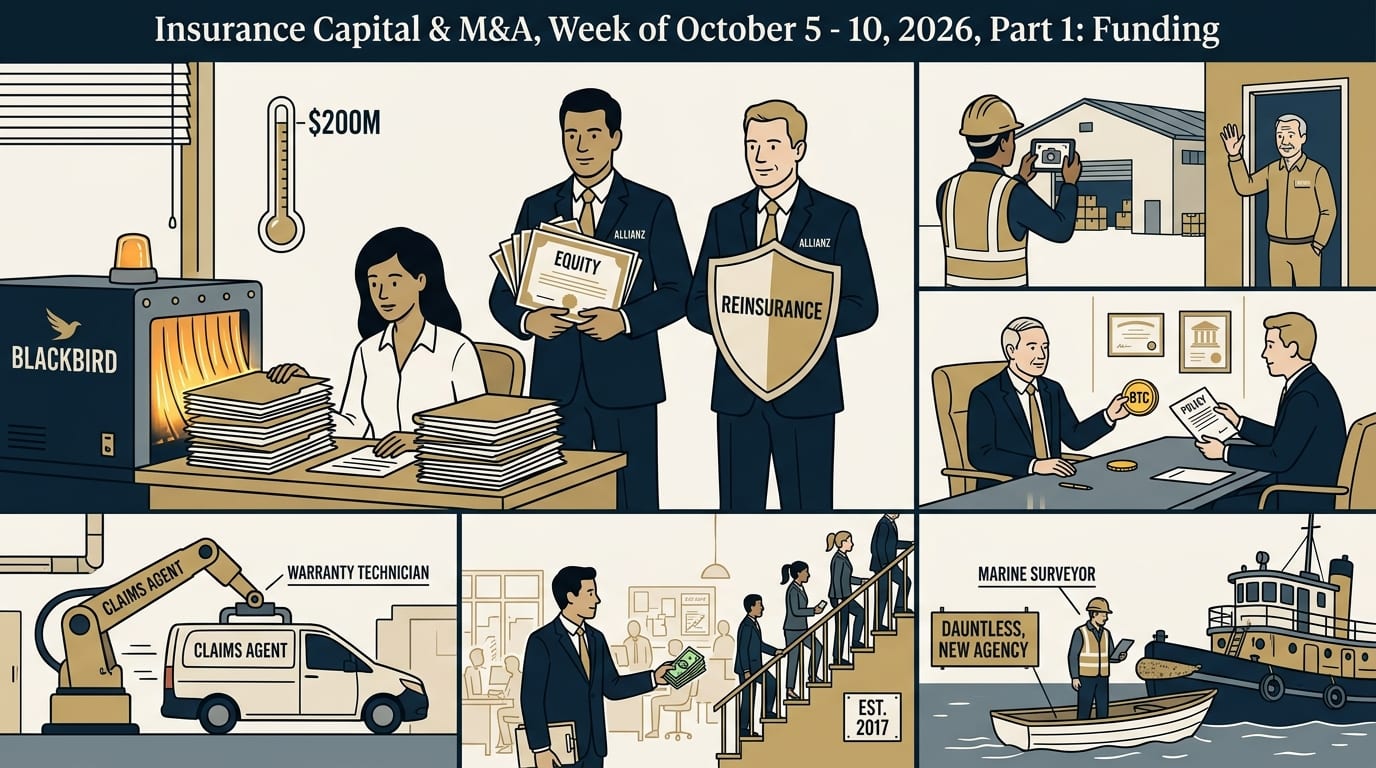
$248.6M in disclosed USD funding | 7 transactions | Allianz co-leads an AI-native specialty insurer and signs on as its reinsurer, Bitcoin life insurance raises again from its existing backers, and the money reaches claims, loss control, brokers and MGAs
This week the insurance industry saw many transactions, so we broke the report into two parts. Part 1 covers the funding rounds: venture capital, AI-driven underwriting, claims and loss control, and capital for distribution. Part 2 dives into acquisitions, risk transfers, consolidation and how insurers are allocating their own capital.
Four rounds disclosed US dollar amounts this week: Ledgebrook ($200 million), Meanwhile ($37.5 million), Polygrade ($6.3 million) and Nettle ($4.8 million), a combined $248.6 million. Konsileo’s £5 million raise, SecondSight’s undisclosed Series A and B.P. Marsh’s investment in a new marine underwriting agency sit outside that subtotal. The figure is the sum of those four rounds, not the value of all seven transactions.
The pattern is capital moving to the places where insurance work is still manual. Ledgebrook uses AI to read and price specialty submissions. Polygrade automates warranty claims. Nettle replaces slow, backlogged loss control inspections. SecondSight sells a modeling layer to insurers. The money also came from people who already know the business: Allianz put equity and reinsurance into Ledgebrook in one announcement, Meanwhile raised its entire round from existing investors, and Konsileo’s round was led by a long-standing shareholder.
GILAD SHAI ON THE WEEK'S DEALS — WHAT THE NUMBERS DON'T SAY
1. Ledgebrook (USA)
$200M Primary Equity | An AI-Native E&S Insurer Gets Allianz as Co-Lead and Reinsurer | Date: October 7, 2026
What Happened
Ledgebrook, a Boston-headquartered, AI-native specialty insurer, raised $200 million in primary equity, co-led by Allianz X, the strategic investment arm of Allianz Group, and Rockefeller Capital Management. Existing and new investors also participated and were not named. Separately, Allianz Re agreed to a multi-year reinsurance agreement with Ledgebrook. No valuation was disclosed.
Ledgebrook writes general liability, professional liability and specialty coverage for mid-sized US businesses in the excess and surplus lines market and distributes only through wholesale brokers. Its Blackbird platform reads submissions, classifies the risk and calculates a technical price, and an underwriter makes the final decision. The company says specialty risks are often quoted in hours rather than weeks.
Founder and CEO Gage Caligaris, a Harvard mathematician and actuary, started the company in Boston in 2022. Ledgebrook employs about 300 people, including roughly 80 underwriters and 50 engineers, and says it is on track to pass $1 billion in cumulative premium written since it began writing business in 2023. Its insurance company, Ledgebrook Specialty Insurance Company, received an A- (Excellent) financial strength rating from AM Best in August 2026.
- Co-leads: Allianz X, Rockefeller Capital Management
- Investors: Existing and new investors, not named
- Reinsurance: Allianz Re, multi-year agreement
Use of Funds
- Scale the technology and extend the Blackbird underwriting platform
- Expand the technology-led approach to US specialty underwriting for custom and complex risks
Strategic Thesis
Most AI underwriting companies sell software to carriers. Ledgebrook is the carrier. That is why this round is more than five times the size of the next largest in the window: an insurer needs capital behind its balance sheet, not only behind its engineering team.
The Allianz structure is the notable part. Allianz X owns equity, and Allianz Re takes reinsurance exposure under the same announcement. A strategic investor that also assumes risk has a stake in the loss ratio as well as the growth rate. For a young carrier, that is also a source of capacity at the time it is scaling premium.
The AM Best rating arrived in August, two months before the raise. The company had a financial strength rating to show brokers and reinsurers before the capital arrived.
Why It Matters
- $200 million is about 80% of the disclosed USD funding this week. One round sets the tone for the report.
- Equity and reinsurance in one announcement is a template other AI-native carriers will want to copy. It ties the investor to the underwriting results.
- Roughly 130 of Ledgebrook’s 300 employees are underwriters and engineers. Experienced underwriters still make the final decision on every risk, so the model is software plus underwriters, not software instead of them.
Competition
- Direct competitors: Kinsale Capital and other E&S carriers that distribute through wholesale brokers and compete on speed of quote for small and mid-sized specialty risks.
- Category competitors: AI underwriting platforms sold to incumbent carriers, such as Federato, which compete for the same technology budget at the carriers Ledgebrook is quoting against.
- Emerging dynamic: Strategic insurers pairing equity with reinsurance capacity to back AI-native carriers directly, rather than leaving them to find capacity through the market.
Market Consequences
For wholesale brokers, a carrier that quotes complex risks in hours raises the standard for turnaround from every E&S market on their panel, over the next several renewal cycles. For incumbent E&S carriers, technical pricing at the submission stage becomes the baseline the market compares them to. For reinsurers, Allianz Re’s agreement sets a precedent for how large reinsurers might support carriers that have an investor, a rating and a track record of premium growth.
Bottom line: Allianz is not only backing Ledgebrook’s software. It is putting equity and reinsurance behind the underwriting, which is a bet on the loss ratio and not on the demo.
2. Nettle
$4.8M Seed | The AI Workspace for Loss Control, Backed by the Insurance Specialist Who Led It | Date: October 6, 2026
What Happened
Nettle raised an oversubscribed $4.8 million seed round led by MTech, with Project A, SVV (Sure Valley Ventures), Portfolio Ventures and Ventures Together participating. The company raised a $2 million pre-seed in March 2025, bringing total funding to $6.8 million. It was founded in 2024.
Jack Miller, CEO and co-founder, and Katya Kinane, CTO and co-founder, previously built and deployed AI products for insurance and financial services at McKinsey, where they worked together at QuantumBlack.
Nettle’s AI Workspace for Loss Control combines remote risk identification, guided inspections, evidence analysis and report generation. It analyzes images, video, audio, documents and third-party data and produces reports, risk scores and recommendations. It started in commercial property and now covers liability, construction and workers’ compensation, and Nettle is extending it to agents and policyholders. Named customers are Allianz and Brotherhood Mutual.
- Lead: MTech
- Investors: Project A, SVV, Portfolio Ventures, Ventures Together
Use of Funds
- Expand across the US and Europe
- Grow engineering and go-to-market teams
Strategic Thesis
Loss control is the part of underwriting that physically touches the risk, and it runs on a shrinking workforce. Nettle’s release estimates that about 40% of risk engineers will retire by 2030 and says industry inspection backlogs can reach six months. Those are company estimates, not independent figures, but they describe a real capacity problem.
Nettle’s answer is to move the inspection into software and let the risk engineer review evidence instead of driving to a site. The company says inspections run up to five times faster and that reports that took days can be produced in seconds.
MTech’s lead is a sector signal. It is a venture investor focused on insurance, backing a founder team whose background is McKinsey’s insurance AI practice, in an area MTech’s founder and managing partner, Kevin McLoughlin, says startups often overlook.
Why It Matters
- Allianz is a Nettle customer and, in the same week, the co-lead of Ledgebrook’s round. A single large insurer is buying and backing AI across underwriting and risk control at once.
- The product’s reach is widening from commercial property into liability, construction and workers’ compensation, which is where loss control spend is largest.
- A $4.8 million seed with two named insurer customers is a small round with early distribution, which is what carriers look for before a pilot becomes a contract.
Competition
- Direct competitors: Carriers’ own risk engineering teams and the inspection vendors they use today. The release does not name a venture-backed rival selling the same multimodal workspace.
- Category competitors: Betterview and Zesty.ai, which sell property risk analytics to insurers and compete for the same underwriting and risk control budget.
- Emerging dynamic: An aging risk engineering workforce and inspection backlogs pushing carriers to extend loss control to more of the portfolio.
Market Consequences
For carriers, faster inspections mean more of the book can be reviewed in a given year, which changes the economics of loss control for mid-sized accounts. For inspection vendors, software that produces the report removes the labor premium they charge. For policyholders, the move to guided inspections puts more of the evidence-gathering on the insured.
Bottom line: Nettle is selling insurers back the capacity they are about to lose to retirement, and an insurance-focused lead investor is betting the shortage is the product.
3. Polygrade (Canada)
$6.3M Seed | An AI Claims Platform for Home Warranty, Insurance-Adjacent With Insurance Ambitions | Date: October 6, 2026
What Happened
Polygrade, a Toronto-based company emerging from stealth, raised $6.3 million in seed funding from Construct Capital, American Family Ventures and Nine Four Ventures. BetaKit reports the round was raised through SAFEs in two parts: $3.3 million in early 2025 and $3 million from Construct in July, with Hustle Fund, Room and Pillar also named as investors.
Polygrade builds an AI-native claims management platform for the warranty industry, starting with home warranty. Specialized AI agents handle first notice of loss, pre-dispatch triage, authorization, parts procurement and payment. The platform sits above a warranty company’s existing systems, follows that company’s rules and sends exceptions to people. It also builds a record of policies, claims, decisions and outcomes.
Founder and CEO David Steckel previously founded Setter, which Thumbtack acquired, and later served as chief product officer of Sears Home Services. Co-founder Eui Chung spent nearly 30 years at Sears and Transformco and led the AI transformation at Sears Home Services. Co-founder Kaustubh Vongole previously led fulfillment products and AI strategy.
- Investors: Construct Capital, American Family Ventures, Nine Four Ventures
- Customers: Fidelity National Home Warranty (in production), Cinch Home Services
- Partners: Encompass, UED, Sibi, Marcone
Use of Funds
- Grow forward-deployed engineering, go-to-market and partner enablement teams
- Expand into extended warranty, OEM warranty and equipment breakdown insurance
Strategic Thesis
This report treats Polygrade as insurance-adjacent. A home warranty is a service contract rather than an insurance policy, and the claims work is closely related. The link to insurance is explicit in the company’s plan to add equipment breakdown insurance and in the presence of an insurer-owned venture arm, American Family Ventures, on the cap table.
Claims is the point where a warranty company’s margin is decided: dispatch, parts and payment. Polygrade targets that chain rather than the front-end sale. Because it sits above existing systems, a warranty company can adopt it without replacing its core platform.
Polygrade discloses no revenue or usage figures. What it does have is a customer in production, a second customer using it for appliance dispatch triage and parts sourcing, and a founding team that ran home services at Sears.
Why It Matters
- Warranty and equipment breakdown sit between product guarantees and insurance, and the claims process is the same operational problem.
- American Family Ventures is a carrier-affiliated investor in a company that plans to move toward insurance products.
- BetaKit reports two of the five largest US warranty firms became customers in the company’s first year. That claim comes from one outlet and the customers are not named.
Competition
- Direct competitors: The claims teams and outsourced administrators warranty companies use today. No venture-backed rival selling the same agentic claims layer was identified in the sources reviewed.
- Category competitors: Assurant, which administers warranty and service contract claims at scale, and Extend, which sells warranty programs to retailers. Both compete for the same warranty budget.
- Emerging dynamic: AI agents that run above legacy claims systems rather than replacing them, deployed by forward-deployed engineers working inside the customer.
Market Consequences
For home warranty providers, faster dispatch and parts sourcing can reduce cost per claim and shorten time to repair, which is where customer complaints concentrate. For claims administrators, software that handles triage and payment threatens the labor-based part of their fees. For insurers writing equipment breakdown, Polygrade’s expansion plan could bring a new claims technology into their line within the year.
Bottom line: Polygrade is going after the dispatch-and-payment chain that decides a warranty company’s margin, with a carrier-backed investor already watching the move toward insurance.
4. Meanwhile (Bermuda)
$37.5M | Bitcoin Life Insurance Raises From Its Existing Backers | Date: October 8, 2026
What Happened
Meanwhile, which sells Bitcoin-denominated life insurance, raised $37.5 million in new funding from existing investors, led by Bain Capital Crypto. Haun Ventures, Framework Ventures, Pantera Capital, Apollo, Northwestern Mutual Future Ventures and Morgan Creek Digital also participated. Sam Altman, MS&AD and Fulgur Ventures are among the other backers named. The company has raised more than $180 million in total. The release does not state the round stage.
Co-founder and CEO Zac Townsend and co-founder Max Gasner run the company. Its insurer, Meanwhile Insurance Bitcoin (Bermuda) Limited, holds a first-class long-term insurance license from the Bermuda Monetary Authority, granted in July 2024 after two years in the regulator’s sandbox. It can write long-term business only with sophisticated persons. Its balance sheet, reserves and audited financials are denominated in Bitcoin, and policyholder Bitcoin is held with regulated institutional custodians.
The product is a single-premium whole life policy: the client pays one Bitcoin premium and receives a guaranteed death benefit in Bitcoin. After year one, the owner can borrow up to 90% against the policy with no repayment schedule and no margin calls. BTC Life 1-Pay, launched in early 2026, is aimed at high-net-worth clients outside the US. BTC 10-Pay, the first product, is designed for US taxpayers.
Meanwhile says it has signed 15 brokers since launch, including in Singapore, Hong Kong, the UAE and Switzerland, and names Lioner and Apeiron Group as distribution partners. It reports that net long-term underwriting income has already passed last year’s total and is on track to more than double in 2026, without giving figures.
- Lead: Bain Capital Crypto
- Investors: Haun Ventures, Framework Ventures, Pantera Capital, Apollo, Northwestern Mutual Future Ventures, Morgan Creek Digital
- Other backers named: Sam Altman, MS&AD, Fulgur Ventures
Use of Funds
- Not stated. The release says the round lets the company meet broker demand and pursue further international growth.
Strategic Thesis
Meanwhile is an insurance company before it is a Bitcoin company. The license, the Bermuda sandbox history and the audited Bitcoin-denominated balance sheet are the credentials a regulated carrier needs, and they are the reason brokers and private banks can place the product.
The distribution model is deliberate. Meanwhile sells through brokers, private banks and family offices serving wealthy clients in Asia, Europe and the Middle East, where Bitcoin holders look for estate and succession planning products. The 90% borrowing feature lets the owner access value without selling Bitcoin.
An all-insider round is a signal in both directions. Existing investors, including a lead who has already backed the company, chose to add capital after seeing a year of results. But no new investor priced the company, so the round does not show how outside capital values it.
Why It Matters
- It is the second-largest round in the report and the only one built on a different unit of account than the dollar.
- Northwestern Mutual Future Ventures, the venture arm of a life insurer, is among the investors alongside Apollo, and MS&AD, an insurance group, is among the other backers named.
- Net underwriting income is described as already ahead of last year’s total. That is the metric a Bermuda carrier lives on, though the release gives no numbers.
Competition
- Direct competitors: The release does not name a rival Bitcoin-denominated life carrier, and none was identified in the sources reviewed.
- Category competitors: Cross-border high-net-worth life insurers such as Zurich International Life and Swiss Life International, which compete for the same wealth-planning client, and Bitcoin-backed lenders such as Ledn and Unchained, which compete with the policy-loan feature.
- Emerging dynamic: Digital assets entering estate and wealth planning, with brokers and private banks looking for a regulated product to hold them in.
Market Consequences
For private banks and family offices, a regulated Bitcoin-denominated policy offers a way to bring digital assets into succession planning without selling them. For traditional high-net-worth life carriers, a competitor that holds reserves in Bitcoin raises questions about how clients would value that denomination. For Bermuda’s regulator, a growing Bitcoin-denominated balance sheet adds to the scrutiny of custody and valuation practices.
Bottom line: Meanwhile raised from people who already own a piece of it, which proves its backers still believe and leaves the outside market’s view of the price untested.
5. SecondSight (USA)
Series A, Amount Undisclosed | An Insurance AI Operating System Leaves Cyber and Hires an Industry President | Date: October 5, 2026
What Happened
SecondSight, an AI operating system for insurance based in Bloomington, Indiana, announced that it closed a Series A. The amount, the lead investor and the investor list were not disclosed. The release says only that the backers have deep insurance-market experience.
The company named Jamie Bouloux as president, responsible for commercial strategy and client relationships. Bouloux was chief executive of Ryan Financial Lines and Celerity Risk and previously spent eight years as founder and CEO of EmergIn Risk, a London and US cyber insurance MGA. He also led CFC Underwriting’s large corporate cyber facility and held leadership roles at AIG, including head of cyber and technology, media and telecom liability for EMEA. Reuben Vandeventer is CEO.
SecondSight’s platform, called SHAPE, learns from an insurer’s own data and live external signals. The company describes a Large Quantitative Model architecture combining algebraic geometry and topological methods with deep learning, plus a model factory for line-specific and segment-specific models. Customers own the trained models, which run in isolated environments. Use cases are underwriting, distribution, reinsurance and portfolio analysis.
Use of Funds
- Accelerate organizational growth and product development as SecondSight expands beyond its cyber origins into other lines
Strategic Thesis
SecondSight began in cyber and is now moving into other lines, which is the usual test for an insurance data company: does the model work where there is less data? Hiring a president who has run cyber MGAs and facilities signals that the first market was cyber and the next conversation is with carrier executives.
The release provides no financial or customer metrics and does not name customers beyond “some of the world’s largest insurers.” What the market learns from this announcement is the company’s direction and its new leader.
Why It Matters
- The leadership hire is the disclosed substance of this announcement. A president with MGA, facility and carrier experience points the company at insurance buyers.
- Customers own the models they train, which addresses a standard objection from insurers about handing data to a vendor.
- An undisclosed round limits what can be said about investor appetite. This report counts it as a transaction and leaves it out of the dollar subtotal.
Competition
- Direct competitors: None verified. The release names no rival offering the same architecture to the same customers.
- Category competitors: Federato and hyperexponential, which sell underwriting and pricing platforms to insurers and compete for the same modeling budget.
- Emerging dynamic: Insurers asking for models they own and can audit, rather than scores returned from a vendor.
Market Consequences
For carriers evaluating AI vendors, model ownership and isolated environments become a requirement to ask about. For cyber insurers, a data company built in their line now has a president from inside the market. Whether the product travels into other lines will become visible in customer announcements over the coming quarters.
Bottom line: SecondSight raised a round it will not size and hired a president who has run cyber insurance businesses, so the story to watch is who signs next.
6. Konsileo (UK)
£5M Equity | A Broker That Grew Without Acquisitions Raises From Its Long-Term Shareholders | Date: October 7, 2026
What Happened
Konsileo, a UK independent chartered commercial insurance broker launched in 2017, raised £5 million in equity. Committed Capital, described as a long-term shareholder, led the round, and ACF Investors, which first invested in 2022, participated. Insurance Business reported the news on October 8.
Konsileo has more than 220 employees and arranges more than £85 million in annual premium for UK businesses. It added about 60 people since November 2024, when it had around 160. Earlier funding was £2.7 million in April 2018, a £4.7 million Series A in 2022 and £8 million of debt and equity in November 2024.
Co-founder and CEO John Warburton, formerly of Aviva, Accenture and Allianz, and co-founder and COO Peter Henderson built the firm on a flat structure in which brokers are paid on client relationships, trained through the Konsileo Academy and supported by a proprietary broking platform that automates administration and builds in compliance checks. The company plans to use the funding to keep hiring, invest in the platform and build on recent momentum ahead of its tenth anniversary.
Strategic Thesis
Konsileo’s pitch is that a broker can grow by recruiting individual brokers rather than buying agencies. In a market where private equity-backed consolidators dominate headlines, a UK broker raising from long-term shareholders to hire people and fund its platform offers a different model.
Why It Matters
- The round continues a funding path of £2.7 million, £4.7 million and £8 million from earlier raises, with long-term shareholders returning.
- The platform investment targets compliance and administration, the work that limits how many clients a broker can serve.
Bottom line: While others buy brokers, Konsileo is paying for the ones it grows itself, and its shareholders keep writing checks.
7. B.P. Marsh / Dauntless (UK)
30% Equity Stake plus £2M Loan Facility | A Specialist Investor Backs a New Marine Hull Underwriting Agency | Date: October 6, 2026
What Happened
B.P. Marsh & Partners, an AIM-listed specialist investor in early-stage financial services businesses, took a 30% stake in Dauntless U/W Limited for nominal consideration and provided a £2 million loan facility. The loan’s terms were not disclosed. B.P. Marsh Investment Director Abigail Benson joined the Dauntless board.
Dauntless is a newly formed London Market underwriting agency specializing in marine hull, with a focus on niche, brown water, older and distressed tonnage. It operates as an Appointed Representative of DA Strategy Limited and is backed by A-rated Lloyd’s carriers. Co-founders Des Keane and Charles Scott-Hopkins previously held senior underwriting roles at Lloyd’s syndicates including Tokio Marine Kiln, CNA Hardy and Ascot.
Strategic Thesis
B.P. Marsh’s model is to fund experienced underwriters at the start of a new agency. Here the investor supplies a minority equity stake and a loan to a team that already has capacity from A-rated Lloyd’s carriers. The Appointed Representative structure lets the agency launch without its own regulatory permissions.
Why It Matters
- It is a distribution-side investment: capital goes into the intermediary that places the risk, not the carrier.
- The consideration for the stake was nominal, so the £2 million loan is the disclosed capital commitment.
Bottom line: B.P. Marsh paid almost nothing for 30% of Dauntless and lent it £2 million, which makes the founders’ marine underwriting record the thing being bought.
FINRA disclosure: This report is for informational purposes only and does not constitute investment advice or a solicitation.