Insurance & InsurTech Investment Intelligence Report: Week of August 16-22, 2026
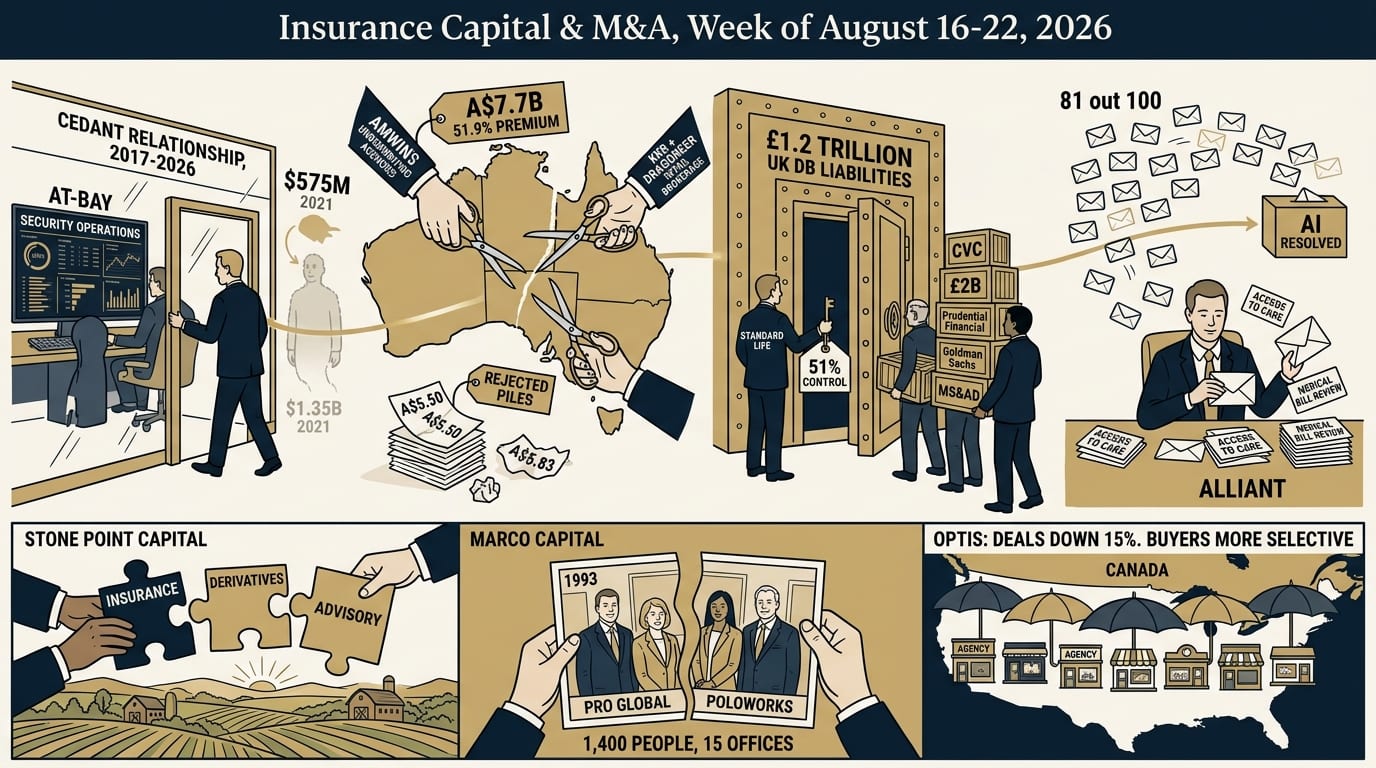
$8.3B+ in disclosed capital | 6 primary transactions + 1 special situation + 5 market context items | A reinsurer buys the cyber insurtech it had been reinsuring since 2017, Australia’s largest broker network signs a binding A$7.7 billion deed, and £2 billion of private capital arrives in UK pension risk transfer
Munich Re agreed to acquire At-Bay for $575 million, converting a nine-year cedant relationship into ownership of a top-ten US cyber insurer. The price is roughly 2x At-Bay’s $278 million in gross written premiums and roughly 57% below the $1.35 billion post-money valuation the company carried after its 2021 Series D, which is the clearest single data point on where insurtech valuations have settled. Steadfast Group signed a binding agreement with the KKR, Amwins, and Dragoneer consortium at A$7.7 billion, ending a process this report has tracked since June. Standard Life brought CVC, Prudential Financial, Goldman Sachs, and MS&AD into a £2 billion pension risk transfer partnership. Stone Point extended its insurance distribution platform into agricultural commodity risk. Marco Capital combined Pro Global with PoloWorks into a 1,400-person London market services group. And Alliant agreed to acquire Nava Benefits, an AI-native benefits platform whose system resolves 81% of member support inquiries without a human, continuing a distribution-technology thread that has now run for three consecutive weeks.
GILAD SHAI ON THE WEEK'S DEALS — WHAT THE NUMBERS DON'T SAY
1. Munich Re / At-Bay (Germany / USA)
$575M Enterprise Value | Reinsurer Acquires Its Own Cedant in Cyber Date: August 19, 2026
What Happened
Munich Re Group agreed to acquire At-Bay, Inc., a US-based insurtech providing cyber insurance and proactive cybersecurity solutions for small and medium-sized enterprises, at an enterprise value of $575 million. Closing is expected in the first quarter of 2027, subject to regulatory approvals.
At-Bay will be overseen by Hartford Steam Boiler (HSB), part of Munich Re’s Global Specialty Insurance business. HSB has been a strategic partner since At-Bay’s founding in 2017 and its lead reinsurer since 2022, supporting the company’s development into a top-ten US cyber insurer with gross written premiums of $278 million as of the end of 2025. At-Bay employs approximately 280 people in the US.
The price implies roughly 2x gross written premiums. It is also approximately 57% below the $1.35 billion post-money valuation At-Bay carried after its $185 million Series D in 2021, its third round in 18 months.
At-Bay’s platform identifies, monitors, and reduces insured cyber risk across the policy lifecycle while generating data used to improve underwriting. Mike Kerner, member of the board of Munich Re, said the business is expected to evolve into a strong earnings growth driver over time. Jeffrey O’Shaughnessy, President and CEO of HSB Group, described the combination as accelerating a shift toward vertically integrated insurer-security platforms, connecting insurance, security, and claims into one continuous risk management ecosystem. Rotem Iram, CEO and co-founder of At-Bay, said joining Munich Re would extend the company’s reach to the 90% of businesses currently underserved by cyber solutions.
- Acquirer: Munich Re Group, via Hartford Steam Boiler (HSB)
- Target: At-Bay, Inc.; Rotem Iram, CEO and co-founder
- Prior relationship: HSB was At-Bay’s lead reinsurer since 2022 and a partner since founding in 2017
Use of Funds
- Combine At-Bay’s underwriting platform with HSB’s cyber underwriting capabilities
- Extend At-Bay’s SME cyber reach within the US market
- Integrate At-Bay’s continuous monitoring data into Munich Re’s cyber underwriting
Strategic Thesis
The structural logic is about data access rather than premium. A reinsurer in a cedant relationship sees loss experience after the fact. It does not see the continuous security telemetry that At-Bay’s monitoring platform generates across the life of every policy. Ownership converts that from an external dataset into an internal one.
The timing sits against a specific market backdrop. Cyber reinsurance pricing fell 32% at the January 2026 renewal, according to Gallagher Re’s Cyber Risk Adjusted Rating Index. In a softening cyber reinsurance market, the ability to underwrite from real-time security data is a competitive position that the traditional cedant model cannot replicate.
The valuation is its own story. At $575 million against a $1.35 billion post-money in 2021, this is a roughly 57% reduction from peak. At 2x gross written premiums it is a rational multiple for a scaled specialty underwriter. Both facts are true simultaneously, which is what the insurtech valuation reset looks like when the underlying business is sound.
Why It Matters
- A reinsurer acquiring its own cedant is a structurally different transaction from a reinsurer acquiring a competitor. Munich Re already carried much of At-Bay’s risk. What it lacked was the technology platform and the continuous data it generates.
- The 57% gap between the 2021 Series D valuation and this transaction price is among the cleanest available public benchmarks for how far well-capitalized insurtech valuations have moved from the venture peak.
- HSB’s nine-year relationship with At-Bay means this acquisition carries substantially less diligence risk than a comparable transaction between parties without prior underwriting history together.
Competition
- Direct competitors: Coalition and Corvus (now Travelers) sell cyber insurance bundled with continuous security monitoring to the same US SME buyers through the same broker channels.
- Category competitors: Chubb, AIG, and Beazley write standalone SME cyber coverage without an integrated security monitoring platform, competing for the same premium on price and capacity rather than on prevention.
- Emerging dynamic: Cyber reinsurance pricing fell 32% at the January 2026 renewal. In a softening market, reinsurers face a choice between accepting compressed cedant margins or acquiring the primary underwriting and data layer directly.
Market Consequences
For cyber reinsurers still operating purely through cedant relationships, Munich Re’s move demonstrates that the data asymmetry between a monitoring-platform primary insurer and its reinsurer is now large enough to justify acquisition. For At-Bay’s broker distribution, Munich Re’s balance sheet resolves any capacity question that a venture-backed MGA structure raised. For remaining independent cyber insurtechs, the transaction sets a public reference multiple of roughly 2x gross written premiums.
Bottom line: Munich Re had been reinsuring At-Bay since 2022 and partnering since 2017. It could see the losses. It could not see the security telemetry. $575 million buys the data layer, at roughly half what the company was worth at the venture peak.
2. Steadfast Group / KKR, Amwins and Dragoneer (Australia / USA)
A$7.7B (US$5.5B) Binding Agreement | Australia’s Largest Broker Network Signs Date: August 21, 2026
What Happened
Steadfast Group signed a binding agreement to be acquired by a consortium of Amwins Group, Dragoneer Investment Group, and KKR at A$6.00 per share in cash, valuing the company at approximately A$7.7 billion (US$5.5 billion). The price represents a 51.9% premium to Steadfast’s undisturbed closing price of A$3.95 on June 9, the last trading day before the non-binding proposal was disclosed.
The structure splits the business. Amwins acquires Steadfast’s underwriting agency operations. Dragoneer and KKR take the retail brokerage business, with KKR having joined as co-lead investment partner in July. Steadfast’s member broker and agency networks place approximately A$25 billion in gross written premium annually.
The transaction concludes a process that began June 10, when Steadfast entered an exclusivity and process deed after rejecting earlier bids of A$5.50 and A$5.83. Exclusivity was extended twice, first to August 19 and then to August 21. Robert Kelly, Steadfast’s long-serving chief executive, was temporarily removed during an external workplace complaint investigation earlier in 2026, which pushed shares to a near three-year low.
- Acquirers: Amwins Group (underwriting agencies), Dragoneer Investment Group and KKR (retail brokerage)
- Target: Steadfast Group (ASX: SDF)
- Premium: 51.9% to the June 9 undisturbed price
Use of Funds
- Amwins integrates Australasian underwriting agency capability into its global specialty distribution platform
- Dragoneer and KKR capitalize the retail broker network for continued consolidation
- Steadfast shareholders receive A$6.00 per share in cash
Strategic Thesis
The split structure is the substantive feature. Underwriting agencies and retail brokerage are different businesses with different buyers. Amwins, as a specialty distributor, wants the agency book. Dragoneer and KKR, as financial sponsors, want the recurring commission stream and consolidation runway of a 25-billion-dollar premium network. Selling the two halves to different owners extracted a price that a single buyer for the whole would have been unlikely to match.
Emanuel Ajay Datt of Datt Capital described the transaction as symptomatic of the persistent valuation arbitrage between Australian public markets and global private markets. A 51.9% premium on an asset of this scale supports that reading.
Why It Matters
- A 51.9% premium on a A$7.7 billion insurance distribution asset confirms that global private capital continues to price broker networks well above what Australian public markets were willing to pay.
- The split-buyer structure is likely to be studied by advisors to other diversified insurance distribution groups where underwriting agency and retail brokerage assets sit under one listed entity.
- KKR’s participation extends a pattern of activity across insurance distribution and reinsurance, following its acquisition of Japan distributor Hoken Minaoshi Hompo and its Peak Re stake purchase alongside Quadrantis.
Competition
- Direct competitors: Aon, Marsh, and Gallagher compete with Steadfast’s retail network for the same Australian commercial insurance clients through the same broker channel.
- Category competitors: Australian underwriting agencies outside the Steadfast network compete with its agency arm for the same delegated authority capacity from the same carriers.
- Emerging dynamic: Private capital is systematically taking listed insurance distribution assets private where public market multiples lag private ones, a pattern also visible this year in the Accelerant take-private.
Market Consequences
For Australian commercial insurance buyers, ownership changes at a network placing A$25 billion in annual premium will influence carrier relationships and placement economics over time. For Amwins, the underwriting agency acquisition creates a substantive Australasian platform where it previously had limited presence. For remaining listed insurance distributors in Australia and New Zealand, the 51.9% premium establishes a reference point that boards will be asked about.
Bottom line: Steadfast rejected A$5.50 and A$5.83 before signing at A$6.00. The consortium split the company in two to get there, with Amwins taking the agencies and KKR and Dragoneer taking the brokerage.
3. Standard Life / CVC, Prudential Financial, Goldman Sachs and MS&AD (UK)
£2B Capital Commitment | Private Capital Enters UK Pension Risk Transfer Date: August 20, 2026
What Happened
Standard Life plc (LSE: SDLF), formerly Phoenix Group, announced a strategic partnership with a consortium comprising CVC Capital Partners, Prudential Financial, Inc. (PFI), The Goldman Sachs Group, and MS&AD Insurance Group Holdings, alongside other long-term institutional investors, to expand its pension risk transfer business.
The partnership, named Standard Life PRT Solutions, carries a combined initial capital commitment of up to £2 billion, expected to be drawn over five years and subject to regulatory approval. Standard Life contributes £500 million funded through annual excess cash generation, with the balance from the consortium, which is led by CVC and PFI. CVC’s own commitment is £400 million.
Standard Life retains full operational control, holding 51% of shareholding, and the partnership operates through the existing regulated insurance platform with the same customer proposition, governance, and service model. Asset origination comes from CVC, PGIM (PFI’s asset management business), and Goldman Sachs Alternatives, spanning asset-backed lending, structured credit, real estate credit, infrastructure credit, direct lending, and liquid credit.
MS&AD is Standard Life’s largest shareholder. Standard Life completed £32 billion of defined benefit de-risking transactions in the decade to December 2025. Approximately £1.2 trillion of UK defined benefit pension liabilities have yet to transfer to insurers. Completion is expected in H1 2027.
- Consortium: CVC Capital Partners and Prudential Financial (co-leads), Goldman Sachs, MS&AD Insurance Group (watchlist hit: MS&AD Ventures parent)
- Structure: Standard Life retains 51% and operational control
- Capital: £500M from Standard Life, balance from consortium, drawn over five years
Use of Funds
- Write PRT business for larger and more complex defined benefit schemes than the existing balance sheet supports
- Access private markets asset origination from CVC, PGIM, and Goldman Sachs Alternatives
- Generate fee-based revenues supporting mid-single-digit operating cash generation growth
Strategic Thesis
Pension risk transfer is capital-intensive under Solvency II. Every scheme an insurer takes on locks up capital against the resulting liabilities, which constrains how many and how large the schemes can be. The partnership structure addresses that directly: third-party capital funds the balance sheet expansion while Standard Life retains the operating platform, the customer relationship, and majority control.
The asset origination side is the other half. Backing long-dated pension liabilities requires long-dated assets, and private credit origination at the scale CVC, PGIM, and Goldman Sachs Alternatives can provide is not something a life insurer generates internally at comparable breadth.
MS&AD’s participation is notable given it is already Standard Life’s largest shareholder. Its inclusion in the consortium deepens an existing relationship rather than establishing a new one.
Why It Matters
- With approximately £1.2 trillion of UK defined benefit liabilities still to transfer and £350 billion to £550 billion of de-risking projected over the next decade, capital availability rather than demand is the binding constraint on PRT growth.
- The structure lets Standard Life compete for jumbo schemes it could not underwrite alone while retaining 51% and full operational control, which is a materially different arrangement from selling a stake in the business.
- MS&AD appearing as both largest shareholder and consortium member is the third consecutive week a tracked insurance investor has appeared in a significant structural transaction.
Competition
- Direct competitors: Legal & General, Rothesay, Pension Insurance Corporation, and Aviva compete for the same UK defined benefit scheme buyouts with the same trustees and corporate sponsors.
- Category competitors: Superfunds and capital-backed run-on arrangements offer alternatives to full buyout for the same sponsors, competing for the same de-risking budget.
- Emerging dynamic: Private capital partnering with regulated life insurers to fund PRT balance sheet growth is an established pattern in the US annuity market now arriving in UK pensions.
Market Consequences
For UK defined benefit trustees running large or complex schemes, an additional well-capitalized bidder should improve pricing competition on jumbo transactions. For competing PRT writers without a private capital partner, the structure raises a question about whether balance sheet capacity alone will remain sufficient to compete at the top of the market. For CVC, this deepens an insurance sector position built alongside its other financial services holdings.
Bottom line: £1.2 trillion of UK defined benefit liabilities still sit with corporate sponsors. Capital, not demand, is what limits how fast insurers can absorb them. Standard Life just added £2 billion of it while keeping 51% and the operating platform.
4. Stone Point Capital / Ever.Ag Risk Management (USA)
Undisclosed | Agricultural Commodity Risk Distribution Date: August 20-21, 2026
What Happened
Funds managed by Stone Point Capital completed the acquisition of Ever.Ag’s Risk Management business from Ever.Ag, a global agri-food technology company. Financial terms were not disclosed.
The business provides agricultural producers, processors, cooperatives, manufacturers, and other businesses with integrated insurance, advisory, and derivatives brokerage services to manage commodity risk across the dairy, swine, cattle, and grain sectors. It operates on a proprietary technology and insights platform. Following close, it operates as an independent company under its current management team and will transition to a new brand.
Pete Turk, co-founder and executive chairman of the Risk Management business, said Stone Point brings the experience, resources, and long-term perspective needed to accelerate its strategy.
Stone Point manages more than $75 billion across private equity, credit, and insurance solutions. Its insurance distribution portfolio includes the $15.5 billion acquisition of Truist Insurance Holdings completed in 2024, a $2.5 billion investment in UK broker Ardonagh Group in 2025, and stakes in Alliant Insurance Services and EPIC Insurance Brokers. Sidley advised Stone Point; Orrick advised Ever.Ag.
- Acquirer: Stone Point Capital
- Target: Ever.Ag Risk Management business; Pete Turk, co-founder and executive chairman
- Advisors: Sidley (Stone Point), Orrick (Ever.Ag)
Use of Funds
- Establish the business as an independent company under a new brand
- Expand across insurance placement, commodity brokerage, advisory, and technology
- Fund growth in products and customer relationships as a standalone platform
Strategic Thesis
Agricultural commodity risk sits at an unusual intersection. Managing it requires insurance placement, derivatives brokerage, and advisory work simultaneously, because a dairy processor’s exposure runs across weather, price, and counterparty risk at once. Few distributors combine all three.
For Stone Point, this fits a distribution platform strategy rather than a single-asset thesis. Truist Insurance, Ardonagh, Alliant, and EPIC are all broad-market distribution. Agricultural commodity risk is a specialty adjacency with its own regulatory framework, its own customer base, and limited overlap with what the existing portfolio already covers.
The transition to a new brand and independent operation, rather than integration into an existing Stone Point holding, indicates the platform is intended to grow on its own rather than function as an add-on.
Why It Matters
- Combining insurance placement, derivatives brokerage, and advisory in one platform is uncommon, and rebuilding that combination organically would require assembling three separately regulated capabilities.
- Stone Point’s stated pattern of building full-scale distribution platforms rather than making one-off investments suggests further consolidation in agricultural specialty risk is likely.
- Agriculture has now drawn acquisition interest in three of the past four weeks, following Amynta’s acquisition of Southern States Underwriters and Marsh McLennan Agency’s purchase of The Accel Group.
Competition
- Direct competitors: StoneX, Marex, and INTL FCStone provide commodity derivatives brokerage and risk advisory to the same agricultural producers and processors.
- Category competitors: Crop insurance specialists including Rain and Hail and ProAg place agricultural insurance for the same customers without the derivatives and advisory components.
- Emerging dynamic: Agricultural risk distribution is consolidating under financial sponsors, with three separate transactions in the past month drawing capital from an MGU platform, a global retail brokerage, and now a specialist financial services investor.
Market Consequences
For agricultural producers and processors, a newly independent and better-capitalized competitor enters a market that has been served largely by regional specialists. For brokers and MGAs in agricultural and commodity risk lines, Stone Point’s platform-building pattern signals that further acquisition activity in the segment is probable. For Ever.Ag, the divestiture concentrates the remaining business on agri-food technology without the regulated brokerage operations.
Bottom line: Stone Point built its insurance distribution portfolio on broad-market assets like Truist and Ardonagh. Agricultural commodity risk is a specialty adjacency where insurance, derivatives, and advisory have to work together, and few competitors do all three.
5. Marco Capital / Pro Global (UK / Malta)
Undisclosed | Legacy Consolidator Builds a 1,400-Person Services Group Date: August 19, 2026
What Happened
Marco Capital, the Malta-based property and casualty legacy consolidator and parent of insurance services group PoloWorks, entered into an agreement to acquire Pro Global, subject to regulatory approval. Financial terms were not disclosed.
Following completion, Pro Global and PoloWorks combine to create what Marco describes as one of the industry’s largest specialist insurance services businesses across Lloyd’s, the London market, and international insurance markets. The combined organisation will operate through 15 offices with approximately 1,400 employees across the UK, Europe, North America, Latin America, and Australasia.
Pro Global was founded in Gloucester in 1993 as a run-off services provider and has grown into a provider of outsourced services to the London market, working with the majority of the largest Lloyd’s syndicates. It is led by Steve Lewis, former RSA and Zurich executive, and includes MGA incubator subsidiary Pro MGA. PoloWorks operates four divisions including Polo Managing Agency and Polo Insurance Managers, the latter serving captive, commercial, and insurance-linked securities clients.
Simon Minshall, group CEO of Marco Capital Group, noted that Marco acquired PoloWorks in 2022 and re-engineered the business through new marketing initiatives, competitive customer propositions, and new leadership appointed in 2023. Marco Capital’s Guernsey-based legacy platform, Marco Re, holds an A- financial strength rating from AM Best.
- Acquirer: Marco Capital; Simon Minshall, Group CEO
- Target: Pro Global; Steve Lewis, CEO
- Combined scale: 15 offices, approximately 1,400 employees, five regions
Use of Funds
- Combine Pro Global with PoloWorks into a single specialist insurance services group
- Provide regulated platform access across Lloyd’s syndicates, MGAs, captives, and specialist structures
- Diversify Marco Capital’s income beyond legacy portfolio acquisition
Strategic Thesis
Legacy consolidation and insurance services are complementary but distinct businesses. Acquiring run-off portfolios is capital-intensive and lumpy. Outsourced services generate recurring fee income. Marco is building both under one group, which smooths the revenue profile of a business that would otherwise depend entirely on deal flow.
The reunification aspect is genuine rather than promotional. Pro Global and PoloWorks share a common origin, and the two businesses have overlapping service scope across managing agency, insurance management, and MGA incubation. Combining them removes a competitor and consolidates capability in the same market segment.
Marco Re’s A- rating from AM Best is a differentiator Minshall has previously highlighted against unrated legacy competitors, which matters when acquiring portfolios from regulated cedants.
Why It Matters
- At approximately 1,400 employees across 15 offices, the combined entity reaches a scale where it can serve the largest Lloyd’s syndicates across the full insurance lifecycle rather than in individual service lines.
- The combination of legacy portfolio acquisition and recurring services fee income addresses the structural lumpiness of a pure run-off acquisition model.
- Pro MGA’s incubator function gives the combined group a position in MGA formation, adjacent to but distinct from both legacy and outsourced services.
Competition
- Direct competitors: Charles Taylor, Davies Group, and Xceedance provide outsourced services to the same Lloyd’s syndicates and London market carriers across underwriting, claims, and operations.
- Category competitors: Enstar, Riverstone, and Compre acquire run-off portfolios from the same cedants, competing with Marco’s legacy business on capital and rating rather than on services.
- Emerging dynamic: Consolidation of London market outsourced services providers is accelerating as syndicates outsource more operational functions, favouring providers with scale across the full lifecycle.
Market Consequences
For Lloyd’s syndicates and London market carriers, the combination reduces the number of independent specialist services providers while creating one with broader capability. For MGAs using Pro MGA’s incubator platform, ownership by a legacy consolidator with an A- rated balance sheet changes the counterparty profile. For competing legacy acquirers, Marco’s diversification into recurring services income strengthens its position in competitive portfolio auctions.
Bottom line: Pro Global and PoloWorks started from the same place in the 1990s. Marco Capital is putting them back together into a 1,400-person group, pairing lumpy legacy portfolio acquisition with recurring services fee income.
6. Alliant Insurance Services / Nava Benefits (USA)
Undisclosed | AI-Native Employee Benefits Platform Date: August 18, 2026
What Happened
Alliant Insurance Services entered into an agreement to acquire Nava Benefits, combining Alliant’s advisory depth, analytics, and national scale with Nava’s AI-native platform. Financial terms were not disclosed. Barclays served as exclusive financial advisor to Nava.
Nava built HQ, a platform connecting all four stakeholders in employee benefits on one system: the producer, the service team, the HR team, and the employee. In the traditional model those groups work in separate tools, passing information by email and spreadsheet. Nava reports that renewal quoting and scenario modeling that previously took a week now happens live in minutes, that HQ’s AI resolves 81% of member support inquiries on its own at a 4.5 out of 5 satisfaction score, and that clients give the company a lifetime Net Promoter Score of 89.
Kevin Overbey, President of Alliant Employee Benefits, said AI is not an incremental change for the industry and creates the opportunity to rethink how benefits are delivered from the ground up. Greg Zimmer, CEO of Alliant, said employers need trusted advisors supported by intelligent technology. Brandon Weber, CEO and co-founder of Nava, said the partnership pulls forward by a decade the company’s six-year effort to make healthcare work better.
- Acquirer: Alliant Insurance Services; Greg Zimmer, CEO; Kevin Overbey, President of Employee Benefits
- Target: Nava Benefits; Brandon Weber, CEO and co-founder
- Advisor: Barclays (exclusive financial advisor to Nava)
Use of Funds
- Combine Nava’s HQ platform with Alliant’s advisory scale and infrastructure
- Build an AI-native, human-backed, advisor-led benefits model
- Extend the combined capability to more employers and employees
Strategic Thesis
The stated framing is worth taking at face value because it identifies a real constraint. Overbey describes a persistent industry tradeoff: better service has meant higher costs, while greater efficiency has meant less support. Automation that resolves 81% of member inquiries changes that arithmetic, letting advocates concentrate on access to care and medical bill review while routine questions resolve around the clock.
The four-stakeholder architecture is the technical substance. Benefits brokerage traditionally runs producer, service team, HR, and employee through separate systems with information passed manually between them. Connecting them on one platform is what makes live renewal modeling possible where it previously took a week.
For Alliant, this follows Stone Point’s ownership stake and sits alongside a broader pattern of established distributors acquiring AI-native platforms rather than building equivalent capability internally.
Why It Matters
- 81% autonomous resolution at 4.5 out of 5 satisfaction is a specific, checkable operating metric rather than a general claim about AI capability.
- A lifetime Net Promoter Score of 89 in employee benefits, a category where service complaints are routine, indicates the platform is solving a real service problem rather than only reducing cost.
- This is the third consecutive week this report has covered a distribution business acquiring or investing in AI-native technology, following EverQuote’s investment in Waniwani and Mapfre’s stake in Tuio.
Competition
- Direct competitors: Gallagher, Marsh McLennan Agency, and Lockton compete for the same mid-market and large employer benefits accounts through the same advisory model.
- Category competitors: Benefits administration platforms including Gusto, Rippling, and Justworks serve overlapping employer needs through technology rather than brokerage, competing for the same HR budget.
- Emerging dynamic: AI-native benefits platforms are being acquired by established brokerages rather than scaling independently, a pattern that concentrates the technology within incumbent distribution rather than disrupting it.
Market Consequences
For employers evaluating benefits brokers, an 81% autonomous inquiry resolution rate creates a service benchmark that competing brokers will be measured against. For independent benefits technology platforms, Alliant’s acquisition of Nava reduces the number of scaled AI-native competitors available as partners. For Alliant’s benefits advisors, the combination changes the work from renewal-cycle transaction management toward continuous account management.
Bottom line: Benefits brokerage has run on a tradeoff between service quality and cost. Nava’s platform resolves 81% of member inquiries without a human at a 4.5 out of 5 satisfaction score. Alliant bought the arithmetic change rather than building it.
Special Situation: Genstar Capital / Oncourse Home Solutions
Undisclosed | Home Infrastructure Warranty, Apax Exit Date: August 19, 2026
Genstar Capital entered into a definitive agreement to acquire Oncourse Home Solutions from funds advised by Apax Partners. Terms were not disclosed. Closing is expected in Q4 2026.
Founded in 1992, Oncourse provides warranties covering water, sewer, gas and electric lines, in-home plumbing, and home systems and appliances. It serves more than two million customers across 48 states through exclusive affinity partnerships and a growing direct-to-consumer channel. Genstar manages approximately $35 billion in assets.
Ryan Clark, President and Managing Partner at Genstar, cited the firm’s experience investing across the warranty industry and identified new distribution partnerships, expanded homeowner relationships, and strategic acquisitions as growth levers. Conor Flemming, Principal at Genstar, described the market for home infrastructure warranties as large and underserved. Ashish Karandikar, Partner at Apax, noted the firm carved Oncourse out of American Water in 2021 and built it into a standalone company with modern technology, claims systems, and an investment-grade financing platform.
Why this is a special situation rather than a primary deal: home warranty is service contract business, not regulated insurance. It sits adjacent to homeowners insurance, competes for the same household budget, and is frequently distributed through the same affinity and utility channels, but Oncourse is not a licensed insurer. The transaction belongs in this report because of that adjacency and because the distribution partnership strategy Genstar describes runs through the same channels insurers use.
Bottom line: Apax carved Oncourse out of American Water in 2021 and is exiting five years later to a warranty-sector specialist. Two million customers across 48 states, reached through affinity partnerships that look a great deal like insurance distribution.
Market Context: Brokerage Consolidation Continues at Pace
Five verified transactions round out the week. OPTIS Partners data shows North American agency acquisitions at 292 in the first half of 2026, down 15% year over year and the lowest first-half total since 2016, with private equity-backed and hybrid buyers accounting for approximately 76% of announced transactions over the trailing twelve months.
Inszone Insurance Services / D.B. Insurance Services and Harris Insurance Services (August 19-20): Inszone moved up seven places to become the 22nd-largest property and casualty agency in the US in Insurance Journal’s 2026 ranking, from 29th a year earlier, now employing more than 1,500 people across 25 states. It acquired D.B. Insurance Services, an agency founded in 2011 built around referral relationships with mortgage brokers, and Harris Insurance Services, a Tulsa personal lines agency founded in 1925 and operated by three generations of the Harris family. Chris Walters, CEO, noted that a family business with nearly a hundred years of history and deep personal lines specialty does not come along every day. Inszone completed 33 acquisitions in the first six months of 2026, second only to BroadStreet Partners with 37.
BrokerLink / CRS-Merrill, Ames’ Insurance & Real Estate, and Schofield Insurance (closed August 1, announced August 21): The Intact Financial subsidiary acquired Calgary-based CRS/Merrill Insurance, Ames’ Insurance & Real Estate in Pincher Creek, Alberta, and Schofield Insurance in Nova Scotia. The Ames acquisition marks BrokerLink’s entry into Pincher Creek, while CRS Merrill expands its Calgary presence. Schofield, founded in 1977, operates offices in Windsor and Halifax across personal, commercial, and specialty lines. BrokerLink operates 235 branches and employs more than 5,000 people across Canada.
King Risk Partners / Norton and Siegel (August 21): King Risk Partners expanded its New York presence with the acquisition of Norton and Siegel. The agency’s employees remain in place following the transaction.
Seltzer Group Partners / Trego Insurance Agency (August 19): Seltzer Group Partners, a Keystone network member, acquired Trego Insurance Agency, giving it a physical presence in Berks County, Pennsylvania, where it already served clients.
Integrity Marketing Group / Meraz Health Insurance Agency (August 18): Integrity partnered with Meraz Health Insurance Agency, which specializes in Medicare Advantage, prescription drug, and Medicare supplement plans with a particular focus on serving the Latino community.
The pattern: Deal count is down 15% year over year but the composition has shifted rather than the activity stopping. Buyers are targeting specific capabilities, whether that is a century-old personal lines book, a Medicare agency serving a defined community, or geographic density in a single Canadian town.