Insurance & InsurTech Investment Intelligence Report: Week of August 9-15, 2026
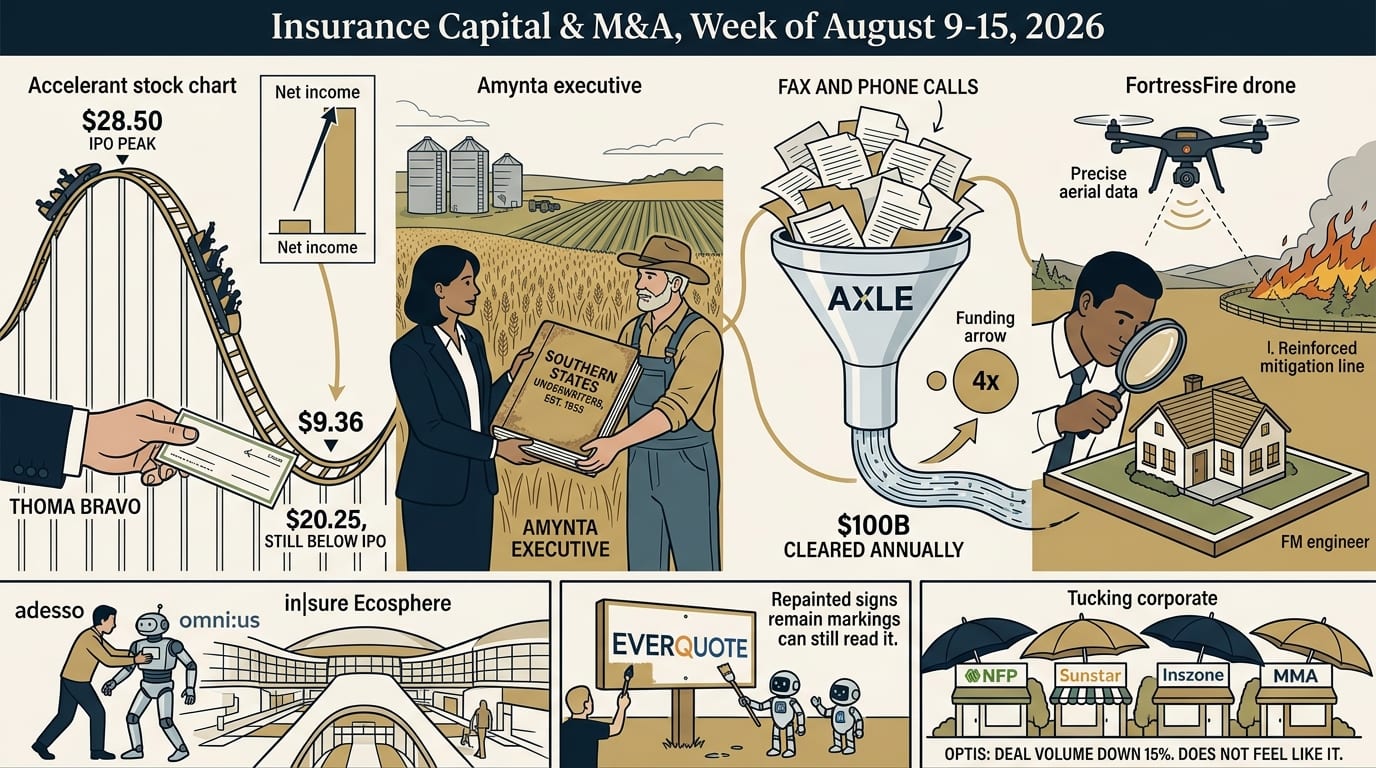
$4.1B+ in disclosed capital | 4 primary transactions + 3 special situations + 7 market context items | A specialty risk exchange goes private for over $4 billion at a premium that still lands below its IPO price, an agribusiness MGU changes hands, an insurance clearinghouse quadruples its funding, and a 200-year-old commercial insurer buys structure-level wildfire modeling
The headline is Accelerant. The specialty insurance risk exchange that listed in July 2025 agreed to be taken private by Thoma Bravo in an all-cash deal worth more than $4 billion. The 49% premium still landed below the IPO price, and it did so in the same week Accelerant disclosed that net income had roughly sextupled year over year. Three other primary deals moved in parallel. Amynta added a 73-year-old agribusiness MGU. Axle, an AI-native clearinghouse for insurance verification, raised $17.5 million at roughly four times its prior total funding after tripling the workflows it automates. FM acquired a wildfire intelligence firm that models ignition risk at the individual structure level rather than by region. Three special situations complicate the picture usefully: a German IT services firm folded a Berlin AI claims startup into its core insurance platform, EverQuote invested in the AI discovery infrastructure that could otherwise disintermediate it, and State Farm Ventures turned up as one of five participants in a banking-first enterprise AI round. Beneath all of that, seven smaller transactions show broker consolidation running at a pace that OPTIS data says is down 15% year over year, but which does not feel slower on the ground.
GILAD SHAI ON THE WEEK'S DEALS — WHAT THE NUMBERS DON'T SAY
1. Thoma Bravo / Accelerant (USA)
$4B+ All-Cash Take-Private | Specialty Insurance Risk Exchange Returns to Private Ownership Date: August 13, 2026
What Happened
Accelerant Holdings (NYSE: ARX) entered into a definitive agreement to be acquired by Thoma Bravo, the software-focused investment firm with more than $172 billion in assets under management, in an all-cash transaction with an enterprise value exceeding $4 billion. Accelerant shareholders receive $20.25 per Class A or Class B share, a 49% premium to the August 12 closing price, but below the company’s $21 IPO price from July 2025. The stock traded as high as $28.50 shortly after listing and as low as $9.36 in February 2026.
Accelerant operates the Accelerant Risk Exchange, a data platform connecting specialty insurance underwriters with risk capital providers. Q2 2026 results, released the same day as the acquisition announcement, showed total revenue of $356.9 million against $219.1 million a year earlier, net income of $80.0 million against $13.1 million, adjusted EBITDA of $93.1 million at a 31% margin, and Exchange Written Premium of $1.32 billion for the quarter, up 23% year over year, with trailing twelve month premium of $4.6 billion.
Altamont Capital Partners, holding approximately 82% of voting rights, agreed to vote in favor and will retain equity alongside Thoma Bravo and the founders. If closing is delayed by pending insurance regulatory approvals, shareholders receive a ticking fee accruing at 6% per annum. Closing is expected in the first half of 2027.
- Acquirer: Thoma Bravo (Matt LoSardo, Principal)
- Target CEO: Jeff Radke, Chairman and CEO
- Retaining equity: Altamont Capital Partners
- Advisors: Morgan Stanley (board), Houlihan Lokey (special committee), BMO Capital Markets and Wells Fargo (Thoma Bravo)
Use of Funds
- Fund the take-private through Thoma Bravo private equity capital
- Continue Risk Exchange platform investment without quarterly public market reporting pressure
- Retain founder and Altamont equity participation through the private ownership phase
Strategic Thesis
The gap between Accelerant’s operating results and its share price is the whole story. Net income rose roughly sixfold, EBITDA margin reached 31%, and premium grew 23%, all in the year following the IPO. The stock still fell from $28.50 to $13.59 the day before the offer. RBC analyst Rowland Mayor described the deal as reflecting the volatility in the market and the disconnect between the company’s fundamentals and the share price.
Thoma Bravo’s Nearmap subsidiary acquired claims technology firm itel for over $1.3 billion last year, which places Accelerant as the second major piece of a sustained insurance technology thesis rather than an opportunistic purchase. Altamont retaining equity rather than fully exiting is the detail worth noting: the majority holder is choosing continued exposure over a clean cash-out.
Why It Matters
- A 49% acquisition premium that still lands below the IPO price, on a business whose net income sextupled in the interim, is the sharpest available evidence that public markets are struggling to price capital-intensive specialty insurance platforms.
- The 6% per annum ticking fee tied to insurance regulatory approval signals both parties expect state-by-state holding company review to extend the timeline well into 2027, a friction pure software take-privates rarely encounter.
- Accelerant’s exit removes one of the few pure-play specialty insurance technology comparables from public markets at a moment when its metrics were accelerating.
Competition
- Direct competitors: Ryan Specialty, CRC Group, AmWINS, and Amynta Group all compete to connect specialty underwriters with capacity, selling to the same MGA and program administrator customer base.
- Category competitors: Traditional Lloyd’s syndicates and wholesale brokers provide the same specialty capacity to the same insureds, without a unified data platform layer.
- Emerging dynamic: Software-focused PE firms are accumulating positions across multiple layers of the insurance technology stack simultaneously, with Thoma Bravo now holding both claims technology and risk exchange infrastructure.
Market Consequences
For specialty capacity providers transacting on the Accelerant Risk Exchange, private ownership under an investor with a demonstrated insurance technology thesis points toward continued platform investment rather than the uncertainty that often accompanies a change of control. For other insurtech platforms weighing a public listing, Accelerant’s fourteen months as a listed company is a cautionary data point: improving fundamentals did not protect the share price, and the eventual buyer paid a premium to a depressed number rather than to intrinsic value.
Bottom line: Accelerant’s net income rose sixfold and premium grew 23% in the year after its IPO. Its stock still fell far enough that a 49% acquisition premium landed below the listing price.
2. Amynta Group / Southern States Underwriters (USA)
Undisclosed | Agribusiness MGU Acquisition Date: August 12-14, 2026
What Happened
Amynta Group, which manages more than $4 billion in total premium across North America, the UK, Europe, and Australia, agreed to acquire Southern States Underwriters and SSC Insurance Agency, the insurance operations of Southern States Cooperative, Inc. Terms were not disclosed. Closing is expected in Q4 2026, subject to regulatory approval.
Southern States Underwriters was founded in 1953 and is headquartered in Richmond, Virginia. It is a managing general underwriter providing commercial property and casualty coverage for suppliers, distributors, and service providers across the agricultural supply chain. It also serves as attorney-in-fact and exclusive distribution partner for the Southern States Insurance Exchange, a reciprocal insurer dedicated to agribusiness. John Madden, president, continues leading the business post-close.
Amynta’s 2026 pattern is consistent: it combined Scion Underwriting Services into Ambridge Group earlier this year to build an integrated specialty casualty platform, and closed International Sureties in late 2025 for admiralty, logistics, and court bond capability.
- Acquirer: Amynta Group; Robert Giammarco, Chairman and CEO
- Target: Southern States Underwriters and SSC Insurance Agency
- Target leadership: John Madden, President (continuing)
Use of Funds
- Extend the Amynta specialty platform into agribusiness underwriting
- Preserve the Southern States Cooperative relationship as a long-term customer
- Add agricultural underwriting expertise that standard commercial markets accommodate poorly
Strategic Thesis
Agribusiness insurance is a specialist line because standard commercial markets systematically underprice or decline its specific exposures: equipment breakdown, cargo in transit, product liability for feed and agricultural inputs, and premises risk spread across dispersed rural locations. Seventy-three years of underwriting judgment in that niche is not replicable by hiring underwriters and starting cold.
Robert Giammarco described the business as dedicated to serving the agribusiness market for over 70 years and as complementing Amynta’s diversified platform. The continuing Southern States Cooperative relationship matters structurally, since the cooperative’s own network of suppliers and dealers is the demand engine the underwriter has served for seven decades.
Why It Matters
- The attorney-in-fact and exclusive distribution role for the Southern States Insurance Exchange gives Amynta a reciprocal insurer relationship, a capital and distribution structure distinct from a standard carrier arrangement.
- Amynta’s three specialty acquisitions inside twelve months point to a deliberate strategy of buying niche underwriting capability rather than extending existing capability into unfamiliar classes.
- Marsh McLennan Agency acquired an Iowa broker with significant agribusiness capability in the same week, making agriculture the most contested category of the week across two different buyer types.
Competition
- Direct competitors: Nationwide Agribusiness, Rain and Hail Insurance Service, ProAg, and Farmers Mutual Hail all underwrite agricultural commercial property and casualty for the same supply chain customers.
- Category competitors: Regional farm mutuals and traditional commercial carriers with agribusiness programs compete for the same premium without the dedicated MGU structure.
- Emerging dynamic: Agricultural insurance is drawing simultaneous acquisition interest from specialty MGU platforms and retail brokerages, a convergence driven by climate volatility and supply chain complexity raising the value of specialized underwriting.
Market Consequences
For agribusiness insureds who have relied on Southern States Underwriters for decades, leadership continuity reduces the disruption that usually accompanies a change of control in specialty lines. For competing agribusiness MGUs, most of which are smaller and regionally focused, Amynta’s platform scale and four-continent distribution reach raises the competitive bar for capacity access and product breadth.
Bottom line: Amynta bought 73 years of underwriting judgment in a niche standard commercial markets serve badly. The relationships and the risk selection are the asset, not the premium.
3. Axle (USA)
$17.5M Series A | AI-Native Insurance Clearinghouse Date: August 11, 2026
What Happened
Axle, a New York-based clearinghouse for insurance verification, raised $17.5 million in Series A funding led by Base10 Partners, with continued participation from Y Combinator and Gradient, plus Stage 2 Capital and insurance industry angels including the founders of Cover Genius. Members of Plaid’s early team are among existing backers. The round is roughly four times Axle’s total prior funding.
Founded in 2023 by Cameron Duncan (CEO), Armaan Sikand, and Nihar Parikh, Axle provides infrastructure and AI agents that automate insurance verification, monitoring, and policy update workflows, normalizing fragmented carrier data into a single programmable API. In the past six months the company tripled the number of workflows it automates. It now clears more than $100 billion in insurance coverage annually for over 4,000 customers including Rocket Mortgage, Avis, Experian, and Sonic Automotive. Axle reports accelerating verification workflows by up to 20 times.
New capital funds expansion from five insurance segments to more than 50 across home, auto, renters, commercial, and specialty, alongside deeper direct carrier relationships and engineering hiring.
- Lead investor: Base10 Partners (Adeyemi Ajao, Co-founder and Managing Partner)
- Participating: Y Combinator, Gradient, Stage 2 Capital, Cover Genius founders
- Founders: Cameron Duncan (CEO), Armaan Sikand, Nihar Parikh
Use of Funds
- Expand from five to more than 50 insurance segments
- Deepen direct carrier integrations
- Accelerate engineering and go-to-market hiring
Strategic Thesis
Adeyemi Ajao framed the thesis in one line: everything the economy runs on, credit, payments, identity, income, has a clearinghouse in the middle, and insurance never has. The presence of early Plaid team members among Axle’s investors makes the analogy explicit.
The structural argument is that carrier integration is the hard part, and once solved for one segment the marginal cost of the next segment falls sharply. That is the dynamic that let Plaid expand from a handful of banks to thousands. Axle raising four times its prior total after tripling automated workflows suggests the company found product-market fit before scaling capital intensity, which is the right order.
The customer roster is worth reading closely. Rocket Mortgage, Avis, Experian, and Sonic Automotive operate in mortgage lending, auto rental, credit reporting, and auto retail, all industries that require insurance verification as a transaction prerequisite. Axle’s growth is therefore tied to transaction volume in large stable verticals rather than to insurance industry growth specifically.
Why It Matters
- Tripling automated workflows in six months before raising a round four times larger than everything prior indicates the carrier integration problem, the slowest part of insurance infrastructure, was solved before capital was scaled against it.
- Cover Genius founders investing connects verification infrastructure to embedded distribution infrastructure, suggesting the same investor base increasingly views them as complementary layers of one stack.
- A clearinghouse position between insurers and lenders, property companies, employers, and automotive businesses captures value regardless of which individual carrier or lender wins any specific transaction.
Competition
- Direct competitors: Verisk data services and LexisNexis Risk Solutions sell insurance verification products to the same lender and property manager customers.
- Category competitors: Certificate of insurance tracking platforms and the manual verification processes still used by most mortgage lenders, auto dealers, and property managers compete for the same workflow budget.
- Emerging dynamic: As Axle expands from five to 50 segments it moves into territory currently held by segment-specific point solutions that lack a cross-segment normalized data layer.
Market Consequences
For lenders and property managers still verifying insurance by phone and fax, Rocket Mortgage and Avis operating at scale on Axle provides a reference implementation that removes the pilot risk. For carriers, a growing intermediary data layer between them and the broader economy raises the same question Plaid raised for banks: does the infrastructure layer create efficiency, or does it commoditize the direct customer relationship.
Bottom line: Axle tripled its automated workflows in six months, then raised four times everything it had raised before. Insurance has never had a clearinghouse. Axle is building it.
4. FM / FortressFire (USA)
Undisclosed | Wildfire Intelligence Acquisition Date: August 10-12, 2026
What Happened
FM, the Johnston, Rhode Island commercial property insurer founded nearly 200 years ago, which insures one in four Fortune 500 companies and employs nearly 2,000 engineers across 14 countries, acquired FortressFire, a San Mateo wildfire intelligence provider combining machine learning with physics-based fire modeling. Terms were not disclosed.
FortressFire operates as an independent, wholly owned division of FM, retaining its brand and leadership under founder and CEO Michael Ashker. Its platform assesses wildfire risk at the individual structure level rather than by area or zip code, producing aerial wildfire reports, ground inspections, monitoring, analytics, and structure-specific mitigation recommendations for insurers, reinsurers, brokers, real estate professionals, lenders, and property owners.
Malcolm Roberts, FM Chairman and CEO, said FortressFire shares FM’s belief in data-driven, location-based risk mitigation and protection measures. Swiss Re Institute estimated global insured catastrophe losses at $107 billion in 2025, with wildfires and severe storms accounting for 83% of that total. More than 20 US states now accept AI-driven wildfire models in insurance rate filings.
- Acquirer: FM; Malcolm Roberts, Chairman and CEO
- Target: FortressFire; Michael Ashker, Founder and CEO (continuing)
Use of Funds
- Integrate structure-level wildfire modeling with FM’s engineering-led loss prevention model
- Continue serving FortressFire’s existing insurer, reinsurer, broker, lender, and property owner clients under its own brand
- Extend FM’s risk mitigation capability to individual property wildfire assessment
Strategic Thesis
FM’s entire underwriting model is built around nearly 2,000 in-house engineers who work directly with policyholders to prevent losses rather than only pricing and transferring risk. That makes FortressFire a philosophically exact fit rather than a bolt-on. Michael Ashker’s framing, that the best risk management is ignition prevention and the path to insurability runs through science, is close to identical to FM’s own institutional position.
The technical distinction that gives the acquisition its value is granularity. Modeling whether a particular building will ignite, and what specific mitigation prevents it, converts wildfire underwriting from a broad exclude-or-price decision into a property-by-property engineering problem. That is the kind of risk selection FM’s model is built to exploit.
Why It Matters
- This extends a pattern visible across the industry: AXA XL acquired S-RM the prior week, IAG Firemark assembled a five-company disaster resilience portfolio, and Mercury Insurance made wildfire mitigation investments. Carriers are buying prevention capability rather than licensing it.
- Structure-level assessment addresses the capacity crisis directly, since it converts a binary exclusion decision into insurable, granular risk selection in markets many carriers have exited.
- With wildfires and severe storms driving 83% of $107 billion in 2025 insured catastrophe losses, the loss-cost case for owning rather than renting this capability is not abstract.
Competition
- Direct competitors: Zurich Resilience Solutions, Chubb Risk Engineering, and AIG Risk Management sell engineering-led loss prevention to the same large commercial property insureds.
- Category competitors: Zesty.ai, Kettle, and Delos Insurance Solutions provide wildfire risk modeling that carriers license rather than own.
- Emerging dynamic: With more than 20 states accepting AI-driven wildfire models in rate filings, carriers without owned or exclusively licensed structure-level modeling face a widening underwriting information gap in wildfire-exposed markets.
Market Consequences
For commercial property owners in wildfire-exposed markets where carriers have restricted or withdrawn, FM acquiring structure-level assessment signals continued capacity for insureds willing to implement specific mitigation. For standalone wildfire modeling vendors, the pattern of carriers acquiring rather than licensing narrows the pool of independent growth paths and raises the probability that remaining vendors become targets.
Bottom line: FM bought the ability to say whether one specific building will burn and what prevents it, not whether a zip code is generally exposed. That distinction is the entire strategic logic.
Special Situation: adesso / omni:us (Germany)
Undisclosed | AI Claims Automation Folded Into Core Insurance Platform Date: August 12-14, 2026
What Happened
adesso SE, the Dortmund-based IT services and insurance software provider, acquired omni:us, a Berlin AI claims automation startup founded in 2015 that raised $56.5 million across eight rounds. Terms were not disclosed. omni:us processes more than one million claims annually for insurers including Allianz, UNIQA, and MS Amlin, offering fully automated no-touch processing for standardized claims and an agentic AI copilot for complex cases.
adesso integrates omni:us into its in|sure Ecosphere core insurance platform, already used by more than 50 customers, adding an Agentic Layer. Mark Lohweber, adesso CEO, said the company is gaining a solution that has already proven itself in day-to-day operations. adesso’s earnings call the same week disclosed that the technology delivers a 35% efficiency gain and improves claims ratios by 4 percentage points for insurers using it.
Why It Matters
The acquisition consolidates AI claims automation into core platform infrastructure rather than leaving it as a point solution insurers must separately integrate. omni:us headcount declined from a peak of 59 to 45 despite $56.5 million raised, which suggests the standalone model faced sustainability pressure that platform distribution to 50 existing customers may resolve. The disclosed metrics, 35% efficiency and 4 points of claims ratio improvement, are specific and auditable in a category where vaguer claims are the norm.
Bottom line: adesso bought proven AI claims technology with named insurer customers and disclosed performance numbers, then put it inside a platform 50 insurers already run.
Special Situation: EverQuote / Waniwani (USA)
Undisclosed Minority Investment | Agentic Discovery Infrastructure Date: August 11, 2026
What Happened
EverQuote, Inc. (Nasdaq: EVER) announced an exclusive commercial partnership with Waniwani, described as revenue and compliance infrastructure for the agentic distribution of financial services, and made a strategic minority equity investment alongside it. Terms were not disclosed.
Waniwani helps service providers get discovered, optimize revenue, and stay compliant as AI agents and assistants mediate how consumers find and choose financial products. EverQuote intends to integrate the offering into its portfolio of AI solutions for P&C carriers and licensed agents. Jayme Mendal, EverQuote CEO, said discoverability and engagement are being redefined in real time as AI agents take a larger role in how people find products. Robin Diligent, Waniwani CEO, said EverQuote sits at the center of US P&C distribution, making it the ideal partner to bring agentic discovery, conversion, and built-in compliance to carriers and agents at scale.
Why It Matters
EverQuote is not a carrier. It is the distribution layer between carriers and consumers, which is precisely the position AI assistants threaten if consumers begin asking an agent to find insurance instead of visiting a comparison site. Investing in agentic discovery infrastructure protects EverQuote’s own position while creating a product it can sell to carriers. This is the third consecutive week this report has covered a distribution platform investing in AI discovery infrastructure, following Mapfre’s stake in Tuio two weeks ago.
Bottom line: EverQuote invested in the infrastructure that keeps it discoverable to AI agents, the same force that could otherwise disintermediate its core business.
Special Situation: Skan AI (USA)
$63M Series C | Enterprise AI, State Farm Ventures Among Five Participants Date: August 12, 2026
What Happened
Skan AI, a Menlo Park enterprise AI platform, raised $63 million in Series C funding co-led by Cathay Innovation and Dell Technologies Capital, with Citi Ventures, Bloomberg Beta, State Farm Ventures, and Wipro Ventures participating. Total funding is approximately $120 million. Skan builds a context graph of work, observing how employees and systems perform tasks across enterprise applications and translating that into grounding data for AI agents.
The company’s headline case studies center on banking, including $37 million in identified operational friction and $18 million in annualized savings at a single top US bank, with seven of the ten largest US banks as customers. Skan also serves more than 40 insurance carriers and suppliers, and reported revenue growth exceeding 300% year over year for a second consecutive year.
Why This Is a Special Situation Rather Than a Primary Deal
State Farm Ventures is a Tier A watchlist investor and its participation is genuine, but it is one of five investors in a round co-led by two generalist firms, and both the company’s materials and the press coverage foreground banking. This differs from Norm AI, where New York Life and TIAA were named strategic investors with New York Life running the platform in production, and from Wordsmith AI, where Intact Private Capital led with an explicit insurance governance framing.
Bottom line: State Farm Ventures backed an enterprise AI platform serving 40+ carriers, but banking is the story and State Farm is one of five participants.
Market Context: Broker Consolidation Runs Faster Than the Data Suggests
Seven smaller verified transactions closed inside the window. OPTIS Partners data shows North American agency deal volume at 292 acquisitions through the first six months of 2026, down 15% year over year and the lowest first-half total in seven years. The week’s activity does not feel like a 15% decline.
NFP (Aon) / Frontier Risk cannabis business (August 14): NFP, the Aon subsidiary, acquired the retail cannabis business of Frontier Risk Group, a Norwalk, Connecticut specialty insurer focused on the marijuana industry. Eric Scheider, Frontier senior vice president, joins NFP with the same title reporting to Scott Foster, healthcare and life sciences practice leader. Foster said the cannabis business is a natural fit for the Life Sciences practice and expands NFP’s ability to serve businesses in highly regulated industries. Frontier retains and will scale Strata Specialty, its multi-program manager for critical infrastructure. Terms undisclosed.
Sunstar Insurance Group / RJR Faribo (August 12): Sunstar, backed by Reverence Capital Partners and operating 58 agencies across nine states with more than $2 billion in annual premium, acquired RJR Faribo Insurance Agency, marking its first Minnesota entry. RJR Faribo has locations in Eden Prairie and Faribault and traces its roots to the 1930s, with the current entity formed in 1986 through a three-agency merger. CEO Marc Lancaster and 22 employees join Sunstar. CEO Adam Meyerowitz, who took the role in May 2026, said the agency is the type central to Sunstar’s long-term growth strategy. Terms undisclosed.
Inszone Insurance Services / Two Fong’s (August 11-12): Inszone, the Sacramento brokerage now operating in 25 states, acquired Two Fong’s Inc., a Bay Area agency founded in 1982 and led since 2000 by brothers Al and Pete Fong, specializing in commercial property and lessor’s risk. The agency grew primarily by referral from local property managers. Chris Walters, Inszone CEO, said the agency aligns with the company’s California growth strategy. Helfer & Associates advised Two Fong’s. Terms undisclosed.
Marsh McLennan Agency / The Accel Group (August 10): MMA agreed to acquire Accel Holdings, parent of the Waverly, Iowa brokerage founded in 1936 and expanded through a 2018 merger with Millhiser Smith Agency. Accel operates seven offices across Iowa, Illinois, Missouri, and Kansas with more than 130 employees across commercial and personal insurance, employee benefits, agribusiness, and wealth advisory. Closing expected Q3 2026. Terms undisclosed.
WCF Insurance / Work First Casualty (August 11-14): WCF Insurance, the 109-year-old Utah workers’ compensation carrier with more than $1.5 billion in policyholder surplus, agreed to acquire Work First Casualty Company, which has provided workers’ compensation exclusively to the temporary staffing industry since 2005 and is licensed in all 50 states with an A (Excellent) AM Best rating. President Jamie Madden and the leadership team remain under a phased integration. Closing expected around December 1, 2026. Terms undisclosed.
INSight Capital (August 10): INSight Capital, a Nebraska firm formed in 2022 that offers independent agency owners capital and succession options, closed an equity offering at $37.4 million from 47 investors per an amended SEC Form D, up from $6.3 million as of June 2025. The company sought $50 million and stated it does not intend to raise the remaining $12.6 million. The filing lists an estimated $1.1 million closing fee payable to related persons, which is worth noting given that the model centers on agency owners exchanging ownership for equity in INSight itself rather than taking a cash exit.
Inshurik (August 10): Inshurik, a Sunny Isles Beach, Florida developer of an AI platform for life insurance carriers, raised $840,000 in debt financing per its PitchBook profile. The technology uses predictive modeling and autonomous communication agents to identify lapse risk and improve policy retention. Small, but a well-defined use case in a category drawing far less dedicated AI investment than P&C claims or underwriting.
The pattern: Century-old carriers and PE-backed consolidators are both buying specialized niche platforms rather than building comparable expertise. Leadership continuity appears in nearly every one of these transactions, which indicates buyers are paying for relationships and risk selection judgment as much as for premium.